

How to teach a toddler how to pedal a bike
Teach a toddler to pedal by securing the right-size bike, showing the push-down motion, guiding one short start, then practising in brief, calm sessions.
Measure the rider before practising
Measure your child’s height and inseam while they wear the shoes they will ride in. Height provides a wheel-size starting point; inseam helps you assess stand-over and whether the child can get on, stop and steady the bike comfortably.
Have the child try the actual bicycle. Check that they can stand over it without being crowded by the frame, reach the handlebar without stretching, turn it while seated and operate every brake control they are expected to use. Compare their inseam and reach with the exact bicycle’s manual or measurements. Do not buy an oversized bike merely to allow room for growth.
| Wheel size | XBikes starting point |
|---|---|
| 12 Inch | Ages 3–4; 34–40 in / 86–102 cm tall |
| 14 Inch | Ages 3–6; 37–45 in / 94–114 cm tall |
| 16 Inch | Ages 4–7; 40–48 in / 102–122 cm tall |
These ranges overlap, so age does not decide the size. Prioritize measured height, inseam, reach, brake control and current confidence.
Set up a simple practice area
Choose a flat, open space away from traffic, slopes, obstacles and other riders. Fit a bicycle helmet so it sits level and secure its straps according to the helmet manufacturer’s instructions. Use closed-toe shoes and clothing that cannot catch in moving parts.
Before each session, follow the bicycle manual’s checks and confirm that the bike is correctly assembled. For adjustments, maintenance, compatibility or torque requirements not stated in the manual, use a qualified bicycle mechanic.
Teach the pedal motion before the start
First let your toddler sit on the stationary bike while you hold it stable. Place one foot on a pedal positioned slightly forward and above its lowest point. Ask them to push that pedal down, then find the other pedal and push again. Simple cues such as “push, find, push” are easier to follow than a long explanation.
If the child repeatedly pedals backward, gently stop the pedals and reset the leading foot. Demonstrate the circular action slowly with your hand, but let the child create the forward pressure. The immediate goal is understanding the sequence, not speed or distance.
Practise one assisted start at a time
- Hold the bike steady at the frame or another support point permitted by its manual; avoid steering for the child.
- Set the preferred starting pedal slightly forward and high enough to press down.
- Ask the child to look ahead, push down and place the second foot on its pedal.
- Walk alongside for a few pedal turns, then stop while the attempt is still controlled.
- Reset and repeat only while the child remains attentive and willing.
Keep sessions short. Finish after a small success, such as making two continuous pushes or starting with less help. If frustration rises, return to the stationary push-down exercise or try again another day.
Separate pedaling from steering and stopping
A toddler may understand pedaling before coordinating direction and braking. Practise looking ahead and making gentle handlebar movements separately. Also rehearse stopping from walking speed: stop pedaling, use the bicycle’s available brake controls as instructed, and put a foot down once the bike has slowed.
Do not reduce support until the child can start, steer and stop predictably in the practice area. Training wheels can stabilize the bike while a child concentrates on the pedal sequence, but they do not replace correct fit, brake reach or direct supervision.
When the catalog options are relevant
The supplied options are training-wheel bikes in 12, 14 and 16 Inch SKU labels, so they are relevant comparison points when a child needs support while learning the push-down sequence. Compare only sizes that match the measured rider and confirm the individual fit on the actual bike.
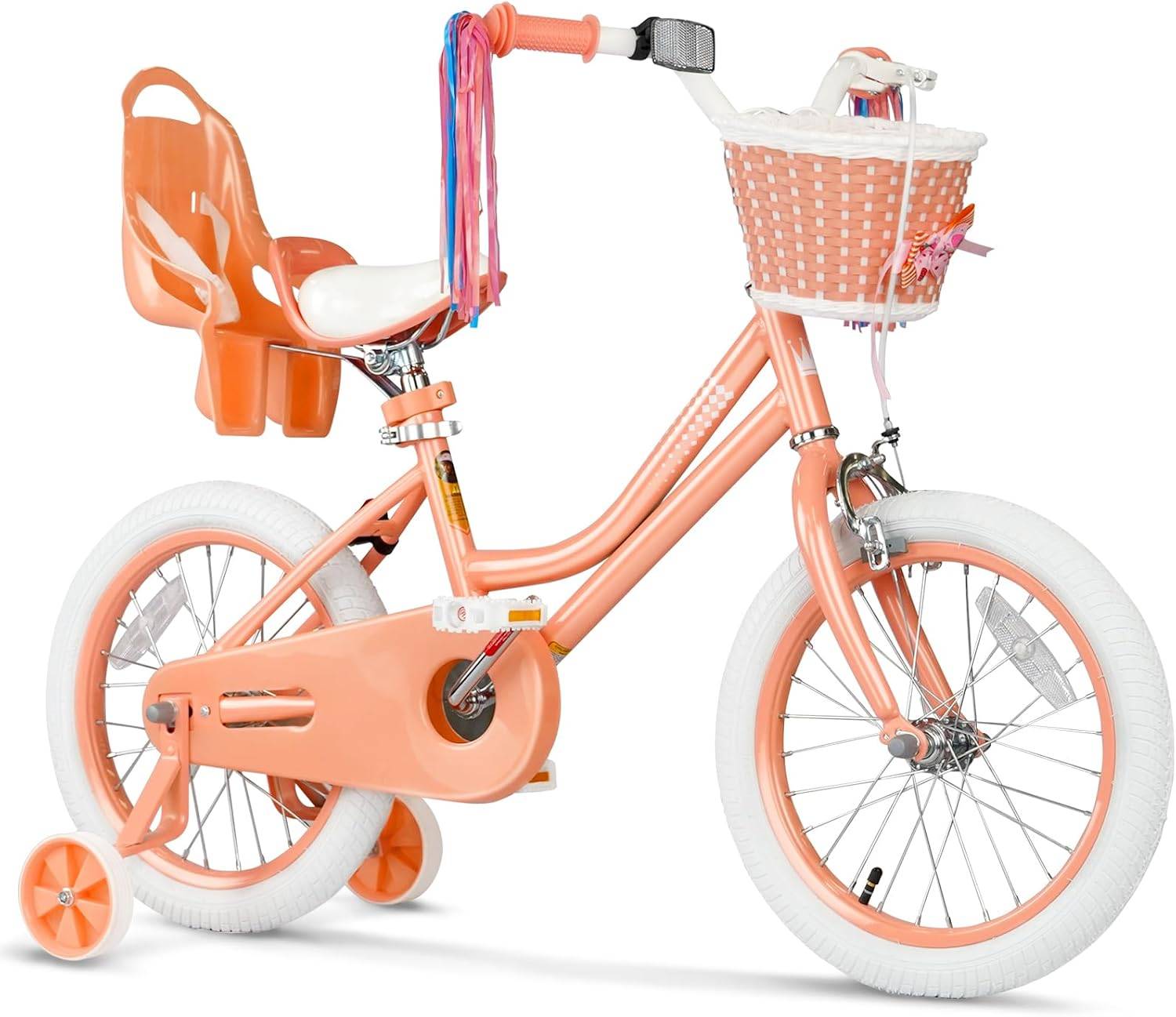 Girls 12/14/16 Inch Kids Bike by XJD with Training Wheels – Peach
A training-wheel bike offered in supplied 12, 14 and 16 Inch SKU labels, relevant for comparing a correctly fitted option while a toddler practises the pedal sequence.
 XJD Light Purple Girls Bike with Basket, Training Wheels, 12/14/16/20 Inch
A training-wheel bike with a basket, offered in supplied 12, 14 and 16 Inch SKU labels; compare the child’s measurements and control reach before choosing.
The Girls 12/14/16 Inch Kids Bike by XJD with Training Wheels – Peach is listed in 12, 14 and 16 Inch versions with training wheels. The XJD Light Purple Girls Bike with Basket, Training Wheels, 12/14/16/20 Inch is also supplied here with available 12, 14 and 16 Inch SKU labels and training wheels. Its title mentions 20 Inch, but 20 Inch is not among the supplied available SKU labels, so do not assume that version is available.
Neither product is relevant if the child does not fit its confirmed size, cannot comfortably reach the controls, or is not ready to practise safely. Your next step is to measure height and inseam, try the correctly sized bike, and begin with five calm push-down repetitions before attempting a short assisted start.
Bikes for your next adventure
-

Kids Bike Helmet by XJD for Boys & Girls – Black, Blue, Green, Pink, Purple
The XJD Kids Bike Helmet covers a wide 2-to-8-year age range thanks to two head-…$59.99
-

Kids Bike Helmet by XJD for Girls – Pink
The XJD Kids Bike Helmet in Pink is a lightweight multi-sport helmet for girls r…$59.99
$99 -

XJD Kids Bike for Girls – Pink, 12/14/16/20 Inch with Training Wheels
The XJD Kids Bike for Girls in Pink is a training-wheel bike built to carry your…$139
$159