

How to teach bicycle to 5 year old
Teach a 5-year-old to ride by choosing a bicycle they can comfortably control, fitting a helmet, and practising one skill at a time: walking, gliding, braking, then pedalling.
Measure the child before choosing a bicycle
Begin with the child’s current height and inseam, measured while wearing the shoes they will ride in. Age five does not determine one correct wheel size. In the XBikes starting points, a 14 Inch bicycle covers heights of 37–45 in / 94–114 cm, a 16 Inch bicycle covers 40–48 in / 102–122 cm, and an 18 Inch bicycle covers 43–52 in / 109–132 cm.
Use those ranges only to shortlist bicycles. Have the child try the actual bicycle. Check that they can stand over it, reach the handlebar without stretching, turn it while remaining balanced, operate the brakes, and place their feet down with confidence. The American Academy of Pediatrics advises against buying an oversized bicycle merely for future growth.
Compare likely wheel sizes for a 5-year-old
| Wheel size | XBikes starting point | What to check |
|---|---|---|
| 14 Inch | Ages 3–6; 37–45 in / 94–114 cm | Reach, stand-over room, brake control and confidence |
| 16 Inch | Ages 4–7; 40–48 in / 102–122 cm | Whether the child controls it without stretching |
| 18 Inch | Ages 5–9; 43–52 in / 109–132 cm | Whether the larger option still passes every fit check |
If the child falls between ranges, compare the actual bicycles rather than automatically sizing up. A smaller listed size may be easier to control, but only the individual fit check can settle the choice. If the child is outside these ranges, use their measured height to consult the broader XBikes sizing standard instead of forcing an age-based selection.
Prepare a simple, safe practice area
Choose a level, open place away from traffic, parked vehicles, steep slopes and obstacles. Fit a bicycle helmet before every session. Following U.S. Consumer Product Safety Commission guidance, the helmet should be the correct size, sit level, and have its straps adjusted according to the helmet manufacturer’s instructions.
Before practice, confirm that the bicycle is assembled and operating as its exact manual requires. For assembly, maintenance, compatibility or torque instructions not stated here, follow that manual or ask a qualified bicycle mechanic.
Teach control before pedalling
- Walk the bicycle: Let the child move beside it, steer around gentle markers and practise stopping it.
- Practise mounting and stopping: Ask them to get on, settle their hands and feet, look ahead, and stop on a clear signal.
- Build balance: With the setup permitted by the bicycle’s manual, let them practise short, controlled glides. Do not alter or remove components unless the manual allows it.
- Add pedalling: Once they can steer, look forward and stop reliably, practise smooth starts over short distances.
- Reduce assistance gradually: Support only as much as needed. End a session before fatigue or frustration makes control worse.
Use brief instructions such as “look ahead,” “steady hands,” and “stop here.” Avoid pulling the handlebar, which can interfere with the child’s steering. Several short, calm sessions are usually more useful than turning one attempt into a test they must pass.
Decide whether training wheels are relevant
Training wheels can provide initial support for a child who is not ready to balance independently, but they do not replace correct fit, steering practice or brake control. A confident child already learning to glide may instead need practice that focuses directly on balance. Base the decision on present confidence and control, then follow the bicycle manual for any adjustment or removal.
The supplied catalog options are useful because they let a parent compare 14 Inch and 16 Inch training-wheel bicycles within the likely height bands for many 5-year-olds. The 12 Inch versions are also listed, while only one option extends to 20 Inch; none supplies an 18 Inch SKU, so these are comparison points rather than substitutes when an individual fit check indicates exactly 18 Inch.
 Light Pink XJD Girls' Bicycle with Basket & Training Wheels
A training-wheel bicycle offered in 12 Inch, 14 Inch, 16 Inch and 20 Inch labels. Compare only sizes supported by the child’s measurements and confirm reach, stand-over room, braking and confidence in person.
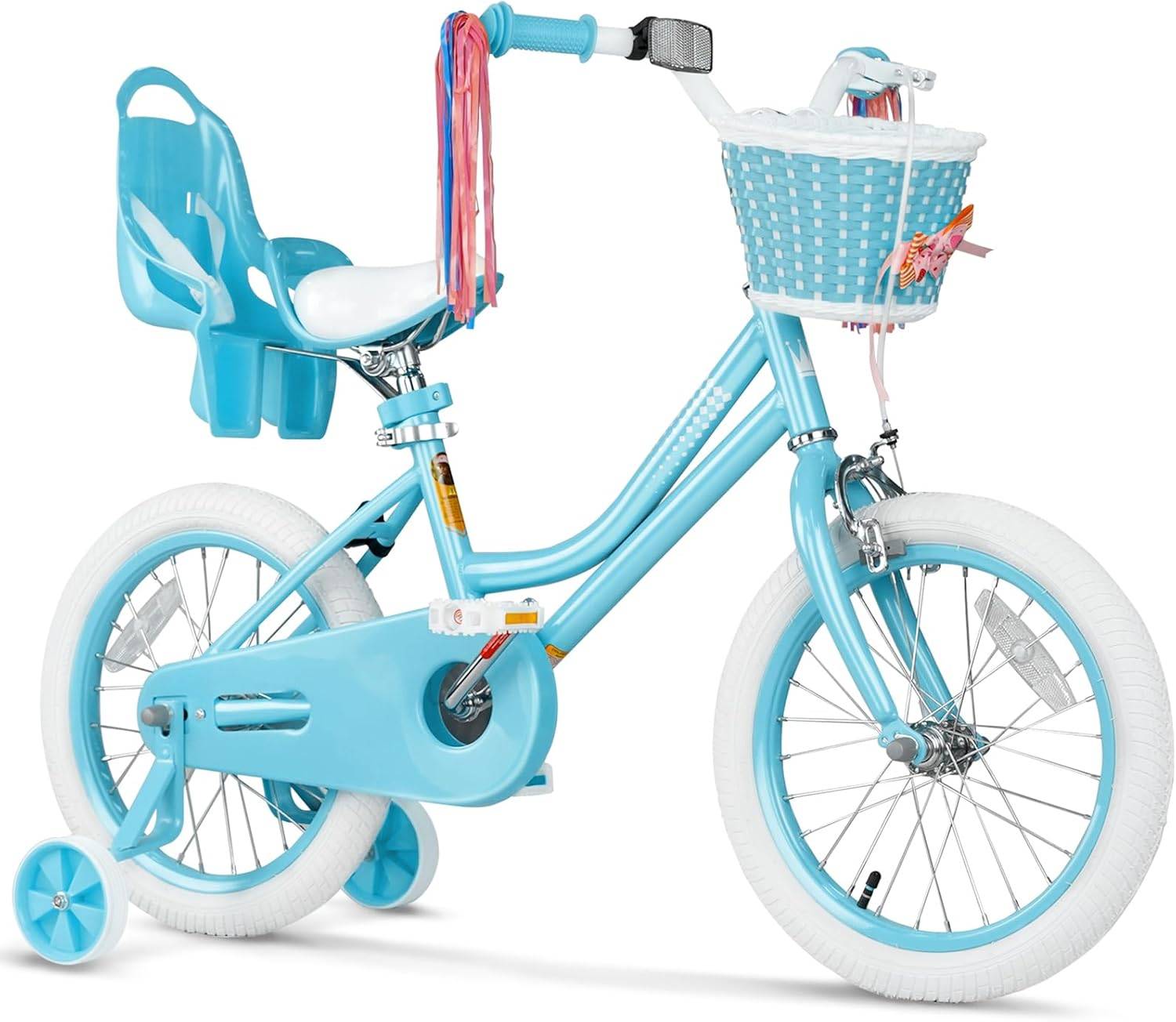 Blue XJD Girls Bike with Training Wheels – 12/14/16 Inch
This training-wheel model offers 12 Inch, 14 Inch and 16 Inch labels, including two common starting-point sizes for age five. Height, inseam, reach, brake control and confidence must determine actual fit.
 XJD Boys 12/14/16" Training Wheel Bike – Blue
A blue training-wheel bicycle available in 12 Inch, 14 Inch and 16 Inch labels. Its 14 Inch and 16 Inch options may merit comparison after measuring the child, but age alone cannot establish fit.
Light Pink XJD Girls' Bicycle with Basket & Training Wheels is categorized as a training-wheel bicycle and is offered in 12 Inch, 14 Inch, 16 Inch and 20 Inch labels. Blue XJD Girls Bike with Training Wheels – 12/14/16 Inch provides 12 Inch, 14 Inch and 16 Inch choices in the same category. XJD Boys 12/14/16" Training Wheel Bike – Blue likewise provides 12 Inch, 14 Inch and 16 Inch choices.
Those titles and labels do not prove fit. Compare only the wheel sizes supported by the child’s measured height, then have the child try the bicycle and verify stand-over room, reach, braking and confident control.
Know what to do next
Measure height and inseam today, shortlist the matching 14 Inch, 16 Inch or 18 Inch range, and arrange an individual fit check. Choose a supplied training-wheel model only if its available size fits and that support matches the child’s current confidence. Then begin in a level, traffic-free area with helmet fit, stopping and steering before asking the child to pedal.
Bikes for your next adventure
-

Kids Bike Helmet by XJD for Boys & Girls – Black, Blue, Green, Pink, Purple
The XJD Kids Bike Helmet covers a wide 2-to-8-year age range thanks to two head-…$59.99
-

Kids Bike Helmet by XJD for Girls – Pink
The XJD Kids Bike Helmet in Pink is a lightweight multi-sport helmet for girls r…$59.99
$99 -

XJD Kids Bike for Girls – Pink, 12/14/16/20 Inch with Training Wheels
The XJD Kids Bike for Girls in Pink is a training-wheel bike built to carry your…$139
$159