

How to teach toddler to ride a bike
Teach a toddler to ride by choosing a correctly fitted bike, practising balance and braking first, then adding pedalling in a flat, traffic-free area.
Measure before choosing a bike
Measure your child’s height without shoes, then measure inseam from the floor to the crotch. Height gives you a wheel-size starting point; inseam helps you check whether the child can stand over and control the actual bicycle. Age is only a rough guide.
| Wheel size | XBikes starting age | Rider height |
|---|---|---|
| 12 Inch | 3–4 | 34–40 in / 86–102 cm |
| 14 Inch | 3–6 | 37–45 in / 94–114 cm |
| 16 Inch | 4–7 | 40–48 in / 102–122 cm |
These ranges overlap, so do not select by age or wheel size alone. Have your toddler try the exact bicycle. They should be able to stand over it comfortably, reach the handlebar without stretching, steer while looking ahead, and operate its brakes with their hands in a natural position. A child who freezes, leans excessively or cannot reach a control needs a different fit or an easier first step.
Do not buy an oversized bicycle for future growth. A larger model can make starting, stopping and recovering from a wobble harder. The child’s measured fit and present confidence matter more than how long the bike may last.
Prepare the rider and practice area
Choose a level, open space away from vehicles, slopes and obstacles. Check the bicycle before every session. For assembly, adjustment, maintenance, load limits, compatibility and torque, follow the exact product manual or ask a qualified bicycle mechanic; do not guess.
Use a bicycle helmet that fits properly, sits level and has straps adjusted according to the helmet manufacturer’s instructions. Clothing should not hang near moving parts, and closed-toe shoes should provide stable footing. Stay close enough to intervene while leaving the child room to control the bike.
Teach the skills in a useful order
- Mount and stop: Practise getting on, looking forward and coming to a controlled stop before trying to travel far.
- Balance and steer: Let the child move slowly and make gentle turns. Support the child lightly around the torso when needed rather than pulling the handlebar, which the rider must learn to steer.
- Use the brakes: At walking speed, ask the child to stop at a visible marker. Confirm that they can reach and operate the controls on the actual bike.
- Start pedalling: Help position the pedals for an easy start, give only enough support to establish motion, and release gradually once the child is steering steadily.
- Repeat short runs: Practise starting and stopping more often than riding long distances. Finish while the child is still attentive rather than pushing through fatigue or frustration.
If the bicycle setup allows a different learning configuration, make changes only as described in its manual or through a qualified mechanic. Do not improvise component removal or adjustment.
Decide whether training wheels help
Training wheels can let a toddler concentrate on pedalling and steering while receiving side support. They do not remove the need to learn independent balance, so watch the child rather than following a fixed timetable. If the rider pedals, steers, brakes and starts confidently but depends less on the supports, consult the bicycle manual or a qualified mechanic about the next setup.
The supplied catalog option, XJD Girls BMX Bike 12/14/16 Inch with Training Wheels – Pink Blue, is relevant because it is a Kids’ BMX Bike offered in 12 Inch, 14 Inch and 16 Inch labels, with training wheels named in the product title. Those three sizes provide comparison points across the toddler and early-childhood starting ranges, but the label alone does not establish fit.
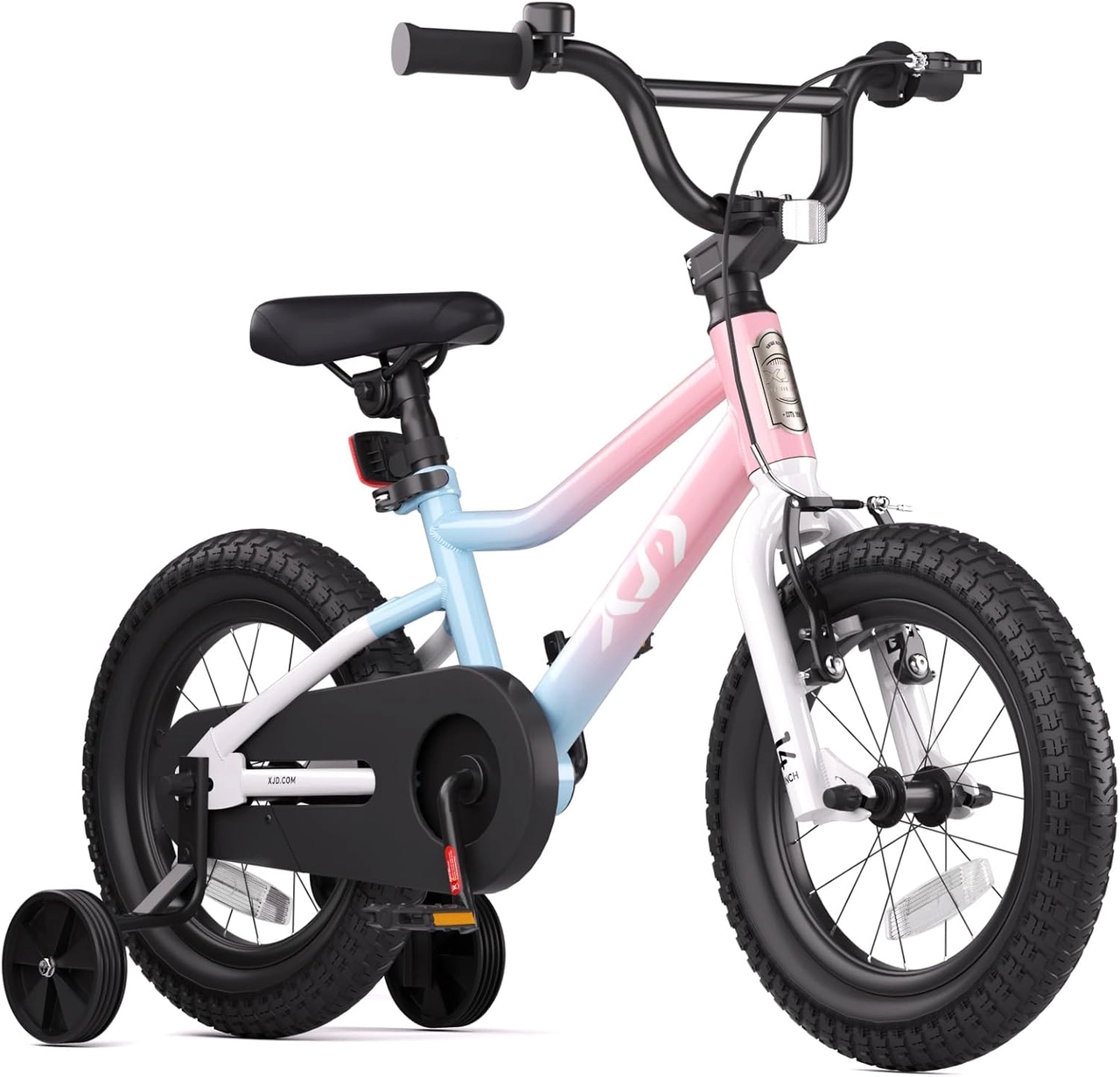
Compare its available size labels with your child’s measured height first: 12 Inch starts at 34–40 in / 86–102 cm, 14 Inch at 37–45 in / 94–114 cm, and 16 Inch at 40–48 in / 102–122 cm. Then require an individual check of inseam, stand-over space, reach, brake control and confidence. If none fits those checks, this product is not the right choice despite the child’s age.
Know when to pause or progress
Pause when your toddler cannot reach the ground or controls reliably, repeatedly looks down, becomes tired, or is frightened by speed. Recheck fit before treating difficulty as a practice problem. Return to mounting, slow steering and stopping until those actions are calm and repeatable.
Progress when the child can look ahead, follow a simple path, respond to a stop cue and recover from small steering corrections without panic. Keep supervising in the same controlled area; increased confidence is not yet readiness for traffic, steep ground or crowded paths.
Your next session
Measure height and inseam today, compare the height with the 12, 14 and 16 Inch starting ranges, and arrange a real fit check. At the first session, teach one short sequence: mount, look ahead, travel to a marker and stop. Choose or keep the bike only if your toddler can perform that sequence with comfortable reach and control.
Bikes for your next adventure
-

Kids Bike Helmet by XJD for Boys & Girls – Black, Blue, Green, Pink, Purple
The XJD Kids Bike Helmet covers a wide 2-to-8-year age range thanks to two head-…$59.99
-

Kids Bike Helmet by XJD for Girls – Pink
The XJD Kids Bike Helmet in Pink is a lightweight multi-sport helmet for girls r…$59.99
$99 -

XJD Kids Bike for Girls – Pink, 12/14/16/20 Inch with Training Wheels
The XJD Kids Bike for Girls in Pink is a training-wheel bike built to carry your…$139
$159