

How young can a baby be in a bike trailer
There is no single safe minimum age for every bike trailer. Wait until your baby can sit upright unsupported, maintain steady head and neck control, fit the required helmet and harness, and meet the trailer manufacturer’s minimum requirements.
Use readiness, not the calendar alone
A birthday is not enough to determine readiness. Babies develop head, neck and trunk control at different rates, while trailers vary in their passenger requirements. The correct threshold is whichever comes later: your child meeting every developmental and fit check, or the minimum stated in the exact trailer manual.
Do not assume that a reclining seat, infant insert or padded support makes an otherwise ineligible baby ready. Use an accessory only if the trailer manufacturer expressly permits it for cycling with that trailer and for your child’s current measurements. An accessory approved for strolling may not be approved while the trailer is attached to a bicycle.
What to measure and check
| Check | What must be true |
|---|---|
| Posture | Your baby sits upright unsupported and does not slump or tip sideways. |
| Head control | The head remains steady while sitting and during ordinary movement. |
| Helmet | The required bicycle helmet fits properly, sits level and can be secured using its straps as its manufacturer directs. |
| Harness | The trailer harness adjusts securely without interfering with breathing, posture or helmet position. |
| Body measurements | Your child falls within every height, weight and seating limit stated in the trailer manual. |
| Total load | The child, accessories and cargo together remain within the stated trailer limit. |
If your baby cannot hold a stable seated position for the full outing, the answer is not yet. Ask the child’s healthcare professional about developmental readiness when head control, muscle tone, prematurity or another medical concern makes the decision uncertain.
Compare the exact manuals before riding
Read the instructions for the trailer, hitch, towing bicycle and helmet. Confirm the permitted passenger stage, harness setup, seating arrangement, accessory use, maximum loads and approved attachment method. Requirements from one trailer cannot be transferred to another.
Inspect the coupling, retaining device, wheels, tires, frame and harness before each ride, following the manufacturer’s procedure. No maintenance intervals, compatibility rules or torque values can be inferred here; use the exact manuals or have a qualified bicycle mechanic inspect the combination.
For a first eligible ride, choose a short, smooth route away from traffic. Recheck posture and harness position after the baby is seated. Stop if the child slumps, the helmet shifts, the harness cannot remain correctly positioned or the trailer behaves unexpectedly.
Helmet fit is a separate pass-or-fail check
A bicycle helmet should fit properly, sit level and use its straps according to the helmet manufacturer’s instructions. A helmet that is merely labeled for children is not automatically a fit for a particular baby.
Check that the trailer provides enough clearance for the correctly positioned helmet without forcing the head forward. Do not alter padding, straps or the trailer seat to manufacture clearance. If the required helmet and trailer seating position conflict, do not ride until the manufacturers’ instructions or a qualified fitting professional resolve the issue.
Where the supplied bicycle fits into this decision
The Light Pink XJD Girls' Bicycle with Basket & Training Wheels is a training-wheel bicycle offered in 12 Inch, 14 Inch, 16 Inch and 20 Inch labels. It is not a bike trailer and does not establish when a baby may ride as a passenger. Its relevance comes later, when a child is ready to try an individually fitted bicycle rather than be transported in a trailer.
These catalog options help separate two different milestones: passenger readiness now and independent bicycle fit later. They are comparison points for a future transition, not substitutes for a suitable trailer, approved hitch, correct harness or trailer-specific passenger requirements.

For that later stage, XBikes’ starting points are 12 Inch for ages 3–4 and heights 34–40 in / 86–102 cm; 14 Inch for ages 3–6 and 37–45 in / 94–114 cm; 16 Inch for ages 4–7 and 40–48 in / 102–122 cm; and 20 Inch for ages 7–12 and 48–60 in / 122–152 cm. These ranges are only starting points. Measure height and inseam, then check stand-over clearance, reach, brake control and current confidence. Have the child try the bicycle, and never buy an oversized size merely for growth.
Your go-or-wait decision
Ride only when your baby passes every posture, head-control, helmet, harness and measurement check and the exact trailer manual permits cycling at that stage. If even one condition is missing or unclear, wait and verify it with the manufacturer, your child’s healthcare professional or a qualified bicycle mechanic before attaching the trailer.
Bikes for your next adventure
-

Kids Bike Helmet by XJD for Girls – Pink
The XJD Kids Bike Helmet in Pink is a lightweight multi-sport helmet for girls r…$59.99
$99 -

Blue XJD Kids Bike Helmet for Boys & Girls
The Blue XJD Kids Bike Helmet is a lightweight, adjustable multi-sport helmet fo…$59.99
$99 -
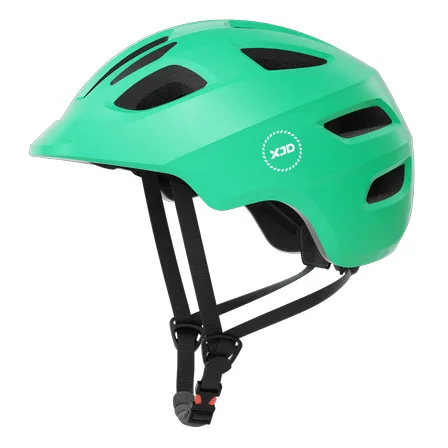
Green XJD Kids Bike Helmet for Boys & Girls
The Green XJD Kids Bike Helmet is a lightweight multi-sport helmet for toddlers …$59.99
$99