

Is 24 inch bike good
Yes—a 24-inch bike can be good for a rider about 54–64 inches (137–163 cm) tall, usually ages 10–14, but only if the individual fit is comfortable and controllable.
When a 24-inch bike is the right starting point
XBikes places 24-inch wheels in the 54–64-inch (137–163 cm) rider-height range, with ages 10–14 as a starting point. Height is more useful than age because children of the same age can differ considerably in proportions, reach and confidence.
Do not move a child onto a 24-inch bike simply because of a birthday or because there is room to grow. The American Academy of Pediatrics advises having the child try the bicycle and avoiding an oversized bike bought for future growth. A bike is good only when the rider can mount, stop, steer and operate its controls without strain.
Measure before choosing
Measure the child without shoes, standing straight against a wall, to establish total height. Then measure inseam from the floor to the crotch. Height identifies the likely wheel-size range; inseam helps you judge stand-over clearance and whether the rider can get on and off confidently.
Wheel size does not determine every frame dimension. Two 24-inch bikes can have different frame shapes, seat positions and reaches. Because the supplied catalog information does not include those measurements, compare the rider directly with the exact bicycle rather than trying to calculate fit from wheel diameter alone.
Check the fit on the actual bike
With an adult steadying the bicycle, ask the rider to perform these checks in a safe, traffic-free place:
- Stand over it: The child should be able to straddle the frame comfortably and step away without becoming trapped or losing balance.
- Reach the handlebars: Hands should rest naturally on the grips without an extreme forward stretch, locked elbows or shoulders pulled upward.
- Control the brake: The rider must reach and operate the brake control confidently while keeping a secure grip. A brake type named in a listing does not prove that its lever reach suits every hand.
- Start and stop: The child should set off, steer, slow down and stop predictably without the bicycle feeling intimidating.
- Assess confidence: If the dimensions appear acceptable but the rider becomes hesitant or cannot manage low-speed control, the bike is not yet a good fit.
Compare 20, 24 and 26 inches carefully
| Wheel size | XBikes starting point | What it means |
|---|---|---|
| 20 Inch | Ages 7–12; 48–60 in / 122–152 cm | Worth comparing when a 24-inch bike feels too tall, long or difficult to control. |
| 24 Inch | Ages 10–14; 54–64 in / 137–163 cm | The requested size; proceed only after the complete individual fit check. |
| 26 Inch | Youth and adults over 60 in / 153 cm | An overlapping height starting point, not proof that a larger bike fits better. |
The ranges overlap, so a rider near a boundary should try the relevant sizes. A taller wheel is not automatically an upgrade, and a smaller wheel is not automatically too juvenile. Choose the bicycle that gives the child better stand-over room, reach, braking control and confidence.
How the supplied XBikes options are relevant
The XJD 24-Inch Green Beach Cruiser Bike with U-Brake and Pink XJD Beach Cruiser Bike, 24"/26", U-Brake are relevant because both are Beach Cruiser Bikes with a supplied 24-inch option and U-Brake labeling. They let families consider the requested wheel size while comparing listed color and size choices.
 XJD 24-Inch Green Beach Cruiser Bike with U-Brake
A Beach Cruiser Bike with Green / 24 Inch and Pink / 24 Inch options, plus Pink / 26 Inch. Its 24-inch choices are relevant when the rider passes an individual fit and control check.
 Pink XJD Beach Cruiser Bike, 24"/26", U-Brake
A U-Brake Beach Cruiser Bike offered with 24 Inch and 26 Inch SKU labels. The 24-inch option matches the requested size; compare the exact bike’s stand-over, reach and control before choosing.
The first listing offers Green / 24 Inch, Pink / 24 Inch and Pink / 26 Inch SKU labels. The second offers 24 Inch and 26 Inch labels. Select the exact 24-inch SKU if the fit assessment points to 24 inches; do not assume the available 26-inch version is equivalent merely because the product family is similar.
The catalog facts do not provide frame geometry, component dimensions, weight, load limits or detailed adjustability. Confirm those points in the exact product manual or with a qualified bicycle mechanic, especially if the rider is close to a size boundary.
Before the first ride
Follow the exact product manual for assembly, adjustments, maintenance, compatibility and any torque requirements. If anything is unclear or the controls do not operate correctly, use a qualified bicycle mechanic rather than inventing an adjustment procedure.
A properly fitting bicycle helmet is also essential. U.S. Consumer Product Safety Commission guidance says the helmet should fit properly, sit level and have its straps used according to the helmet manufacturer’s instructions.
Choose a 24-inch bike only after measuring the rider and confirming stand-over clearance, comfortable reach, reliable brake operation and confident starts and stops on that exact bicycle.
Bikes for your next adventure
-

Light Pink XJD Girls' Bicycle with Basket & Training Wheels
The Light Pink XJD Girls' Bicycle with Basket & Training Wheels is a retro-style…$109.99
$129.99 -

Blue XJD Kids Bike Helmet for Boys & Girls
The Blue XJD Kids Bike Helmet is a lightweight, adjustable multi-sport helmet fo…$59.99
$99 -
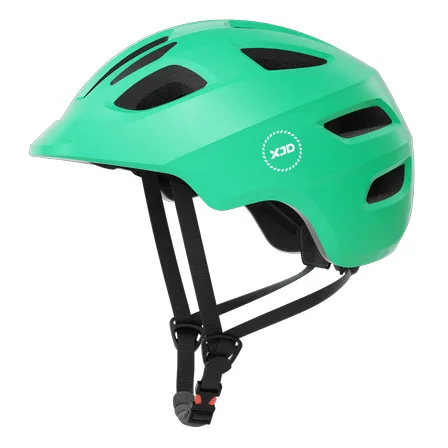
Green XJD Kids Bike Helmet for Boys & Girls
The Green XJD Kids Bike Helmet is a lightweight multi-sport helmet for toddlers …$59.99
$99