

Is 24 inch bike too small
A 24-inch bike is too small if the rider feels cramped, cannot pedal comfortably, or has outgrown its adjustment range. It is not too small merely because the rider is 14 or older. Measure height and inseam, then check stand-over clearance, reach, brake control and confidence on the actual bicycle.
Start with measured height, not age
XBikes uses 24-inch wheels as a starting point for riders 54–64 inches (137–163 cm) tall, commonly ages 10–14. Age is only a rough reference because children of the same age can differ substantially in height, leg length, reach and riding ability.
A rider above 64 inches (163 cm) may have outgrown this starting range. A rider between 60 and 64 inches (153–163 cm) falls within both the 24-inch starting range and the lower end of the 26-inch guidance, which covers youth and adults over 60 inches (153 cm). That overlap means an individual fit check—not age or wheel diameter alone—should decide.
Take the two measurements that matter first
- Standing height: Have the rider stand without shoes against a wall, looking straight ahead. Measure from the floor to the top of the head.
- Inseam: With feet slightly apart, place a firm, thin book between the legs and raise it gently to simulate saddle contact. Measure from the floor to the top edge of the book.
Compare standing height with the XBikes starting ranges above. Use the inseam when checking whether the rider can stand over the actual frame comfortably. Wheel size does not reveal frame shape, saddle adjustment or handlebar position, so measurements cannot replace trying the bicycle.
Check the rider on the actual 24-inch bike
Ask the rider to straddle the bicycle while wearing the shoes normally used for cycling. There should be comfortable clearance rather than pressure against the frame. Next, adjust the saddle only within the limits marked or described by the exact product manual.
While seated, the rider should reach the handlebars without stretching, locking the elbows or crowding the knees. Have the rider operate each brake control from the normal riding position. They should be able to reach and apply the controls securely without shifting the hands into an awkward position.
During a short supervised ride in a traffic-free area, look for smooth starting, steering, pedaling, braking and stopping. The rider should remain balanced and confident. Follow the exact bicycle manual or ask a qualified bicycle mechanic about assembly, adjustments, compatibility, maintenance or torque.
Signs that 24 inches is too small—or still suitable
| Likely too small | May still fit |
|---|---|
| Knees feel crowded or rise awkwardly while pedaling | Pedaling is smooth without cramped knees |
| Reach feels compressed even after permitted adjustments | Handlebars are reached with relaxed, controlled arms |
| Saddle needs to exceed its marked adjustment limit | Saddle position stays within the manual’s limits |
| Rider is above the height starting range and the fit check confirms crowding | Stand-over, reach, braking and control all work for the individual rider |
Do not move up solely to provide growing room. An oversized bicycle can make mounting, steering and braking harder. The appropriate choice is the size the child can control now, even when a larger wheel size appears likely from height alone.
How the supplied 24-inch options help
The XJD 24-Inch Green Beach Cruiser Bike with U-Brake provides Green / 24 Inch and Pink / 24 Inch choices, plus a Pink / 26 Inch choice. The Pink XJD Beach Cruiser Bike, 24"/26", U-Brake is offered with 24 Inch and 26 Inch SKU labels. Because both catalog products include the size named in the question—and each also has a supplied 26-inch option—they are useful comparison points when a rider is near the overlap between XBikes’ 24-inch and 26-inch height guidance. Their category is Beach Cruiser Bikes, so confirm that this bicycle type suits the intended riding.
 XJD 24-Inch Green Beach Cruiser Bike with U-Brake
A beach cruiser offered in Green / 24 Inch and Pink / 24 Inch, with a Pink / 26 Inch option for direct size comparison during an individual fit check.
 Pink XJD Beach Cruiser Bike, 24"/26", U-Brake
This beach cruiser has both 24 Inch and 26 Inch SKU labels, making it relevant when comparing sizes for a rider near the overlapping XBikes height guidance.
The catalog labels establish wheel-size choices only. They do not establish frame dimensions, rider fit, current availability or equivalence between the two sizes. Compare the 24-inch and 26-inch versions in person when possible, using the same shoes and repeating the stand-over, reach, brake-control and short-ride checks on each.
Make the decision safely
Choose the 24-inch bicycle if the rider falls near its height guidance and can stand over, reach, pedal, steer and brake with comfortable control. Consider trying a 26-inch model if the rider is over 60 inches (153 cm), especially when the 24-inch bike feels cramped—but reject the larger size if control or confidence declines.
Whichever size fits, use a bicycle helmet that fits properly, sits level and has straps adjusted according to its manufacturer’s instructions. The next step is simple: measure the rider today, test both relevant sizes if the ranges overlap, and keep the 24-inch bike only if the rider—not merely the age chart—demonstrates a comfortable, controlled fit.
Bikes for your next adventure
-

Light Purple XJD Toddler Bike Helmet, Adjustable, Size XS (46–51 cm)
This Light Purple XJD toddler bike helmet is made for the smallest riders — the …$20.39
-

Green XJD Toddler Bike Helmet with Adjustable Fit, XS (46–51 cm)
The XJD toddler bike helmet in Green is built for the youngest riders — the size…$20.39
$23.99 -
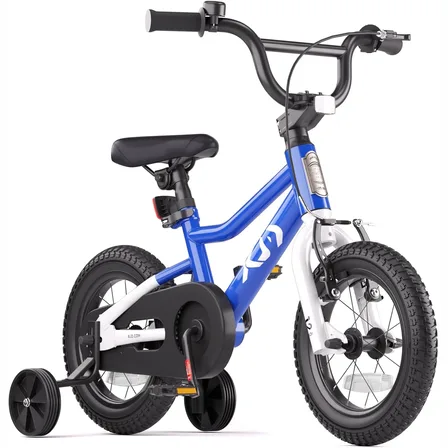
XJD Boys & Girls BMX Bike with Training Wheels, 12/14/16" – Blue
The XJD Boys & Girls BMX Bike in Blue is a first pedal bike for kids roughly age…$99.99
$119.99