

What age child rides a 20 inch bike
Most children who ride a 20-inch bike are ages 7–12 and 48–60 inches (122–152 cm) tall, but measured fit and control matter more than age.
Start with height, not the birthday
The XBikes starting point for a 20-inch wheel is a rider height of 48–60 inches (122–152 cm). Age 7–12 is only a broad guide: children of the same age can differ greatly in leg length, reach and riding confidence.
Measure the child without shoes, standing straight against a wall. Record total height. Then measure inseam from the floor to the crotch using a book held level between the legs. Compare those measurements with the bicycle’s geometry and fit information rather than assuming every 20-inch model fits identically.
If the child is below 48 inches (122 cm), begin the comparison with a smaller wheel size. If the child is above 60 inches (152 cm), compare a 24-inch bike; the XBikes starting point for that size is ages 10–14 and 54–64 inches (137–163 cm). Overlap in these ranges is a reason to try the bike, not permission to choose by age alone.
Perform the fit check on the actual bike
Have the child try the exact bicycle whenever possible. The American Academy of Pediatrics advises against buying an oversized bicycle simply for future growth. A bike that is difficult to stand over, steer or stop is not made suitable by the expectation that the rider will grow into it.
- Check stand-over: With the child straddling the bicycle, confirm that the frame does not prevent a stable stance. Use the model’s manual for its intended clearance and adjustment guidance.
- Check seated reach: The child should reach the handlebar without stretching, locking the elbows or losing a balanced riding position.
- Check brake control: Confirm that the child can comfortably reach and operate the provided braking controls. Do not assume hand size or strength from age.
- Check starts and stops: In a controlled area, have the child demonstrate a steady start, turn and stop while remaining in control.
If the seat, handlebar or controls cannot be adjusted to give a stable position, follow the exact product manual or ask a qualified bicycle mechanic. Do not improvise beyond the manufacturer’s instructions.
Compare the neighboring wheel sizes
| Wheel size | XBikes age starting point | XBikes rider-height starting point |
|---|---|---|
| 18 Inch | Ages 5–9 | 43–52 in / 109–132 cm |
| 20 Inch | Ages 7–12 | 48–60 in / 122–152 cm |
| 24 Inch | Ages 10–14 | 54–64 in / 137–163 cm |
A child within an overlapping height range may need to compare two sizes. Choose the one on which stand-over, reach, brake operation and handling are all manageable. An 18-inch bike is not equivalent to a 20-inch bike, and a 24-inch bike should not be selected merely to provide more growing room.
When the supplied XBikes product is relevant
The Pink 12/14/16/20" XJD Girls Bike with Training Wheels & Basket is cataloged in Training Wheel Bikes and has 12 Inch, 14 Inch, 16 Inch and 20 Inch SKU labels. Its 20 Inch option makes it directly relevant to this question, while its smaller labeled options can help a parent compare sizes when the child is not yet ready for 20 inches. The catalog facts do not establish individual fit, so the same measurement and control checks still apply.
This catalog option helps answer the title because it includes the requested 20 Inch label alongside three smaller wheel-size labels, making the size distinction explicit rather than treating age as the deciding factor.

Use the exact SKU label when reviewing the product. Details such as assembly, adjustments, load limits, component compatibility and maintenance procedures must come from the exact product manual or a qualified bicycle mechanic; they should not be inferred from the product name.
Confidence can change the size decision
A child who falls within the 20-inch height range may still lack the confidence or control needed for a particular bicycle. Hesitation when starting, difficulty steering at low speed, an inability to use the brakes reliably, or an unstable stop means the fit or setup needs another look.
Likewise, a confident rider should not move to a larger wheel when reach or stand-over is unsuitable. Riding skill cannot compensate for a bicycle that is physically too large. Recheck fit after adjustments and whenever growth noticeably changes the child’s riding position.
Make the final 20-inch decision
Choose a 20-inch bike only when the child is around the 48–60 inch (122–152 cm) starting range and can comfortably stand over, reach, steer, brake, start and stop on that exact model. Reject the size if any essential control is strained, even when the child is ages 7–12.
Before riding, provide a properly fitting bicycle helmet. The U.S. Consumer Product Safety Commission advises that it sit level and that its straps be used according to the helmet manufacturer’s instructions. Your next step is simple: measure height and inseam, try the exact 20-inch bicycle, and select it only after the child demonstrates comfortable control.
Bikes for your next adventure
-
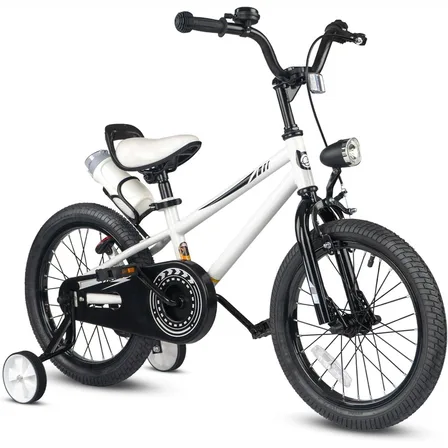
XJD Kids' Training Wheel Bike for Boys & Girls, 12/14/16 Inch – White
The XJD kids' training wheel bike in White is made for riders ages 3–8 (roughly …$169
$199 -
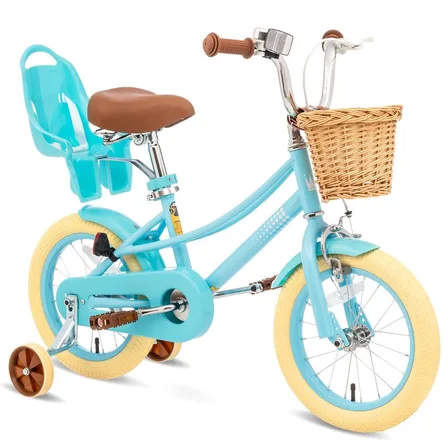
Girls' Training Wheel Bike by XJD, 12–20 Inch Wheels – Blue
This XJD girls' training wheel bike in Blue covers one of the widest fit ranges …$139
$159 -

XJD Kids Bike for Girls – Pink, 12/14/16/20 Inch with Training Wheels
The XJD Kids Bike for Girls in Pink is a training-wheel bike built to carry your…$139
$159