

What age do kids ride 2 wheel bike
Most kids ride a two-wheel bike independently between ages 4 and 7, but there is no single correct age. Measure height, check fit and watch readiness.
Age is only the starting point
Some children are ready before age 4, while others need more time after age 7. The useful question is whether your child can balance, steer, stop and follow simple directions while riding. Confidence matters too: pressure can make learning harder even when a child is physically capable.
Choose the bicycle from the child's current measurements and control, not from age alone. Never buy an oversized bike merely to leave room for growth. A bike that is difficult to stand over, steer or stop can delay progress toward independent riding.
Measure and compare before choosing
Measure the child without shoes, standing straight against a wall. Record total height. Also measure inseam from the floor to the crotch, because two children of the same height may need different frames or saddle positions.
Use these XBikes wheel-size ranges as starting points only:
| Wheel size | Starting age | Rider height |
|---|---|---|
| 12 Inch | 3–4 | 34–40 in / 86–102 cm |
| 14 Inch | 3–6 | 37–45 in / 94–114 cm |
| 16 Inch | 4–7 | 40–48 in / 102–122 cm |
| 18 Inch | 5–9 | 43–52 in / 109–132 cm |
| 20 Inch | 7–12 | 48–60 in / 122–152 cm |
| 24 Inch | 10–14 | 54–64 in / 137–163 cm |
| 26 Inch | Youth and adults | Over 60 in / 153 cm |
Where ranges overlap, do not automatically select the larger wheels. Compare the actual bicycles and choose the one the child can control comfortably now.
Check the fit on the actual bike
Have your child try the bicycle rather than relying on a label. A useful fit check covers all of the following:
- Stand-over: the child can straddle the bike securely rather than being forced onto tiptoes by the frame.
- Reach: the child can hold the handlebars and steer without stretching, locking the elbows or leaning excessively.
- Brake control: the child can reach and operate the available braking controls reliably.
- Starting and stopping: the child can get underway and stop without losing control.
- Confidence: the child remains attentive and willing rather than freezing, rushing or panicking.
If any of these checks fail, try another fit or postpone independent riding. Follow the exact product manual for assembly, adjustments, maintenance, load limits and compatibility; use a qualified bicycle mechanic when the instructions or setup are unclear.
Are the supplied XBikes options relevant?
The supplied catalog options are training-wheel bicycles, so they may suit a child who still needs supported practice. Their listed wheel choices also let you begin the comparison with the child's measured height. They do not, by themselves, show that a child is ready to ride on two wheels without support.
 XJD Kids Bike for Girls – Pink, 12/14/16/20 Inch with Training Wheels
A training-wheel bicycle offered in 12, 14, 16 and 20 Inch options. Compare the child's measured height with the XBikes starting ranges, then confirm stand-over, reach, braking control and confidence on the actual bike.
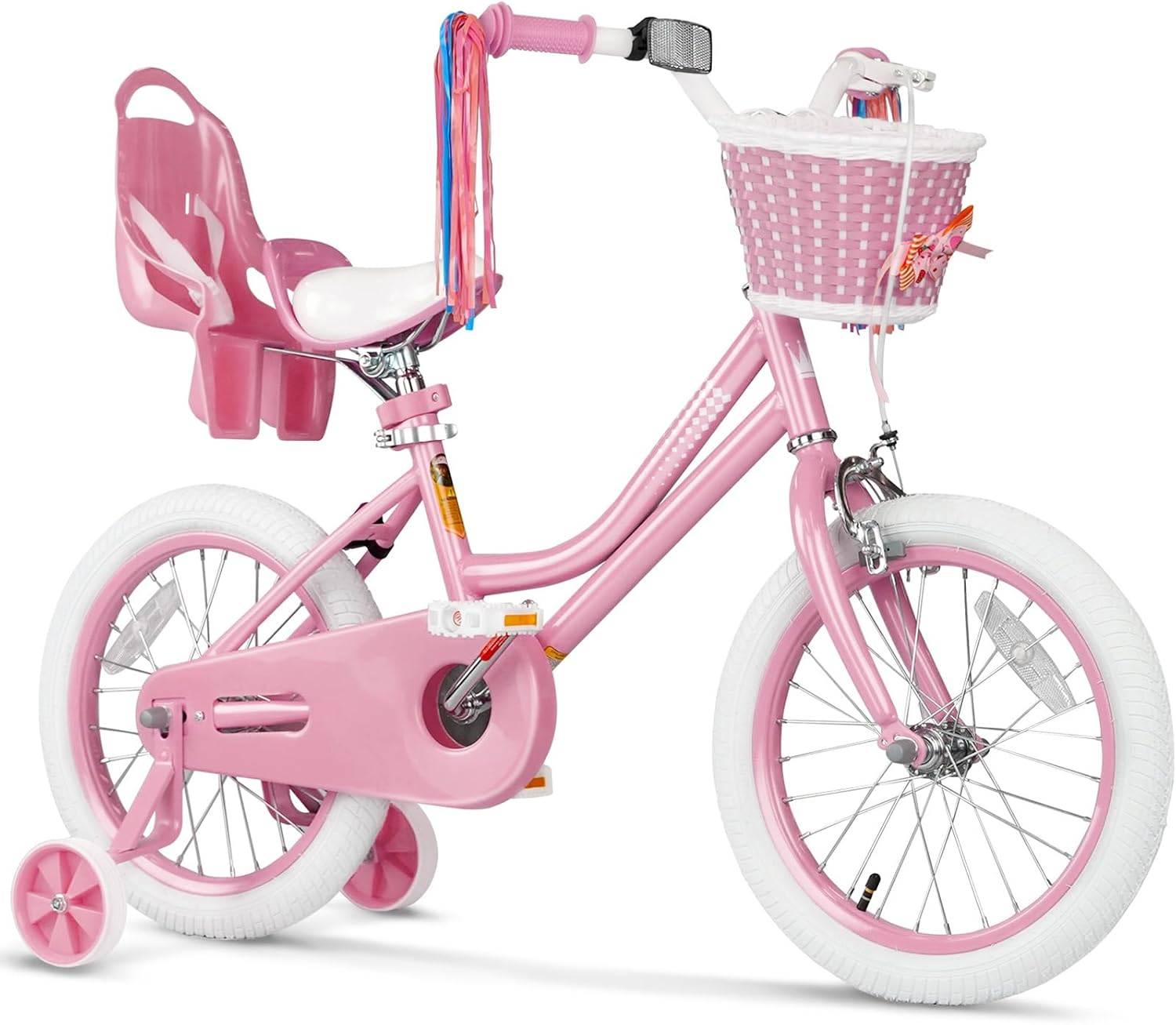 XJD Pink Girls' Bike – Kids 12/14/16 Inch Training Wheel Bicycle
A training-wheel bicycle offered in 12, 14 and 16 Inch options. It is relevant for supported practice when a listed wheel size matches the rider's measured height and the individual fit check succeeds.
XJD Kids Bike for Girls – Pink, 12/14/16/20 Inch with Training Wheels is listed in 12, 14, 16 and 20 Inch options. That span corresponds to several starting ranges in the table, but the correct option still depends on an individual fit check.
XJD Pink Girls' Bike – Kids 12/14/16 Inch Training Wheel Bicycle is listed in 12, 14 and 16 Inch options. It is relevant when those wheel-size starting points match the measured rider and training wheels suit the child's present stage.
Neither catalog title supplies frame geometry, brake details or a promise of independent-riding readiness. Treat the wording in each exact product title as a catalog label, not as evidence that the bicycle fits a particular age.
Know when to remove support
Training wheels can help with pedaling and steering practice, but independent two-wheel riding requires balance. A child may be ready to progress when they can steer deliberately, stop on request, keep their eyes forward and show steady confidence. Make the change in a flat, open area away from traffic and obstacles, with close adult supervision.
If the child repeatedly tips, cannot stop reliably or becomes frightened, restore an appropriate level of support and try again later. Read the bicycle's manual before changing or removing fitted parts; if the procedure is uncertain, ask a qualified bicycle mechanic.
Make the decision today
Measure height and inseam, identify the matching wheel-size starting points, and have the child try those sizes. Choose only a bike they can stand over, reach, steer and stop comfortably. Then decide separately whether training wheels match their current confidence. Age can narrow the search, but demonstrated control on a correctly fitted bicycle determines whether your child is ready to ride two wheels now.
Before every ride, use a bicycle helmet that fits properly, sits level and has its straps adjusted according to the helmet manufacturer's instructions.
Bikes for your next adventure
-

XJD Girls BMX Bike 12/14/16 Inch with Training Wheels – Pink Blue
The XJD Girls BMX Bike in Pink/Blue is built as a first pedal bike for kids roug…$99.99
$119.99 -

Blue XJD Girls Bike with Training Wheels – 12/14/16 Inch
If you're shopping for a first pedal bike for a daughter roughly 3 to 8 years ol…$149
$169 -

XJD Pink Beach Cruiser for Girls – Rear Rack & V-Brake
The XJD Pink Beach Cruiser for girls is the step-up bike for riders who've outgr…$179.99
$209.99