

What age for 20 inch wheel bike
A 20-inch wheel bike is usually a starting point for ages 7–12 and rider heights of 48–60 in (122–152 cm), but the child must be measured and fitted.
Age gives you a starting point, not the final answer
For the XBikes sizing standard, a 20-inch bike corresponds to ages 7–12 and a rider height of 48–60 in (122–152 cm). Height is more useful than age because children of the same age can differ considerably in leg length, reach and riding confidence.
Do not choose a 20-inch bike simply because the child is seven, or buy one oversized so they can grow into it. A child who falls outside the stated height range, or cannot comfortably control the bicycle, should be compared with another wheel size and checked on the actual bike.
Measure the child before comparing bikes
Measure the child in ordinary riding clothes and shoes. Record their full standing height, then measure their inseam from the floor to the crotch. Use the height range to identify 20 inches as a possible size; use the inseam and an in-person check to determine whether a particular frame actually fits.
- Have the child stand straight against a wall and measure from the floor to the top of the head.
- Measure the inseam with the feet slightly apart, keeping the measuring tool level at the crotch.
- Write down both measurements rather than relying on clothing size, school year or an estimate.
- Compare the result with the 20-inch starting range: 48–60 in (122–152 cm) in height.
Wheel diameter alone does not determine stand-over clearance or reach. Two bicycles with 20-inch wheels may fit differently, so the exact bicycle still needs to be tried.
Check fit and control on the actual 20-inch bike
With an adult stabilizing the bicycle, have the child stand over it. They need comfortable clearance rather than contact with the frame. Seated in a normal riding position, they should be able to reach the handlebar without stretching, turn it with control and operate the brakes confidently.
Also watch how they start, stop and place a foot down. A bike is too large if the child has to strain for the controls, cannot stop predictably, or appears intimidated by its height. A bike may be too small if the riding position is cramped. Current confidence matters alongside measurements: a cautious new rider may need a different fit decision from a confident rider of the same age and height.
A practical decision requires all five checks: measured height, inseam, stand-over clearance, reach and brake control.
How nearby wheel sizes frame the decision
| Wheel size | Starting age | Starting rider height |
|---|---|---|
| 18 Inch | 5–9 | 43–52 in / 109–132 cm |
| 20 Inch | 7–12 | 48–60 in / 122–152 cm |
| 24 Inch | 10–14 | 54–64 in / 137–163 cm |
The overlapping ranges show why age cannot settle the choice. If the child is near 48 inches or 60 inches tall, compare the adjacent size as well. Choose according to actual control and fit, not the larger wheel or the size that promises the longest period of use.
Which supplied XBikes options are relevant?
All three supplied catalog options include a 20 Inch SKU label, so they are directly relevant for comparing the requested wheel size. They also list 12, 14 and 16 Inch variants, but those smaller labels are separate size choices and are not equivalent to a 20-inch bicycle.
The Light Pink XJD Girls' Bicycle with Basket & Training Wheels is listed in Training Wheel Bikes with 12 Inch, 14 Inch, 16 Inch and 20 Inch options. The Girls' Training Wheel Bike by XJD, 12–20 Inch Wheels – Blue has the same four supplied wheel-size labels. The XJD Girls' Bike with Training Wheels, 12/14/16/20 Inch – Purple likewise includes a 20 Inch option in the Training Wheel Bikes category.
These particular products help answer the title because each provides an exact 20 Inch catalog option to inspect after measuring the rider; their supplied facts also identify them as training-wheel bikes, which may matter when considering the child's current confidence.
 Light Pink XJD Girls' Bicycle with Basket & Training Wheels
A Training Wheel Bikes option offered with 12 Inch, 14 Inch, 16 Inch and 20 Inch SKU labels. Its 20 Inch variant is relevant only after the rider passes an individual fit and control check.
 Girls' Training Wheel Bike by XJD, 12–20 Inch Wheels – Blue
This blue Training Wheel Bikes model lists 12 Inch, 14 Inch, 16 Inch and 20 Inch choices. Compare the explicitly labeled 20 Inch SKU with the child's measurements, reach, brake control and confidence.
 XJD Girls' Bike with Training Wheels, 12/14/16/20 Inch – Purple
This purple Training Wheel Bikes option is supplied in 12, 14, 16 and 20 Inch labels. The 20 Inch variant addresses the requested size, but its fit must still be checked on the individual rider.
Confirm that the selected SKU is labeled 20 Inch rather than assuming the title covers every variant. No supplied facts establish frame dimensions, brake type, load limit, assembly procedure or compatibility. Follow the exact product manual for those details, and use a qualified bicycle mechanic when fit, adjustment or assembly remains uncertain.
Make the 20-inch decision
Start with 20 inches when the child is generally age 7–12 and measures 48–60 in (122–152 cm). Then have them try the exact bicycle and reject it if stand-over clearance, reach, braking or confident control is inadequate. Finish by fitting a bicycle helmet level on the head and securing its straps according to the helmet manufacturer's instructions.
If every check works, the 20-inch option is a reasonable fit to consider now. If any check fails, compare the adjacent wheel size and repeat the hands-on fit test instead of buying for future growth.
Bikes for your next adventure
-
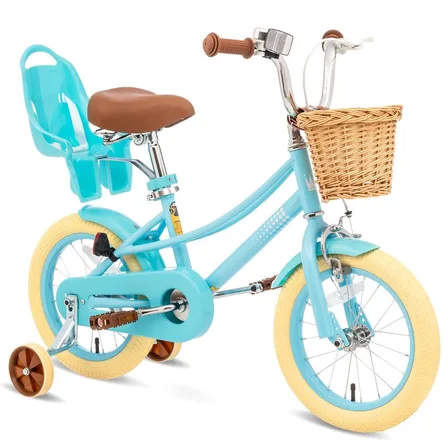
Girls' Training Wheel Bike by XJD, 12–20 Inch Wheels – Blue
This XJD girls' training wheel bike in Blue covers one of the widest fit ranges …$139
$159 -
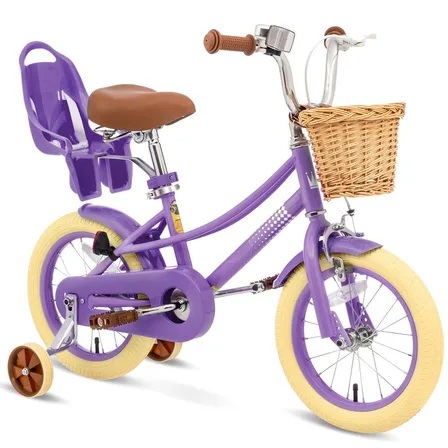
XJD Girls' Bike with Training Wheels, 12/14/16/20 Inch – Purple
The XJD girls' bike with training wheels in Purple is built to grow with your ri…$139
$159 -
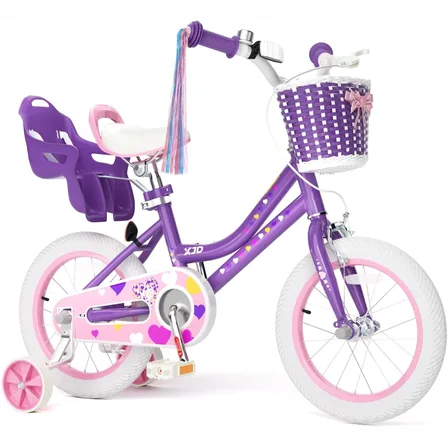
XJD Light Purple Girls Bike with Basket, Training Wheels, 12/14/16/20 Inch
The XJD Girls Bike with Basket in Light Purple is a single-speed training-wheel …$99.99
$119.99