

What age for a 24 inch bike forum
A 24-inch bike is a starting point for ages 10–14 and riders 54–64 inches (137–163 cm) tall. Measure the child and confirm fit before buying.
Age is only the first check
If you are comparing answers in a forum, the clearest XBikes starting point is ages 10–14. However, children of the same age can differ greatly in height, leg length, arm reach and riding confidence. A younger tall rider may fit a 24-inch bike, while an older shorter rider may still have better control on a 20-inch bike.
Do not choose a larger bicycle solely to leave room for growth. The child should try the bike whenever possible and demonstrate comfortable stand-over clearance, steering control and access to the brakes.
What to measure before choosing
- Rider height: Measure without shoes, with the child standing straight against a wall. Compare the result with the 24-inch starting range of 54–64 inches (137–163 cm).
- Inseam: Measure from the floor to the crotch while the child stands with feet slightly apart. Compare that measurement with the stand-over space and adjustment information for the exact bicycle.
- Reach: With the child seated in a normal riding position, check that the handlebar can be reached without an extreme forward stretch or locked elbows.
- Brake access: The rider must be able to reach and operate the brake controls reliably while maintaining a secure grip.
- Current confidence: Starting, stopping, turning and putting a foot down should feel controlled rather than intimidating.
How 20-, 24- and 26-inch starting points compare
| Wheel size | XBikes age starting point | XBikes rider-height starting point |
|---|---|---|
| 20 Inch | Ages 7–12 | 48–60 in / 122–152 cm |
| 24 Inch | Ages 10–14 | 54–64 in / 137–163 cm |
| 26 Inch | Youth and adults | Over 60 in / 153 cm |
The ranges overlap because wheel size alone cannot establish fit. A child near 60 inches tall could fall within more than one starting point. In that case, compare the actual bicycles and favor the one on which the rider can stand over, reach, steer and brake with confidence. A 26-inch bike is not automatically appropriate merely because the rider exceeds 60 inches.
How the supplied 24-inch bikes are relevant
The two catalog options are useful because each includes an exact 24-inch choice for comparison. They can help a family evaluate real reach, stand-over and brake access rather than relying on a forum age answer alone. Their 26-inch variants are different sizes and should not be treated as equivalent substitutes.
 XJD 24-Inch Green Beach Cruiser Bike with U-Brake
This beach cruiser includes Green / 24 Inch and Pink / 24 Inch labels, making it directly relevant to a 24-inch fit check. It has a U-brake, whose reach and operation should be checked by the rider.
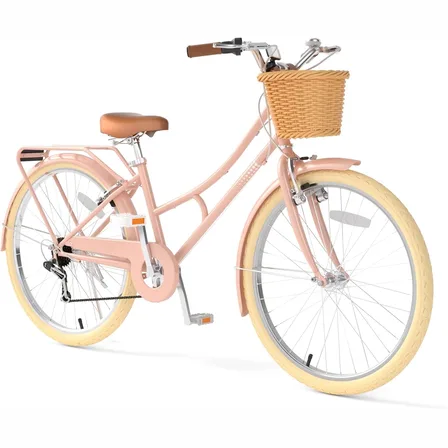
 Pink XJD Beach Cruiser Bike, 24"/26", U-Brake
This beach cruiser includes distinct 24 Inch and 26 Inch labels. Its 24 Inch option is relevant to the question; the 26 Inch option is a different size and should receive its own individual fit check.
The XJD 24-Inch Green Beach Cruiser Bike with U-Brake is listed with Green / 24 Inch, Pink / 24 Inch and Pink / 26 Inch SKU labels. For this question, compare only one of its 24-inch variants with the child’s measurements and control. Its U-brake must also be comfortably reachable and operable by the rider.
The Pink XJD Beach Cruiser Bike, 24"/26", U-Brake has 24 Inch and 26 Inch SKU labels. Select the 24 Inch label when assessing a 24-inch fit; the 26 Inch label represents the next listed wheel size, not extra growing room within the same fit.
Both products are beach cruiser bikes. Their catalog facts do not provide frame dimensions, adjustment limits, load limits, assembly details or maintenance procedures. Consult the exact product manual for those details, and use a qualified bicycle mechanic when fit, assembly or brake operation remains uncertain.
A quick in-person fit decision
Have the child try the bicycle in a controlled setting. First, check that the frame permits suitable stand-over clearance. Next, observe whether the rider can sit naturally, reach the handlebar, turn it without strain and place a foot down promptly. Finally, ask the child to demonstrate deliberate brake operation without shifting the hands into an insecure position.
Reject the fit if the rider has to stretch markedly, cannot control the brakes, feels overwhelmed by the bicycle, or lacks appropriate stand-over clearance. Moving up for future growth does not compensate for poor control today. If the child falls below the 24-inch height starting point, compare a 20-inch bike rather than assuming adjustments will solve the mismatch.
Helmet check before the first ride
Wheel size does not determine helmet size. Use a bicycle helmet that fits the individual child, sits level on the head and has its straps adjusted according to the helmet manufacturer’s instructions. Recheck the fit whenever the helmet is adjusted or worn differently.
Decision: consider a 24-inch bike when the rider is roughly 10–14 years old and 54–64 inches tall, but proceed only if the measured child can stand over, reach, steer and brake confidently on the exact 24-inch model.
Bikes for your next adventure
-

26-Inch XJD Beach Cruiser Bike for Girls – Purple, V-Brake
This XJD 26-inch purple beach cruiser is sized for big kids and teens — suggeste…$218.49
$229.99 -
Pink XJD Beach Cruiser Bike, 24"/26", U-Brake
The XJD Pink Beach Cruiser Bike is a single-speed cruiser built for older kids a…$159.99
-

XJD Pink Beach Cruiser for Girls – Rear Rack & V-Brake
The XJD Pink Beach Cruiser for girls is the step-up bike for riders who've outgr…$179.99
$209.99