

What age kid rides a 24 inch bike
A 24-inch bike generally suits a child age 10–14 who is 54–64 inches (137–163 cm) tall, but measured fit and control matter more than age.
Start with height, not the birthday
Age is only a starting point because children of the same age can differ greatly in height, proportions and riding ability. Measure your child barefoot, standing straight against a wall, and compare the result with the XBikes 24-inch range of 54–64 inches (137–163 cm).
A child outside that height range should not be moved onto a 24-inch bike simply because they are 10, or kept on one simply because they are under 15. The neighboring XBikes starting points are 20-inch bikes for ages 7–12 and heights of 48–60 inches (122–152 cm), and 26-inch bikes for youth and adults over 60 inches (153 cm). These ranges overlap, so an individual fit check decides between sizes.
Measure inseam and check stand-over clearance
Measure inseam with the child standing in socks, feet slightly apart. Place a rigid book between the legs with its edge level, gently raising it to simulate a bicycle saddle, then measure from the floor to the top edge. Record the result and compare it with the stand-over and saddle-adjustment information in the exact bicycle manual; no universal inseam number can confirm fit across every 24-inch frame.
Have the child straddle the bicycle while standing over the frame. They need comfortable clearance rather than pressure from the frame. The American Academy of Pediatrics advises having a child try the bicycle and avoiding an oversized bike bought for future growth. If stand-over clearance is inadequate, reject that bike even when the age and height chart appear to match.
Test reach, braking and confidence
With the bicycle supported securely, have the child sit in a normal riding position and place both hands on the controls. Check that they can steer without stretching, turn the handlebar without losing balance, and reach and operate the brakes deliberately. Their posture should look controlled, not tense or extended.
- Likely ready: the rider fits the height starting point, clears the frame, reaches the controls comfortably and can start, stop and turn with confidence.
- Needs another comparison: the rider falls in an overlapping height range or can stand over the bike but struggles with reach or braking.
- Not ready for this bike: the frame crowds the rider, the controls are out of reach, or the child cannot stop and steer reliably.
Current confidence matters alongside body measurements. A less experienced rider may handle a smaller, manageable bicycle better than a larger one that technically matches age. Do not treat a brief ability to reach the pedals as proof of full control.
How the supplied 24-inch options are relevant
The two catalog choices below include the wheel size named in the question, so they provide relevant 24-inch bicycles to try during the fit check. They also let families compare available size and color labels without treating those labels as proof that a particular child fits.
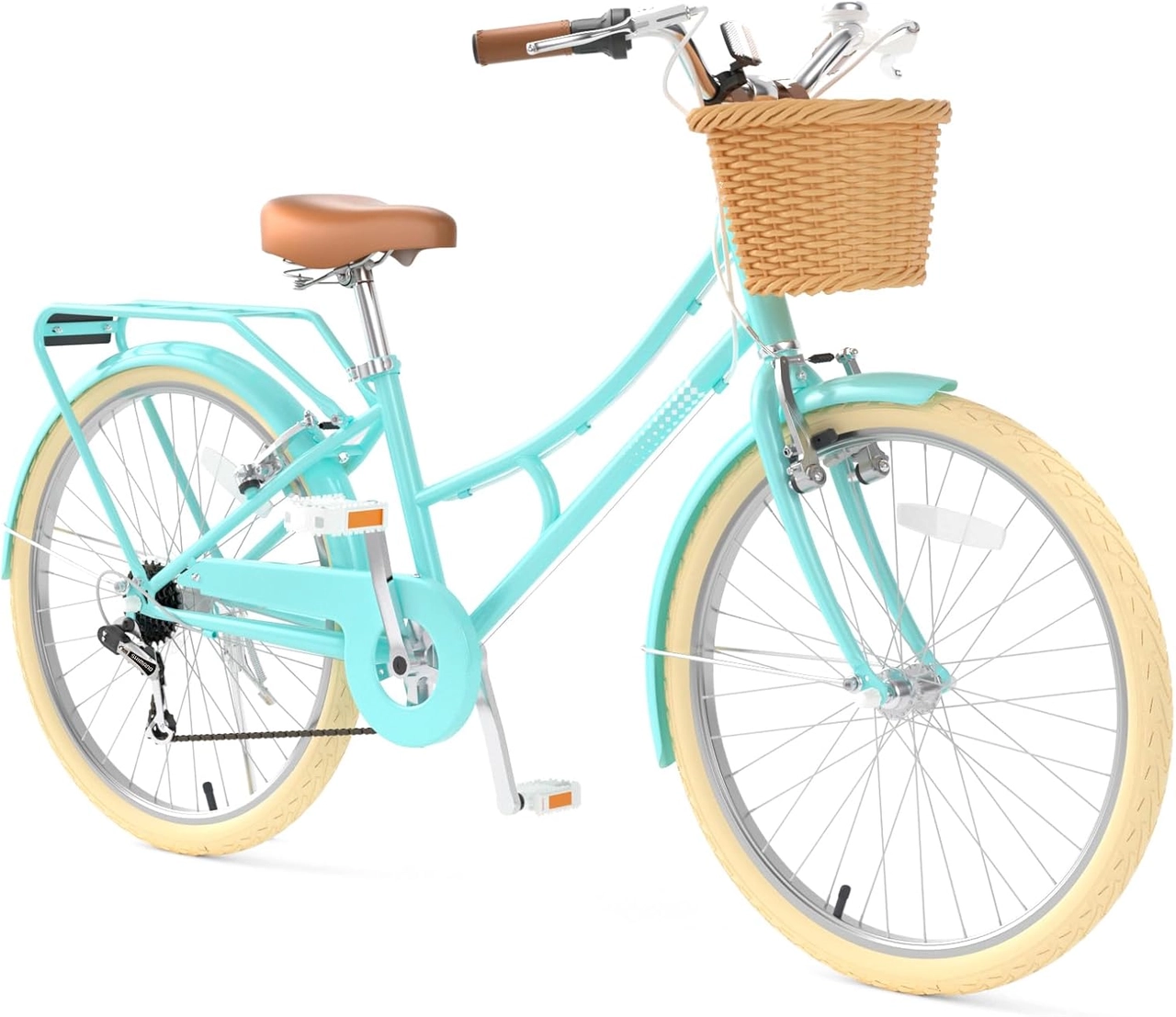 XJD 24-Inch Green Beach Cruiser Bike with U-Brake
A relevant 24-inch option with Green / 24 Inch and Pink / 24 Inch labels; the separate Pink / 26 Inch variant requires its own size and fit comparison.
 Pink XJD Beach Cruiser Bike, 24"/26", U-Brake
This cruiser listing includes distinct 24 Inch and 26 Inch SKU labels. Its 24-inch option is relevant only after checking the child’s height, stand-over clearance, reach and control.
The XJD 24-Inch Green Beach Cruiser Bike with U-Brake is listed with Green / 24 Inch, Pink / 24 Inch and Pink / 26 Inch SKU labels. Its 24-inch variants match the requested wheel-size category, while its 26-inch variant is a different size and must be evaluated against the separate over-60-inch (153 cm) starting point.
The Pink XJD Beach Cruiser Bike, 24"/26", U-Brake has 24 Inch and 26 Inch SKU labels. Choose the 24-inch label only if the individual fit checks support it; the presence of both sizes in one listing does not make them interchangeable.
For assembly, adjustments, compatibility, load limits, maintenance and torque requirements, follow the manual for the exact product and selected SKU. If anything is unclear or the controls cannot be positioned appropriately, use a qualified bicycle mechanic.
Complete the safety check
Before riding, inspect the assembled bicycle according to its exact manual and confirm that the child can demonstrate a controlled start, turn and stop in a traffic-free area under adult supervision. A properly fitted bicycle helmet is also essential. The U.S. Consumer Product Safety Commission advises that the helmet sit level, fit properly and have its straps used according to the helmet manufacturer’s instructions.
Make the 24-inch decision
Measure height and inseam, then arrange a hands-on fit check. Choose a 24-inch bike only when the child is near the 54–64-inch starting range and can comfortably clear the frame, reach the controls, operate the brakes, steer and stop. If any of those checks fail, compare the adjacent wheel-size starting point instead of buying room to grow.
Bikes for your next adventure
-

26-Inch XJD Beach Cruiser Bike for Girls – Purple, V-Brake
This XJD 26-inch purple beach cruiser is sized for big kids and teens — suggeste…$218.49
$229.99 -

Blue XJD Girls Bike with Training Wheels – 12/14/16 Inch
If you're shopping for a first pedal bike for a daughter roughly 3 to 8 years ol…$149
$169 -

XJD Kids Bike for Girls – Pink, 12/14/16/20 Inch with Training Wheels
The XJD Kids Bike for Girls in Pink is a training-wheel bike built to carry your…$139
$159