

What age kids learn to pedal bike
There is no single age when kids learn to pedal a bike. Many begin within the 12–16 Inch fit ranges, ages 3–7, but readiness and fit matter more than age.
When is a child ready to learn?
A child is ready to try pedaling when they want to ride, can follow simple directions and can stay composed while practicing steering, starting and stopping. Confidence may develop earlier or later than the age printed beside a wheel size.
For an initial comparison, XBikes lists 12 Inch bikes for ages 3–4 and heights 34–40 in / 86–102 cm; 14 Inch for ages 3–6 and 37–45 in / 94–114 cm; and 16 Inch for ages 4–7 and 40–48 in / 102–122 cm. These overlapping ranges show why age cannot select a bike by itself.
Measure before choosing a wheel size
Measure the child’s height without shoes, standing straight against a wall. Also measure inseam from the floor to the crotch while the child stands with feet slightly apart. Use height to identify likely wheel sizes, then have the child try each realistic candidate.
| Wheel size | Starting age | Rider height |
|---|---|---|
| 12 Inch | 3–4 | 34–40 in / 86–102 cm |
| 14 Inch | 3–6 | 37–45 in / 94–114 cm |
| 16 Inch | 4–7 | 40–48 in / 102–122 cm |
| 20 Inch | 7–12 | 48–60 in / 122–152 cm |
| 24 Inch | 10–14 | 54–64 in / 137–163 cm |
| 26 Inch | Youth and adults | Over 60 in / 153 cm |
These are starting points, not proof of fit. The American Academy of Pediatrics advises having the child try the bicycle rather than buying an oversized model for future growth.
What to compare during the fit check
- Stand-over: Check that the child can straddle the bicycle securely and is not crowded by the frame.
- Reach: Their hands should reach the handlebar without an uncomfortable stretch or locked elbows.
- Brake control: Confirm that they can reach and operate the bicycle’s actual controls reliably.
- Handling: Watch whether they can keep the bike upright, turn the handlebar and stop without panic.
- Confidence: Choose the size they can control now, even when age and height ranges overlap.
Do not assume a larger wheel is a useful shortcut. A bike that is difficult to mount, steer or stop can interfere with learning. If adjustment, assembly or compatibility is uncertain, follow the exact product manual or ask a qualified bicycle mechanic.
How to teach pedaling next
- Choose a flat, open practice area away from traffic and obstacles.
- Let the child become comfortable sitting, looking ahead and steering before combining every task.
- Position the pedals so the child can press one forward to begin, then practice short starts.
- Work on stopping as often as starting. The child should know how to use the fitted braking controls before gaining speed.
- Keep sessions short and stop before frustration replaces attention.
A properly fitting helmet is part of every session. The U.S. Consumer Product Safety Commission says the helmet should fit properly, sit level and have its straps used according to the manufacturer’s instructions.
How the supplied bikes relate to learning age
The Pink 12/14/16/20" XJD Girls Bike with Training Wheels & Basket provides 12 Inch, 14 Inch, 16 Inch and 20 Inch catalog choices, so it spans several supplied starting ranges relevant to children learning or progressing. Its training-wheel category may be relevant when a family specifically wants that format, but wheel size still requires an individual fit check.
The 26-Inch XJD Beach Cruiser Bike for Girls – Purple, V-Brake has 20 Inch, 24 Inch and 26 Inch variants in its supplied SKU labels. The XJD 24-Inch Green Beach Cruiser Bike with U-Brake has 24 Inch and 26 Inch variants. These larger beach-cruiser options are comparison points for taller, generally older riders, not evidence that a beginner should size up. The catalog options help answer the title by showing the progression from common early-learning sizes to later youth sizes.
 Pink 12/14/16/20" XJD Girls Bike with Training Wheels & Basket
Its 12 Inch, 14 Inch and 16 Inch choices overlap the supplied early-learning age and height ranges; the 20 Inch choice supports later progression. Its training-wheel category is relevant only if that format suits the family.
 26-Inch XJD Beach Cruiser Bike for Girls – Purple, V-Brake
Supplied 20 Inch, 24 Inch and 26 Inch variants make this beach cruiser a comparison for taller or generally older riders, rather than a reason to put a young learner on an oversized bicycle.
 XJD 24-Inch Green Beach Cruiser Bike with U-Brake
With supplied 24 Inch and 26 Inch variants, this beach cruiser is relevant to later youth sizing. It is not a substitute for the smaller 12–16 Inch sizes commonly associated with beginning pedal-bike ages.
Make the age decision
If your child falls within the 12–16 Inch starting ranges and can comfortably straddle, reach, steer and operate the controls, a supervised pedal-bike trial is reasonable now. If those checks fail or the child is unwilling, wait and reassess rather than choosing by birthday. Measure height and inseam today, compare the overlapping ranges, and select only after watching the child control the actual bike.
Bikes for your next adventure
-
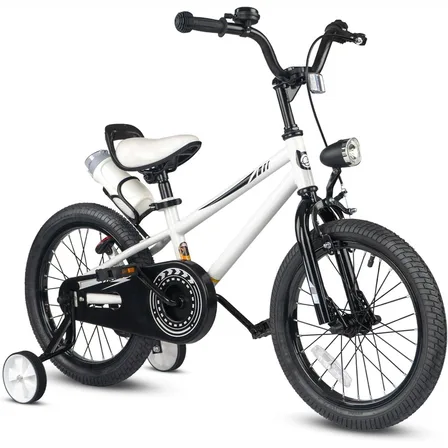
XJD Kids' Training Wheel Bike for Boys & Girls, 12/14/16 Inch – White
The XJD kids' training wheel bike in White is made for riders ages 3–8 (roughly …$169
$199 -

Black XJD Kids Bike for Boys – 12, 14 & 16 Inch Sizes
For a son between roughly 3 and 8 years old, the XJD Kids Bike in Black covers t…$169
$199 -

Blue XJD Girls Bike with Training Wheels – 12/14/16 Inch
If you're shopping for a first pedal bike for a daughter roughly 3 to 8 years ol…$149
$169