

What age would a 24 inch bike suit
A 24-inch bike usually suits ages 10–14 and riders 54–64 inches (137–163 cm) tall, but measured fit and confident control matter more than age.
Start with height, not the birthday
The age range is a useful starting point, not a guarantee. Children of the same age can differ considerably in height, leg length, reach and riding confidence. Measure the child’s current height without shoes and compare it with the 54–64-inch (137–163 cm) starting range for a 24-inch wheel bike.
If the rider is shorter than that range, do not choose a 24-inch bicycle simply because they will grow into it. A 20-inch bike is the XBikes starting point for ages 7–12 and heights of 48–60 inches (122–152 cm). The overlap means an individual fit check is especially important for riders between 54 and 60 inches tall.
At the upper end, compare carefully with a 26-inch option. XBikes treats 26-inch bikes as a starting point for youth and adults over 60 inches (153 cm), but wheel diameter alone does not establish fit.
Measure inseam and check stand-over clearance
Measure the child’s inseam while they are standing straight. Use that measurement to assess the actual bicycle rather than trying to calculate fit from age. With the child straddling the bike while stationary, confirm that they can stand over it comfortably and manage it without leaning precariously or standing on tiptoe.
Frame shapes vary even when the wheel size is identical, so there is no universal stand-over result for every 24-inch model. Have the child try the exact bike where possible. If its manual gives a fitting or adjustment procedure, follow that model-specific guidance.
Test reach, brakes and control
A suitable bike should let the rider sit in a stable position, hold the handlebars without an uncomfortable stretch and turn them without losing balance. The child should be able to reach and operate the brake controls reliably while maintaining a secure grip.
Check control in a quiet, traffic-free area with close adult supervision. The rider should be able to start, steer, stop and put a foot down without panic or excessive effort. Current confidence matters: a child whose measurements fall within the range may still need a smaller, more manageable bike, while a confident rider still should not move up if stand-over, reach or braking are poor.
Do not make unsupported changes to assembly or adjustment. Follow the exact product manual for setup, maintenance, compatibility, load limits and torque requirements, or ask a qualified bicycle mechanic.
How the supplied 24-inch options relate
The XJD 24-Inch Green Beach Cruiser Bike with U-Brake has Green / 24 Inch and Pink / 24 Inch SKU labels, plus a Pink / 26 Inch option. The Pink XJD Beach Cruiser Bike, 24"/26", U-Brake likewise offers 24 Inch and 26 Inch SKU labels. These particular catalog options help because a parent can consider the requested 24-inch size and a listed 26-inch comparison while keeping the model’s actual fit central.
 XJD 24-Inch Green Beach Cruiser Bike with U-Brake
A beach cruiser with Green / 24 Inch and Pink / 24 Inch options, plus Pink / 26 Inch for a clearly separate size comparison. Its U-brake still requires an individual brake-reach and control check.
 Pink XJD Beach Cruiser Bike, 24"/26", U-Brake
This beach cruiser offers both 24 Inch and 26 Inch SKU labels, making it relevant for comparing the requested wheel size with a distinct larger option. It lists a U-brake, so verify the child can operate it reliably.
Both products are categorized as beach cruiser bikes and list a U-brake. Those facts do not establish that either bicycle fits a particular child. The 24-inch versions are relevant when the rider is near the 54–64-inch (137–163 cm) range and passes the individual checks. A listed 26-inch version is not equivalent to a 24-inch bike and should not be chosen merely because the child is near the top of the age range.
A quick decision before choosing
- Measure current height: use 54–64 inches (137–163 cm) as the 24-inch starting range.
- Measure inseam: compare it with the stand-over position on the exact bicycle.
- Try the bike: confirm comfortable handlebar reach, stable steering and reliable access to the brake controls.
- Observe basic control: the child should start, turn, stop and put a foot down confidently.
- Reject an oversized fit: do not buy a larger bicycle solely to allow room for growth.
A properly fitting bicycle helmet is also essential. It should sit level, fit securely and have its straps adjusted according to the helmet manufacturer’s instructions.
What should you do next?
If the child is 54–64 inches tall, arrange a fit check on the exact 24-inch bike and assess inseam, stand-over, reach, braking and control. If any of those checks fails, do not rely on the age label: compare a more manageable size or seek help from a qualified bicycle mechanic before choosing.
Bikes for your next adventure
-

XJD 24-Inch Green Beach Cruiser Bike with U-Brake
This XJD 24-inch beach cruiser in green is made for riders about 4'8" to 5'4" ta…$159.99
$199.99 -
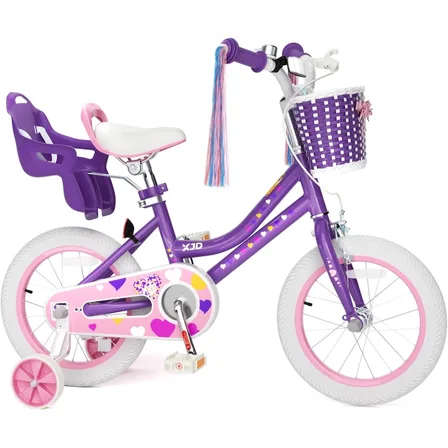
Purple XJD Girls' Bike with Doll Seat & Basket
For girls 71–122 cm tall (about ages 3–7), this XJD girls' bike in Purple pairs …$75.99
$99.99 -

Kids Bike Helmet by XJD for Boys & Girls – Black, Blue, Green, Pink, Purple
The XJD Kids Bike Helmet covers a wide 2-to-8-year age range thanks to two head-…$59.99