

What does 14 inch bike mean
A 14 inch bike means a children’s bicycle built around 14-inch wheels. The number describes wheel size, not the frame or the child’s height.
What the 14-inch label tells you
The label identifies the bicycle’s wheel-size class. It is useful for narrowing the search, but it does not guarantee that every 14-inch bike will fit the same rider. Frame shape, saddle adjustment, handlebar position and control placement can affect how a child sits, stands and steers.
Under the XBikes starting points, a 14-inch bike generally corresponds to ages 3–6 and a rider height of 37–45 inches (94–114 cm). Height is the more useful first comparison. Age overlaps considerably between sizes and should never decide the purchase by itself.
| Wheel label | Age starting point | Rider-height starting point |
|---|---|---|
| 12 Inch | 3–4 | 34–40 in / 86–102 cm |
| 14 Inch | 3–6 | 37–45 in / 94–114 cm |
| 16 Inch | 4–7 | 40–48 in / 102–122 cm |
These ranges overlap intentionally because two children of the same age or height can have different proportions, reach and riding confidence.
Measure the rider before comparing bikes
Measure the child without shoes, using a wall and a level book or similar flat object for total height. Then measure inseam from the floor to the crotch while the child stands naturally. Record both measurements rather than relying on a remembered clothing size or age.
Use measured height to select the likely wheel-size range. Use inseam during the physical fit check: the child needs suitable clearance when standing over the bicycle. Exact clearance and adjustment instructions depend on the bicycle, so follow its product manual or ask a qualified bicycle mechanic rather than applying an invented universal number.
Check the fit on the actual 14-inch bike
The American Academy of Pediatrics advises having the child try the bicycle and avoiding an oversized bike bought only for future growth. With the bike properly assembled and adjusted according to its manual, check whether the rider can:
- stand over the bicycle with appropriate clearance;
- sit in a stable position and reach the handlebars without an awkward stretch;
- steer and turn while remaining in control;
- reach and operate the fitted brake controls reliably; and
- start, stop and put a foot down with confidence.
A rider within the 37–45 inch range may still need a different size if reach, stand-over clearance or control is poor. Likewise, do not move automatically to a 16-inch bike just because the child is near the upper end of the 14-inch range. Compare the actual fit.
How the supplied XBikes options are relevant
Both supplied catalog models include a 14 Inch SKU, as well as 12 Inch and 16 Inch SKUs. That makes them directly relevant to the title and useful for comparing the three overlapping wheel-size starting points, provided the exact variant selected is confirmed before ordering.
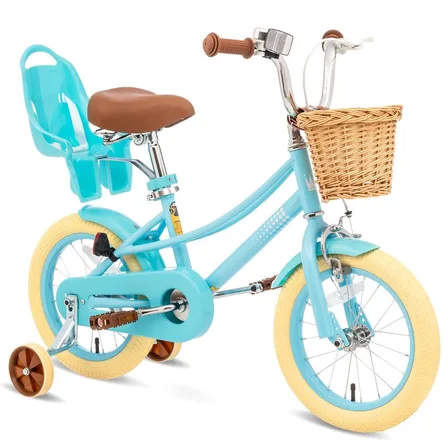
 Blue XJD Girls Bike with Training Wheels – 12/14/16 Inch
This Training Wheel Bike offers 12 Inch, 14 Inch and 16 Inch SKU labels. Its 14 Inch variant directly matches the topic, while the adjacent sizes help compare overlapping height ranges before an individual fit check.
 XJD Boys 12/14/16" Training Wheel Bike – Blue
This Training Wheel Bike is available with 12 Inch, 14 Inch and 16 Inch SKU labels. Consider its 14 Inch option only after checking the rider’s measured height, inseam, reach, brake control and confidence.
Blue XJD Girls Bike with Training Wheels – 12/14/16 Inch is listed in the Training Wheel Bikes category and offers 12 Inch, 14 Inch and 16 Inch SKU labels. The 14 Inch option is the title-matching variant; the other two sizes are comparison choices, not equivalents.
XJD Boys 12/14/16" Training Wheel Bike – Blue is also listed as a Training Wheel Bike with 12 Inch, 14 Inch and 16 Inch SKU labels. Again, select the 14 Inch SKU only if the child’s measurements and hands-on fit check support it.
The supplied facts do not establish dimensions beyond wheel labels, or specify brake type, weight, load limits, materials, assembly details or compatibility. Consult the exact product manual for those points, and use a qualified bicycle mechanic if assembly or adjustment is uncertain.
What to do before the first ride
- Measure height and inseam.
- Use 37–45 inches (94–114 cm) as the 14-inch starting range.
- Have the child try the exact bicycle and verify stand-over, reach, steering, braking and confidence.
- Reject an oversized fit chosen merely to allow room for growth.
- Follow the exact manual for assembly, adjustment and maintenance.
A bicycle helmet is also essential. The U.S. Consumer Product Safety Commission says it should fit properly, sit level and have its straps used according to the helmet manufacturer’s instructions.
The practical decision is simple: treat “14 inch” as the wheel-size label, then choose it only when the child’s measured height, inseam and real-world control all confirm the fit.
Bikes for your next adventure
-

XJD 24-Inch Green Beach Cruiser Bike with U-Brake
This XJD 24-inch beach cruiser in green is made for riders about 4'8" to 5'4" ta…$159.99
$199.99 -

Kids Bike Helmet by XJD for Girls – Pink
The XJD Kids Bike Helmet in Pink is a lightweight multi-sport helmet for girls r…$59.99
$99 -
Girls' Training Wheel Bike by XJD, 12–20 Inch Wheels – Blue
This XJD girls' training wheel bike in Blue covers one of the widest fit ranges …$139
$159