

What frame size bike for 13 year old
For most 13-year-olds, start by comparing a 24-inch bike if they are 54–64 in (137–163 cm) tall, or a 26-inch bike if they are over 60 in (153 cm). Height ranges overlap, so measure the rider and confirm stand-over clearance, reach, brake control and confidence before choosing.
Frame size or wheel size?
Children’s bikes are commonly compared by wheel size, while the frame’s shape and dimensions determine how the bicycle actually feels. Two bikes with the same wheel size can differ in stand-over height, reach and riding position. The title’s question therefore cannot be answered from age or a wheel label alone.
For a 13-year-old, the XBikes starting points are 24-inch wheels for riders 54–64 in (137–163 cm) tall and 26-inch wheels for youth and adults over 60 in (153 cm). A rider between 60 and 64 inches falls within both starting points. That overlap means the better choice must come from an individual fit check, not an assumption that the larger wheel is automatically preferable.
Measure before comparing bikes
- Measure total height: Have the rider stand barefoot against a wall, looking straight ahead. Mark the top of the head and measure from the floor.
- Measure inseam: With feet slightly apart, place a firm, level book between the legs to simulate a saddle. Measure vertically from the floor to the top edge of the book.
- Record riding experience: Note whether the child starts, stops, turns and uses hand brakes confidently. Current control matters when deciding between overlapping sizes.
Use measured height to select the wheel-size range first. Then compare the inseam with the actual stand-over clearance and saddle adjustment information for the exact bicycle. If those measurements are not provided, consult its product manual, seller or a qualified bicycle mechanic rather than estimating.
Perform an in-person fit check
Have the child try the bicycle whenever possible. With the rider straddling the frame, confirm that they can stand over it comfortably rather than being pressed against the frame. The exact clearance needed depends on the bicycle and its design, so follow the product manual instead of inventing a universal number.
Next, seat the rider in a normal riding position. They should be able to hold the handlebar without an awkward stretch, steer smoothly, and operate each brake lever reliably. Check that stopping does not require shifting the hands into an unstable position. Also ask the rider to start, turn, stop and dismount in a controlled area.
A bike that feels intimidating or difficult to control is not a suitable fit simply because the child may grow into it. Do not buy an oversized bicycle for future growth. If both 24-inch and 26-inch options appear plausible, choose according to present stand-over clearance, reach, braking control and confidence.
How the supplied catalog option helps
The 26-Inch XJD Beach Cruiser Bike for Girls – Purple, V-Brake provides useful comparison choices because its supplied variants include 20-inch, 24-inch and 26-inch wheel labels, with the Purple option listed only in 26 Inch. For this question, the 24-inch and 26-inch variants are the relevant starting points; the 20-inch variants correspond to the XBikes range of ages 7–12 and heights 48–60 in (122–152 cm), so they may be relevant only when the rider’s measured height and individual fit support that smaller starting point.
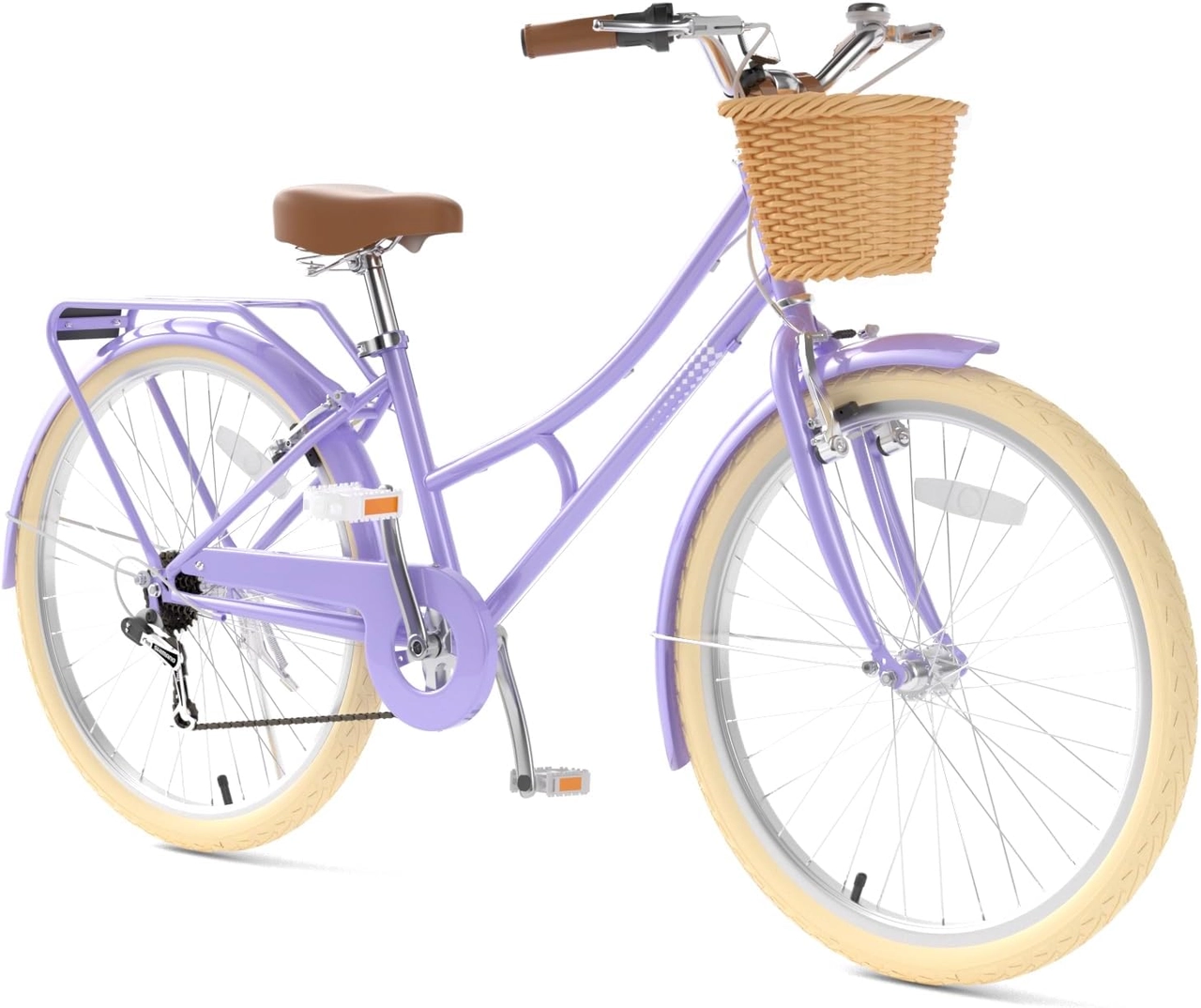
The product title identifies a 26-inch Purple V-brake configuration, but that label does not prove that its frame geometry, reach or brake-lever reach fits a particular 13-year-old. Compare the exact chosen variant, because a 24-inch variant is not equivalent to a 26-inch variant. For assembly, adjustment, maintenance, load limits, compatibility and torque requirements, follow the exact product manual or use a qualified bicycle mechanic.
Make the final 24-inch or 26-inch decision
| Measured rider height | Starting comparison | What decides the fit |
|---|---|---|
| 54–60 in (137–152 cm) | 24 Inch | Stand-over clearance, reach, brake control and confidence |
| Over 60–64 in (over 153–163 cm) | Compare 24 Inch and 26 Inch | Individual fit and present control; do not size up merely for growth |
| Over 64 in (over 163 cm) | 26 Inch starting point | Confirm the exact frame still fits |
These are starting points, not guarantees. If the rider’s measurements sit near a boundary, trying both sizes is especially important. Reject any option that prevents comfortable stand-over, creates an excessive reach, or makes the brakes difficult to operate.
Complete the check before riding
Once the bicycle size is chosen, make sure the rider’s helmet fits properly, sits level and has its straps adjusted according to the helmet manufacturer’s instructions. A helmet does not correct a poorly fitting bicycle.
For a 13-year-old, measure height and inseam now, shortlist 24-inch or 26-inch wheels from the ranges above, and have the child demonstrate comfortable stand-over, steering and braking. Buy the size they can control today—not the larger one they may eventually grow into.
Bikes for your next adventure
-

XJD Girls Bike for Kids Ages 3-8, 12/14/16 Inch with Training Wheels – Purple
The XJD Girls Bike in Purple is a training-wheel bicycle for kids ages 3 to 8, f…$149
$169 -

Pink Girls' 12/14/16" Bike by XJD – Basket & Doll Seat
The XJD Pink Girls' Bike with Basket & Doll Seat is made for riders 71–122 cm ta…$75.99
$99.99 -

Black XJD Kids Bike for Boys – 12, 14 & 16 Inch Sizes
For a son between roughly 3 and 8 years old, the XJD Kids Bike in Black covers t…$169
$199