

What height is a 17 inch bike for
A 17-inch kids’ bike is most likely for a child between the XBikes 16- and 18-inch starting points: measure the rider first, then check actual fit.
Start by checking what “17 inch” means
On a children’s bicycle, 17 inches may describe the wheel diameter, but some listings use a number for the frame instead. Those measurements are not interchangeable. Confirm which measurement appears in the bicycle’s specification or manual before using a sizing comparison.
If it means a 17-inch wheel, XBikes does not provide a separate 17-inch fit range. The useful reference points are therefore the adjacent 16- and 18-inch wheel sizes. A 17-inch bike should not automatically be treated as identical to either one because frame shape, saddle adjustment and reach can change how it fits.
Compare the rider with the adjacent sizes
| Wheel size | XBikes age starting point | XBikes rider-height starting point |
|---|---|---|
| 16 Inch | Ages 4–7 | 40–48 in / 102–122 cm |
| 18 Inch | Ages 5–9 | 43–52 in / 109–132 cm |
These overlapping ranges suggest that a 17-inch-wheel bicycle may be worth trying when the rider falls around the 16- and 18-inch ranges, especially between 43 and 48 inches (109–122 cm). This overlap is only a starting point, not a guaranteed 17-inch fit standard. Height and age cannot reveal whether a particular child can stand over, steer or brake on a particular bicycle.
Use age only as a rough cross-check. A taller five-year-old and a shorter seven-year-old may need different bicycles even though both ages appear in the reference ranges.
Measure height and inseam before choosing
Measure the child without shoes, standing straight against a wall. Mark the top of the head and measure vertically from the floor. Compare that result with the ranges above.
Then measure inseam:
- Have the child stand in socks with feet a natural distance apart.
- Place a firm, thin book between the legs and raise it gently to simulate the bicycle saddle.
- Measure from the floor to the book’s top edge.
Do not convert that inseam measurement into a promised bicycle size without the exact manufacturer’s geometry. Instead, take the measurement to the fit check and compare it with the bicycle’s stand-over clearance and saddle-adjustment information. Follow the exact product manual or ask a qualified bicycle mechanic when those details are unclear.
Make the bicycle pass a real fit check
The American Academy of Pediatrics advises having a child try the bicycle and avoiding an oversized model bought merely for future growth. With the saddle set according to the manual, check that the child can mount and stop without struggling.
- Stand-over: The child should be able to straddle the bicycle with usable clearance and without leaning precariously.
- Reach: The handlebars should be reachable without locking the elbows, stretching the torso or losing steering control.
- Brake control: The child must be able to reach and operate the bicycle’s braking controls confidently. Check the actual model rather than assuming a brake configuration.
- Confidence: Look for controlled starts, turns and stops in a traffic-free practice area. Fear, wobbling or difficulty stopping signals that the fit or setup needs reconsideration.
Also use a properly fitting bicycle helmet. U.S. Consumer Product Safety Commission guidance says it should sit level and its straps should be adjusted according to the helmet manufacturer’s instructions.
How the supplied XBikes options relate
Neither supplied product offers a 17-inch SKU, so these are nearest-size comparison points rather than substitutes for the requested wheel size. The Pink 12/14/16/20" XJD Girls Bike with Training Wheels & Basket and the Light Pink XJD Girls' Bicycle with Basket & Training Wheels each offer 12 Inch, 14 Inch, 16 Inch and 20 Inch labels. Their 16 Inch options provide the closest supplied catalog comparison; their 20 Inch options represent a larger step and must not be treated as equivalent to 17 inches.
 Pink 12/14/16/20" XJD Girls Bike with Training Wheels & Basket
Its 16 Inch SKU is the closest supplied comparison to a 17-inch wheel; its other available labels are 12 Inch, 14 Inch and 20 Inch. It is not an exact 17-inch substitute.
 Light Pink XJD Girls' Bicycle with Basket & Training Wheels
This training-wheel bicycle is available in 12 Inch, 14 Inch, 16 Inch and 20 Inch labels. The 16 Inch option is a nearby comparison point, but the product has no supplied 17-inch SKU.
For context, the XBikes starting point for a 20-inch wheel is ages 7–12 and a height of 48–60 inches (122–152 cm). A child near the 17-inch question should not be moved to 20 inches solely to allow room for growth. Compare measured height, inseam, reach, brake control and present confidence on the exact bicycle.
Make the final 17-inch decision
If “17 inch” is the wheel size, arrange a supervised try-on and use the 16- and 18-inch ranges only to decide whether the trial is reasonable. If it is a frame measurement, consult that exact model’s sizing chart or a qualified bicycle mechanic. Choose the bicycle only when the child can stand over it, reach the controls and stop confidently now; otherwise, try a different size.
Bikes for your next adventure
-
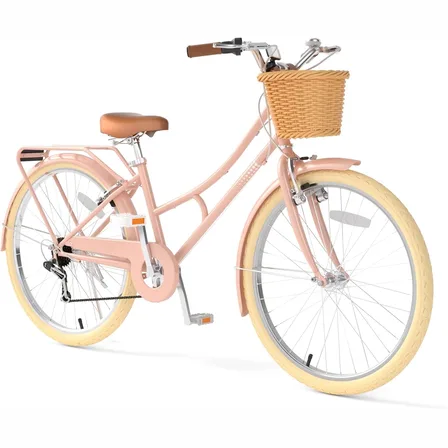
Pink XJD Beach Cruiser Bike, 24"/26", U-Brake
The XJD Pink Beach Cruiser Bike is a single-speed cruiser built for older kids a…$159.99
-
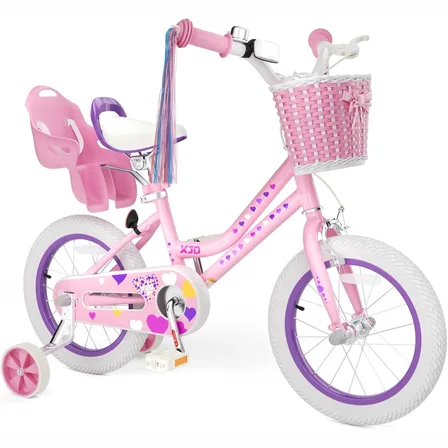
Light Pink XJD Girls' Bicycle with Basket & Training Wheels
The Light Pink XJD Girls' Bicycle with Basket & Training Wheels is a retro-style…$109.99
$129.99 -

XJD Boys 12/14/16" Training Wheel Bike – Blue
The XJD Boys Bike in Blue is a training wheel bike for riders 71–122 cm tall—rou…$169
$199