

What is bicycle for kids
A bicycle for kids is a child-sized cycle selected to match the rider’s body, control, and confidence—not simply their age or room to grow.
What makes a bicycle suitable for a child?
The defining feature is fit. A suitable bicycle lets the child stand over it comfortably, reach the handlebars without stretching, steer predictably, and operate the brakes with control. Wheel size is a useful starting point, but it does not prove that a particular frame fits.
Measure the child’s current height and inseam before comparing bicycles. Then have the child try the exact bicycle whenever possible. Check whether mounting and stopping feel manageable, whether the riding position permits easy steering, and whether the child can reach and use the brake controls. Current confidence matters too: two children of equal height may need different levels of support.
Do not choose an oversized bicycle merely to leave growing room. A bike that is too large can make starting, stopping, steering, and dismounting more difficult.
Use wheel size as a starting point
| Wheel size | Starting age | Rider height |
|---|---|---|
| 12 Inch | 3–4 | 34–40 in / 86–102 cm |
| 14 Inch | 3–6 | 37–45 in / 94–114 cm |
| 16 Inch | 4–7 | 40–48 in / 102–122 cm |
| 18 Inch | 5–9 | 43–52 in / 109–132 cm |
| 20 Inch | 7–12 | 48–60 in / 122–152 cm |
| 24 Inch | 10–14 | 54–64 in / 137–163 cm |
| 26 Inch | Youth and adults | Over 60 in / 153 cm |
Because the ranges overlap, age should never make the final decision. Begin with measured height, identify the likely wheel sizes, and compare the actual stand-over clearance, inseam fit, reach, brake control, and handling. If the child falls between sizes, the bicycle that provides better control is more appropriate than the larger option chosen for future growth.
When training-wheel bicycles are relevant
Training-wheel models are relevant when a child is learning to pedal and the family wants temporary side support. They are not automatically appropriate for every beginner, and training wheels do not correct a bicycle that is too large or otherwise poorly fitted. A child already balancing independently may not need them.
The supplied XBikes options help answer the title for families comparing training-wheel bicycles in three starting wheel sizes: both catalog models are offered with 12 Inch, 14 Inch, and 16 Inch SKU labels. Those labels narrow the comparison, but the child must still try the selected size and demonstrate comfortable control.
 Blue XJD Girls Bike with Training Wheels – 12/14/16 Inch
A training-wheel bicycle offered in 12 Inch, 14 Inch, and 16 Inch labels. It is relevant when the rider’s measurements and individual fit check support one of those sizes.
 XJD Boys 12/14/16" Training Wheel Bike – Blue
A blue Training Wheel Bike available with 12 Inch, 14 Inch, and 16 Inch labels. Consider it only after checking the child’s height, inseam, reach, brake control, and confidence.
How the two supplied products compare
Blue XJD Girls Bike with Training Wheels – 12/14/16 Inch is categorized as a Training Wheel Bike and is available in 12 Inch, 14 Inch, and 16 Inch labels.
XJD Boys 12/14/16" Training Wheel Bike – Blue is also categorized as a Training Wheel Bike and has the same three available size labels: 12 Inch, 14 Inch, and 16 Inch.
Based on the supplied facts, the meaningful verified similarities are their category and available wheel-size labels. Their titles use different gender wording, but that wording is not fit evidence. Choose by the individual child’s measurements, reach, brake control, comfort, and confidence rather than by “girls” or “boys” in a catalog title.
These products are relevant only when the likely fit falls within the supplied 12, 14, or 16 Inch starting ranges and training wheels suit the rider’s present learning needs. They are not relevant when measurements point toward an 18 Inch or larger bicycle, or when the child needs a different learning setup.
What to check before deciding
- Measure now: record the child’s height and inseam without estimating from age.
- Shortlist sizes: use the XBikes ranges to find one or two likely wheel sizes.
- Try the exact bicycle: confirm comfortable stand-over, an unstrained reach, controlled steering, and accessible brake operation.
- Observe confidence: ask the child to mount, start, stop, and dismount in a controlled setting with suitable adult supervision.
- Confirm the setup: follow the exact product manual for assembly, maintenance, load limits, compatibility, and torque. If anything is uncertain, use a qualified bicycle mechanic.
Include a properly fitted helmet
A child should wear a bicycle helmet that fits properly. It should sit level on the head, and its straps should be adjusted and used according to the helmet manufacturer’s instructions. A helmet is separate from bicycle sizing: it does not make an oversized or poorly controlled bicycle suitable.
The decision to make next
Measure the rider, use height to shortlist the wheel size, and arrange an individual fit check. Consider either supplied 12/14/16 Inch training-wheel model only if the child can comfortably stand over, reach, steer, and brake on that exact bicycle; otherwise choose a more suitable size or setup.
Bikes for your next adventure
-

XJD Girls Bike for Kids Ages 3-8, 12/14/16 Inch with Training Wheels – Purple
The XJD Girls Bike in Purple is a training-wheel bicycle for kids ages 3 to 8, f…$149
$169 -
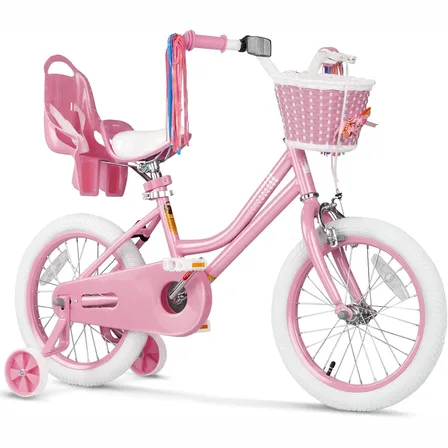
XJD Pink Girls' Bike – Kids 12/14/16 Inch Training Wheel Bicycle
The XJD Pink Girls' Bike is a training-wheel bicycle for girls ages 3 to 8 (ride…$149
$169 -
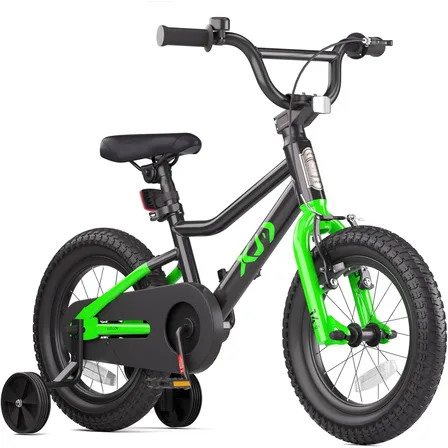
Black XJD Kids' BMX Bicycle with Training Wheels
The XJD Kids' BMX Bicycle with Training Wheels is built for children roughly 3 t…$99.99
$119.99