

What is bike size 20 inch
A 20-inch bike is a children’s bicycle built around 20-inch wheels. At XBikes, it is a starting point for riders 48–60 inches (122–152 cm) tall, typically ages 7–12, but the child must still pass an individual fit check.
What “20 inch” tells you
The size refers to the bicycle’s wheel-size class, not the child’s height and not one universal frame measurement. Two bicycles with 20-inch wheels can still differ in saddle position, stand-over space and reach, so the label narrows the search without confirming the fit.
Use age only as a rough starting point. For a 20-inch bike, the XBikes range is ages 7–12, but measured height and actual control matter more. Do not choose a bicycle that is currently oversized merely to leave room for growth.
Measure before comparing
Measure the child while they are wearing the shoes they will normally ride in. Record standing height from the floor to the top of the head. Then measure inseam from the floor to the crotch, with the child standing upright and feet slightly apart.
Compare standing height first with the XBikes 20-inch starting range of 48–60 inches (122–152 cm). Keep the inseam measurement ready for the physical stand-over check; a wheel-size chart alone cannot tell you whether a particular frame leaves suitable space.
| Check | What to compare or observe |
|---|---|
| Standing height | 48–60 in (122–152 cm) is the XBikes starting range for 20-inch wheels. |
| Inseam and stand-over | The child should be able to straddle the bicycle without the frame obstructing a comfortable, controlled stance. |
| Reach | They should reach the handlebar without stretching, locking their arms or losing a balanced posture. |
| Brake control | They must be able to reach and operate the bicycle’s controls confidently. |
| Confidence | Starting, steering, stopping and getting a foot down should feel manageable now. |
How to confirm the fit in person
Have the child try the exact bicycle. Begin with stand-over: ask them to straddle it with both feet planted. Next, check that they can settle into a natural riding position and turn the handlebar without their knees, arms or balance becoming awkward.
Ask them to demonstrate that they can reach and use the brakes or other fitted controls. A child whose height falls within the chart may still need another size if the reach, stand-over position or controls do not suit their proportions or present riding ability.
A 20-inch bike is too large right now if the child cannot stand over it comfortably, must stretch to steer, cannot operate the brakes reliably, or appears unable to start and stop under control. It may be too small if the riding position is cramped or the bicycle cannot be adjusted to provide a workable posture. Follow the exact product manual for permitted adjustments; if fit or assembly is uncertain, use a qualified bicycle mechanic.
Where the supplied product fits the question
The Light Pink XJD Girls' Bicycle with Basket & Training Wheels is directly relevant because its supplied size labels include 20 Inch. The same catalog entry also lists 12 Inch, 14 Inch and 16 Inch, which helps distinguish the requested 20-inch option from smaller wheel-size choices. Its title identifies a basket and training wheels, but those features do not prove that the 20-inch version fits a particular rider.

Select the size label carefully when viewing this product. Do not assume that another listed size is equivalent to 20 Inch, and do not infer fit from the styling or product title. The decisive checks remain the child’s measured height, inseam, reach, brake control and confidence on the exact bicycle.
What to do if the child is near a boundary
A rider below 48 inches (122 cm) is outside the XBikes 20-inch starting range. A rider above 60 inches (152 cm) is also outside it. Near either boundary, do not choose by age or by the desire to make the bike last longer; compare the actual fit and control of candidate sizes.
For context, the adjacent XBikes starting points are 18 Inch for heights 43–52 inches (109–132 cm), typically ages 5–9, and 24 Inch for heights 54–64 inches (137–163 cm), typically ages 10–14. These overlapping ranges are comparison starting points, not proof that either neighboring size will fit.
Finish with the safety check
Once the bicycle fits, add a properly fitting bicycle helmet. It should sit level and its straps should be used according to the helmet manufacturer’s instructions. Consult the bicycle’s exact manual for assembly, maintenance, load limits, compatibility and any torque requirements not stated in the catalog.
The practical decision is simple: consider 20 Inch when the rider measures 48–60 inches tall, then buy it only if the child can comfortably stand over, reach, steer, brake, start and stop on that exact bike today.
Bikes for your next adventure
-

XJD Kids Bike for Girls – Pink, 12/14/16/20 Inch with Training Wheels
The XJD Kids Bike for Girls in Pink is a training-wheel bike built to carry your…$139
$159 -
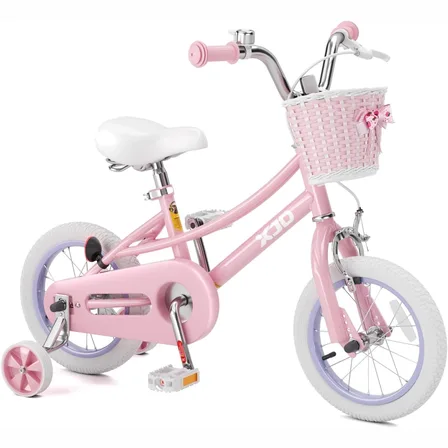
Pink 12/14/16/20" XJD Girls Bike with Training Wheels & Basket
The Pink XJD Girls Bike with Training Wheels & Basket is a first-bike pick f…$65.99
$75.99 -

Blue XJD Kids Bike Helmet for Boys & Girls
The Blue XJD Kids Bike Helmet is a lightweight, adjustable multi-sport helmet fo…$59.99
$99