

What is the best bike for a 1 year old
For most 1-year-olds, the best bike is not a pedal bicycle. Choose a low, age-appropriate ride-on or balance-style product only when the child fits it, can control it, and meets its manufacturer’s requirements.
Why a pedal bike is usually not the right choice
XBikes’ smallest bicycle starting point is a 12-inch wheel bike, listed for ages 3–4 and rider heights of 34–40 inches (86–102 cm). A typical 1-year-old therefore falls below the starting guidance for the smallest catalog bicycle. Age is only a starting point, but it should not be ignored when height, coordination, reach, and control also indicate that a bicycle is too large.
Do not buy an oversized bicycle for a child to grow into. HealthyChildren guidance recommends having the child try the bicycle and checking stand-over room, control, and brake reach. A bike that cannot be managed now is not made suitable by its future usefulness.
Measure before comparing anything
Measure the child’s standing height and inseam without shoes. For the inseam, measure from the floor to the crotch while the child stands upright. Record both measurements rather than estimating from clothing size or age.
Next, compare those measurements with the product manufacturer’s fit requirements. For any ride-on or balance-style option, check that the seat can be adjusted according to its manual so the child can place their feet securely on the ground. The child should not have to lean sharply, stretch, or stand on tiptoe to support the product.
- Height and inseam: Do the child’s measurements fall within the stated fit range?
- Stand-over: Can the child straddle the product without being forced onto tiptoe?
- Reach: Can the child hold and turn the handlebar without overreaching?
- Control: Can the child start, stop, steer, and dismount with calm assistance?
- Brakes: If hand controls are present, can the child reach and operate them as directed?
What to look for at one year old
Development varies widely at this age. The relevant question is not whether a product is marketed as a “first bike,” but whether this particular child can sit or stand as required, keep the product upright, steer deliberately, stop, and get off without becoming trapped beneath it.
Use only a product explicitly intended by its manufacturer for the child’s present age, measurements, and abilities. Follow its manual for supervision, riding surface, assembly, load limits, adjustments, and maintenance. If any component, adjustment, or assembly step is uncertain, consult a qualified bicycle mechanic rather than improvising.
Are the supplied XBikes bicycles relevant?
The two catalog choices help establish the lower end of the available pedal-bike comparison: both offer a 12-inch SKU, which is XBikes’ smallest listed wheel-size starting point. That makes them useful as a future-fit reference, but generally not a present recommendation for a 1-year-old who falls below the 12-inch guidance.
 XJD Kids Bike for Girls – Pink, 12/14/16/20 Inch with Training Wheels
This training-wheel bicycle offers 12-, 14-, 16-, and 20-inch labels. Its smallest 12-inch option starts at ages 3–4 and 34–40 inches, so it is generally a future comparison rather than a current fit for a 1-year-old.
 XJD Pink Girls' Bike – Kids 12/14/16 Inch Training Wheel Bicycle
Available in 12-, 14-, and 16-inch labels, this training-wheel bicycle begins with a 12-inch option. XBikes places that size at ages 3–4 and 34–40 inches, with measured fit and control still required.
XJD Kids Bike for Girls – Pink, 12/14/16/20 Inch with Training Wheels is categorized as a training-wheel bike and is available in 12-, 14-, 16-, and 20-inch labels. Only the 12-inch version is the smallest relevant comparison, beginning at ages 3–4 and 34–40 inches (86–102 cm), subject to an individual fit check.
XJD Pink Girls' Bike – Kids 12/14/16 Inch Training Wheel Bicycle is also categorized as a training-wheel bike, with 12-, 14-, and 16-inch labels. Its 12-inch option has the same XBikes starting point. Nothing in the supplied catalog facts establishes either product as appropriate for a 1-year-old.
Training wheels do not correct a frame that is too tall, a handlebar that is out of reach, or controls the child cannot operate. The wheel-size label is only a starting point; measured fit and demonstrated control decide whether to proceed.
Helmet and riding setup
Whenever the child rides, use a bicycle helmet that fits properly. U.S. Consumer Product Safety Commission guidance says the helmet should sit level and its straps should be used according to the helmet manufacturer’s instructions. An oversized helmet is not an appropriate grow-into purchase.
Provide close adult supervision and use only the environment permitted by the product manual. Before each session, follow the manual’s inspection instructions. Do not invent torque settings, substitute incompatible parts, or assume assembly is correct; use the exact manual or ask a qualified bicycle mechanic.
What to do next
- Measure the child’s height and inseam.
- Check whether the child meets the intended-use and fit requirements of a low ride-on or balance-style product.
- Let the child try it while closely supervised, checking support, reach, steering, stopping, and dismounting.
- Revisit a 12-inch pedal bike only when the child approaches the 34–40-inch (86–102 cm) range, the age 3–4 starting point, and passes a real fit and control check.
For a 1-year-old today, choose the correctly fitting, manufacturer-approved pre-pedal option—or wait—rather than sizing up to either supplied training-wheel bicycle.
Bikes for your next adventure
-
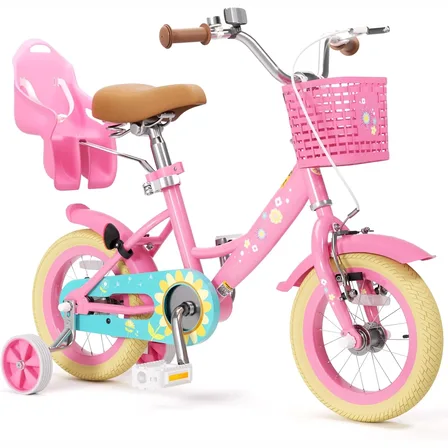
Flower Pink XJD Girls Bike with Doll Seat & Basket
The XJD Flower Pink girls' bike is made for riders 71–122 cm tall (roughly ages …$69.99
-

Pink Girls' 12/14/16" Bike by XJD – Basket & Doll Seat
The XJD Pink Girls' Bike with Basket & Doll Seat is made for riders 71–122 cm ta…$75.99
$99.99 -

Light Purple XJD Toddler Bike Helmet, Adjustable, Size XS (46–51 cm)
This Light Purple XJD toddler bike helmet is made for the smallest riders — the …$20.39