

What is the best bike for a 9 year old
For most 9-year-olds, start by trying a 20-inch bike, then confirm the fit using measured height, inseam, reach, brake control and confidence.
The short answer: usually 20 inches, but measure first
XBikes places 20-inch bikes at ages 7–12 and rider heights of 48–60 inches (122–152 cm), so that is the most useful starting point for a typical 9-year-old. It is not an automatic answer: two children of the same age can need different sizes or cockpit setups.
An 18-inch bike covers heights of 43–52 inches (109–132 cm) and ages 5–9, so it may suit a shorter 9-year-old. A 24-inch bike starts at 54 inches (137 cm) and ages 10–14; a tall 9-year-old could therefore be ready for one after a successful fit check. A 26-inch bike is a youth-and-adult size for riders over 60 inches (153 cm), not the default choice at this age.
| Wheel size | XBikes starting range | What it means for a 9-year-old |
|---|---|---|
| 18 Inch | 43–52 in / 109–132 cm; ages 5–9 | Check for a shorter rider |
| 20 Inch | 48–60 in / 122–152 cm; ages 7–12 | Best starting size to try for most |
| 24 Inch | 54–64 in / 137–163 cm; ages 10–14 | Consider for a taller rider if control is good |
| 26 Inch | Over 60 in / 153 cm; youth and adults | Relevant only above the stated height and after a fit check |
Measure the child before comparing bikes
Measure height without shoes against a wall. Then measure inseam from the floor to the crotch while the child stands upright with feet slightly apart. Use height to identify the likely wheel sizes, but use inseam and an in-person trial to decide whether a particular frame works.
During the trial, check that the child can stand over the bicycle rather than being trapped against the frame. Seated, they should be able to reach the handlebar without an uncomfortable stretch or cramped posture. They must also be able to operate the brakes reliably with their hands in a normal riding position.
Do not move up a size merely to leave room for growth. An oversized bicycle can make starting, stopping, steering and dismounting harder. If the child cannot control the larger option calmly, choose the smaller properly fitting bike or keep comparing models.
Use confidence as part of the fit decision
A technically plausible wheel size can still be wrong for the rider today. Ask the child to start, ride a straight line, turn, brake and put a foot down in a controlled practice area. Watch for hesitation caused by excessive reach, difficulty squeezing the brakes, or trouble managing the bicycle at low speed.
A confident rider near the overlap between 20 and 24 inches may be able to compare both. A newer or cautious rider may control the smaller suitable option more comfortably. Wheel diameter alone does not determine frame clearance, reach or brake accessibility, which is why the actual trial matters.
How the supplied XBikes options fit this decision
The two catalog options help bracket the decision: one includes a 20-inch selection in a training-wheel-bike listing, while the cruiser listing offers 20-, 24- and 26-inch selections. They are useful comparisons only when the relevant size matches the child's measurements and the complete bicycle passes the individual control checks.
 Pink 12/14/16/20" XJD Girls Bike with Training Wheels & Basket
The 20 Inch selection is the relevant starting point for many 9-year-olds. This training-wheel-bike listing also includes 12, 14 and 16 Inch labels, but measured fit and current confidence should decide suitability.
 26-Inch XJD Beach Cruiser Bike for Girls – Purple, V-Brake
Available in 20, 24 and 26 Inch SKU labels across listed colors. Start with 20 Inch; consider 24 Inch for a rider at least 54 inches tall, while 26 Inch is relevant only over 60 inches.
20-inch training-wheel listing
The Pink 12/14/16/20" XJD Girls Bike with Training Wheels & Basket has 12-, 14-, 16- and 20-inch SKU labels. For a 9-year-old, the 20-inch selection is the relevant one to investigate because its XBikes starting range is ages 7–12 and 48–60 inches (122–152 cm). The smaller selections fall below the normal age starting point for this question, although measured fit still takes priority.
Because this listing is categorized as a training-wheel bike, it may be pertinent when the family specifically wants that product type. Do not assume training wheels are required from age alone; compare the child's current balance and confidence, and consult the exact product manual or a qualified bicycle mechanic for assembly, adjustment and compatibility questions.
Cruiser listing with three possible wheel sizes
The 26-Inch XJD Beach Cruiser Bike for Girls – Purple, V-Brake is categorized as a beach cruiser bike. Its available SKU labels include 20-, 24- and 26-inch options in the listed colors, although Purple is supplied only with the 26-inch label.
Start with its 20-inch options for a rider measuring 48–60 inches (122–152 cm). Consider its 24-inch options only when the child is at least 54 inches (137 cm) and can comfortably manage stand-over, reach and braking. Its 26-inch options become relevant only over 60 inches (153 cm). The exact title is a catalog name, not evidence that every 9-year-old fits the Purple 26-inch selection.
Make the final choice in this order
- Measure height and inseam.
- Use 20 inches as the first trial size unless the measured height points toward 18 or 24 inches.
- Check stand-over space, comfortable handlebar reach and dependable access to the brakes.
- Have the child demonstrate controlled starting, steering, braking and stopping.
- Fit a bicycle helmet so it sits level, fits properly and uses its straps according to the helmet manufacturer's instructions.
For a 9-year-old, choose the 20-, 18- or occasionally 24-inch bike that the child can control now—not the largest bicycle they might grow into. If none passes every fit and control check, keep looking rather than forcing a catalog size to work.
Bikes for your next adventure
-
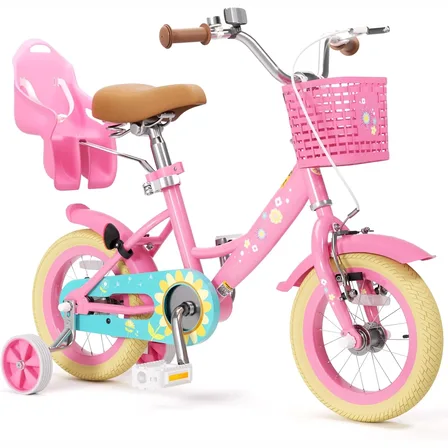
Flower Pink XJD Girls Bike with Doll Seat & Basket
The XJD Flower Pink girls' bike is made for riders 71–122 cm tall (roughly ages …$69.99
-

Pink Girls' 12/14/16" Bike by XJD – Basket & Doll Seat
The XJD Pink Girls' Bike with Basket & Doll Seat is made for riders 71–122 cm ta…$75.99
$99.99 -

Light Purple XJD Toddler Bike Helmet, Adjustable, Size XS (46–51 cm)
This Light Purple XJD toddler bike helmet is made for the smallest riders — the …$20.39