

What is the best child seat for a bike
The best child seat for a bike is one that fits your child, your bicycle and your riding needs, with compatibility confirmed by the seat and bike manuals.
Start with compatibility, not a product name
Child bike seats are not universal. Before comparing comfort or mounting position, identify your bicycle’s exact make, model, frame size and year. Note whether it has a rear rack, rack mounting points, and enough clear space around the frame, saddle, wheel and cables.
Then check the child-seat manufacturer’s compatibility instructions against the bicycle manual. Confirm the permitted mounting method, child size limits, bicycle requirements and any restrictions involving racks, frames or components. If either manual leaves the combination unclear, ask the manufacturer or a qualified bicycle mechanic. Do not improvise a mount or invent a substitute fastener, torque value or load limit.
Measure the child and the bicycle
Record the child’s current height and weight, then compare both with the exact seat manual. Also check how the child sits in the seat: the harness must adjust correctly, the feet must reach and remain contained by the intended supports, and the helmet must not be pushed forward by the seat back.
On the bicycle, measure or inspect the mounting area specified by the seat maker. Depending on the design, that may include frame-tube dimensions, rack dimensions, saddle clearance or space above the rear wheel. A seat that technically attaches but interferes with steering, pedaling, braking, cables or the rider’s position is not an appropriate match.
Compare front, rear and rack-mounted seats
| Seat type | What to compare |
|---|---|
| Front-mounted | Steering space, knee clearance, cockpit access and the child’s effect on handling. |
| Rear frame-mounted | Approved frame location, saddle clearance, wheel clearance and mounting compatibility. |
| Rear rack-mounted | Whether both the rack and bicycle are approved for that seat and the stated load. |
No mounting position is automatically best for every family. Choose only after confirming that the complete combination is permitted and that the adult can start, steer, stop and dismount with control. Follow the exact manuals for assembly, maintenance, fastener checks and torque.
Check the features that affect everyday use
Once compatibility is established, compare the parts you will use on every ride:
- A harness that adjusts securely to the child’s current body size.
- Foot supports and retention that fit the child and keep feet away from moving parts.
- A mounting and removal process you can perform exactly as instructed.
- Enough clearance for the child’s helmet and the adult rider’s normal position.
- Cleaning, inspection and replacement guidance that suits regular use.
Inspect the seat and mount before each ride according to the manufacturer’s directions. A bicycle helmet must fit properly, sit level and have its straps adjusted according to its manufacturer’s instructions. A helmet does not correct an incompatible seat or bicycle.
Where the supplied XBikes product is relevant
XJD Girls Bike for Kids Ages 3-8, 12/14/16 Inch with Training Wheels – Purple is a child bicycle in the Training Wheel Bikes category, offered with 12 Inch, 14 Inch and 16 Inch SKU labels. It is not a child passenger seat and should not be treated as a substitute. It is relevant only if the decision is shifting from carrying the child to selecting a bicycle the child rides.
These catalog options help answer the title by clarifying that a ride-on child bicycle is a different purchase from a child seat, while providing nearby size comparison points if independent riding is the real goal.

The age wording in the product’s exact title is a catalog label, not proof of fit. XBikes uses these starting points: 12 Inch for 34–40 in / 86–102 cm, ages 3–4; 14 Inch for 37–45 in / 94–114 cm, ages 3–6; and 16 Inch for 40–48 in / 102–122 cm, ages 4–7. Measure the rider and prioritize height, inseam, reach, brake control and current confidence over age. Have the child try the bicycle, check stand-over and control, and do not buy an oversized bike merely for growth.
Make the decision
- Decide whether you need a passenger seat or a bicycle the child rides.
- For a passenger seat, record the child’s height and weight plus the bicycle’s exact identity and mounting details.
- Eliminate every seat whose manual does not explicitly permit the child-and-bike combination.
- Among compatible choices, compare harness fit, foot containment, helmet clearance and adult handling.
- Have a qualified bicycle mechanic resolve uncertain compatibility or installation details.
The best child seat is therefore the compatible one that fits the child now and lets the adult retain confident control—not the one chosen by age wording, appearance or room to grow.
Bikes for your next adventure
-
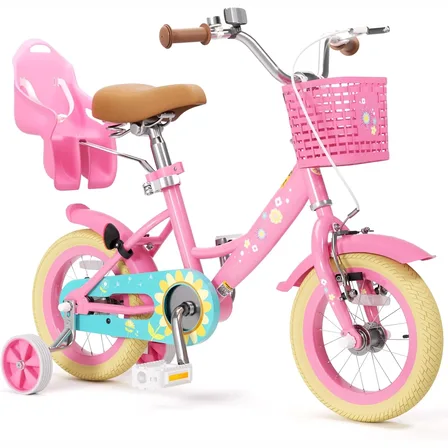
Flower Pink XJD Girls Bike with Doll Seat & Basket
The XJD Flower Pink girls' bike is made for riders 71–122 cm tall (roughly ages …$69.99
-

Kids Bike Helmet by XJD for Girls – Pink
The XJD Kids Bike Helmet in Pink is a lightweight multi-sport helmet for girls r…$59.99
$99 -

Light Purple XJD Toddler Bike Helmet, Adjustable, Size XS (46–51 cm)
This Light Purple XJD toddler bike helmet is made for the smallest riders — the …$20.39