

What is the best size bike for 5 year old
For most 5-year-olds, start by comparing a 14-inch and 16-inch bike. Choose by measured height and fit—not age—and never size up just for growth.
Use height to narrow the wheel size
Measure your child without shoes, standing straight against a wall. The XBikes starting ranges place a 14-inch bike at 37–45 in (94–114 cm), a 16-inch bike at 40–48 in (102–122 cm), and an 18-inch bike at 43–52 in (109–132 cm).
This overlap is important: two children who are both five may need different sizes. A child below 40 in (102 cm) is more likely to begin with a 14-inch bike. From 40 to 45 in (102–114 cm), compare 14-inch and 16-inch models in person. Above 45 in (114 cm), start with 16 inches and consider 18 inches only when the complete fit check supports it.
| Measured height | Useful starting comparison |
|---|---|
| 37–40 in / 94–102 cm | 14 inch |
| 40–45 in / 102–114 cm | 14 and 16 inch |
| 45–48 in / 114–122 cm | 16 inch |
| 48–52 in / 122–132 cm | 16 and 18 inch |
These are starting points, not automatic prescriptions. The complete XBikes ranges are 14 inches for ages 3–6, 16 inches for ages 4–7, and 18 inches for ages 5–9, but measured fit and control take priority over age.
Measure inseam before choosing
Have the child stand in socks with feet slightly apart. Place a firm, thin book between the legs, raise it gently to simulate the bicycle saddle, and measure from the floor to the book’s top edge. Record the result rather than estimating from trouser size.
Compare that measurement with the actual stand-over clearance and minimum saddle position of the exact bicycle. Those dimensions are not provided in the catalog facts here, so check the product manual or confirm them with a qualified bicycle mechanic. Wheel size alone cannot tell you whether the frame will clear the child comfortably.
Perform the fit check on the actual bike
Have your child try the bicycle. A suitable candidate should let the child stand over the frame without being trapped by it, mount and dismount confidently, and sit in a position that does not force an uncomfortable stretch.
- Stand-over: Check that the child can straddle the bike securely rather than balancing on tiptoe against the frame.
- Reach: The child should hold the handlebar and steer through turns without leaning or stretching excessively.
- Brake control: Confirm that the child can reach and operate the fitted braking controls reliably. Follow the exact product manual for their operation or adjustment.
- Confidence: Ask the child to start, stop, turn and put a foot down. Hesitation or loss of control is a reason to reassess the size.
Do not choose an oversized bicycle merely to leave room for growth. If two wheel sizes match the height chart, the bike the child can control now is the better fit.
When the supplied catalog options are relevant
The Girls 12/14/16 Inch Kids Bike by XJD with Training Wheels – Peach and the XJD Light Purple Girls Bike with Basket, Training Wheels, 12/14/16/20 Inch are relevant because both are categorized as training-wheel bikes and both have supplied 14-inch and 16-inch SKU labels—the two sizes most often worth comparing for a five-year-old. Their supplied SKU choices also include 12 inches.
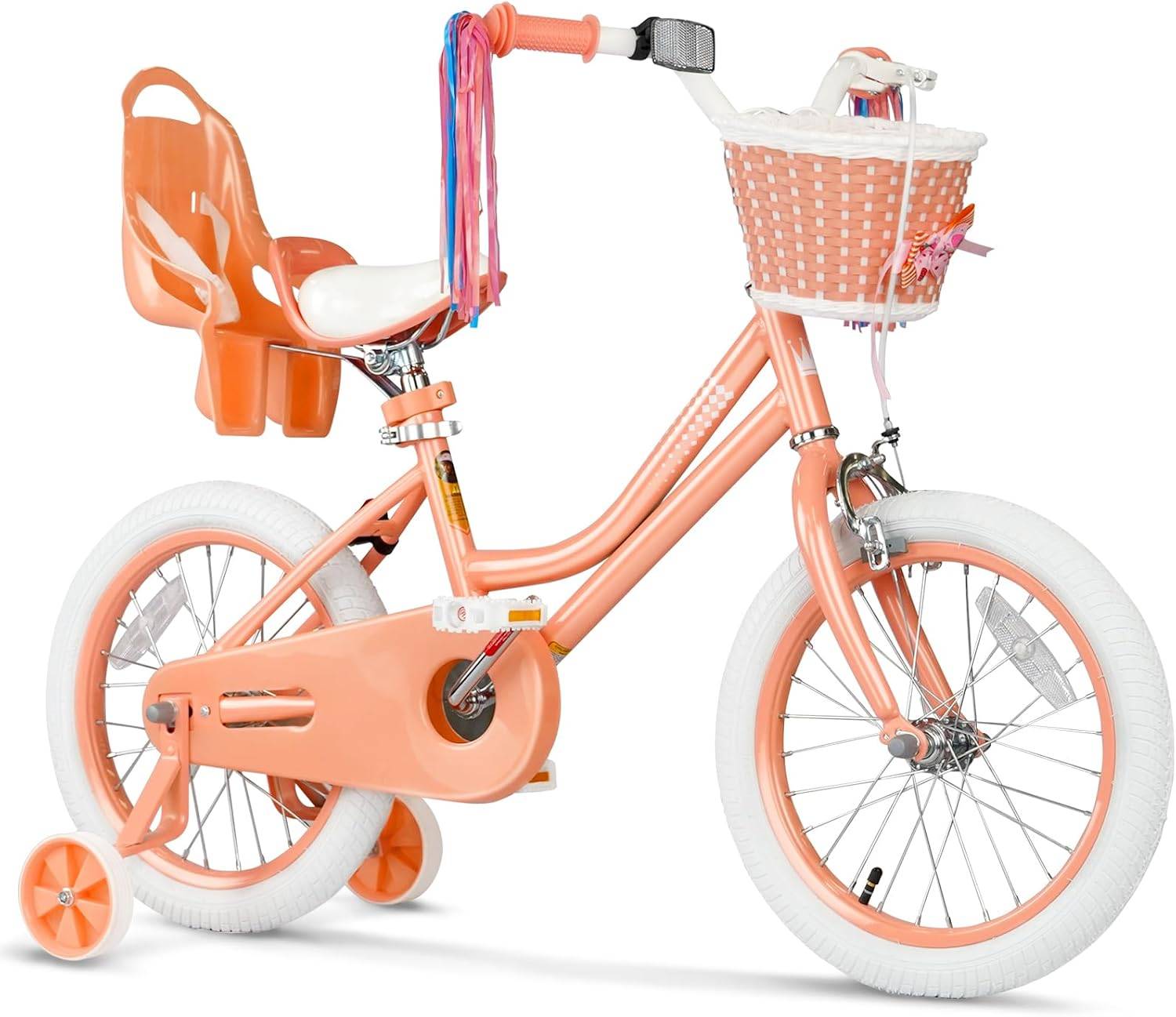 Girls 12/14/16 Inch Kids Bike by XJD with Training Wheels – Peach
Available in 12-, 14- and 16-inch SKU labels with training wheels; its 14- and 16-inch choices are relevant for a five-year-old when measured height and an individual fit check support them.
 XJD Light Purple Girls Bike with Basket, Training Wheels, 12/14/16/20 Inch
A training-wheel bike with supplied 12-, 14- and 16-inch SKU labels. Compare its 14- and 16-inch choices using the child’s measured height, inseam, reach, brake control and confidence.
Consider either product when the child’s height and hands-on fit point to 14 or 16 inches and training wheels suit the child’s current confidence. A 12-inch SKU starts at ages 3–4 and 34–40 in (86–102 cm), so it is relevant only for a particularly short five-year-old whose individual fit check supports it.
Neither supplied product provides an 18-inch SKU label. If your child measures 43–52 in (109–132 cm) and fits an 18-inch bicycle better, these catalog options may not be appropriate. Although the second exact title contains “20 Inch,” the supplied available SKU labels list only 12, 14 and 16 inches; do not assume a 20-inch choice from the title alone.
Complete the decision safely
Once one size passes the stand-over, reach, braking and confidence checks, follow that exact bicycle’s manual for assembly, adjustment and maintenance. Use a qualified bicycle mechanic when instructions or fit remain uncertain. Do not invent or transfer torque settings, load limits or compatibility guidance between models.
Finish with a properly fitted bicycle helmet. It should sit level and be secured with its straps according to the helmet manufacturer’s instructions.
For a five-year-old, measure height and inseam today, try 14-inch and 16-inch candidates where the height ranges overlap, and buy only the size the child can comfortably mount, steer, brake and stop now.
Bikes for your next adventure
-

Flower Pink XJD Girls Bike with Doll Seat & Basket
The XJD Flower Pink girls' bike is made for riders 71–122 cm tall (roughly ages …$69.99
-

Pink Girls' 12/14/16" Bike by XJD – Basket & Doll Seat
The XJD Pink Girls' Bike with Basket & Doll Seat is made for riders 71–122 cm ta…$75.99
$99.99 -

Light Purple XJD Toddler Bike Helmet, Adjustable, Size XS (46–51 cm)
This Light Purple XJD toddler bike helmet is made for the smallest riders — the …$20.39