

What's a good size bike for a 5 year old
For most 5-year-olds, start by comparing 14-, 16-, and 18-inch bikes—but choose by measured height, inseam, reach, brake control, and confidence, not age alone.
Which wheel size should you check first?
A five-year-old falls within several overlapping XBikes starting ranges. That is why age cannot produce one correct size by itself. Measure the child’s height without shoes, then use the following ranges to narrow the bikes they should actually try.
| Wheel size | XBikes age starting point | Rider height starting point |
|---|---|---|
| 14 Inch | Ages 3–6 | 37–45 in / 94–114 cm |
| 16 Inch | Ages 4–7 | 40–48 in / 102–122 cm |
| 18 Inch | Ages 5–9 | 43–52 in / 109–132 cm |
For example, a child who is 41 inches tall falls within the 14- and 16-inch starting ranges, while a child who is 46 inches tall falls within the 16- and 18-inch ranges. Overlap means both sizes deserve a fit check; it does not mean they fit identically.
A 12-inch bike has a starting range of ages 3–4 and heights of 34–40 inches / 86–102 cm. A 20-inch bike starts at ages 7–12 and heights of 48–60 inches / 122–152 cm. Those sizes generally sit outside the age starting point for a five-year-old, although measured height and an individual fit check remain more useful than a birthday.
Measure height and inseam before shopping
Record standing height first. For inseam, have the child stand in socks with feet slightly apart and measure from the floor to the top of the inside leg. Inseam is not used to calculate a wheel size from the supplied chart, but it helps you judge stand-over clearance when the child tries a specific bicycle.
Bring both measurements when comparing models. Frame shapes can differ even when wheel labels match, so “16 Inch” alone cannot prove that a bicycle fits. Clothing and footwear similar to what the child will ride in can also make the trial more realistic.
What should happen during the fit check?
Have the child try the bicycle rather than buying an oversized model for future growth. During the trial, check these points:
- Stand-over: The child should be able to straddle the bicycle with usable clearance and feel stable rather than trapped by the frame.
- Starting and stopping: They should be able to get on, set off, and stop without the bicycle overwhelming them.
- Reach: Their hands should reach the controls comfortably without an exaggerated stretch or locked arms.
- Brake control: Confirm that the child can reach and operate the bicycle’s braking controls. Do not assume this from wheel size.
- Steering: Ask them to turn, ride a simple line, and look ahead while remaining in control.
- Confidence: Hesitation, tipping, or difficulty correcting direction can indicate that the bike is too large or otherwise unsuitable, even when height appears to match the chart.
If two wheel sizes match the height range, choose according to the better complete fit and easier control—not the larger number.
How the supplied catalog option helps
The XJD Boys & Girls BMX Bike with Training Wheels, 12/14/16" – Blue is listed in Kids’ BMX Bikes and has 12 Inch, 14 Inch, and 16 Inch SKU labels. Those choices make it useful for comparing the two most common starting candidates here—14 and 16 inches—while the 12-inch option provides a smaller comparison point. Its title identifies training wheels, but that detail does not establish fit; use the same measurements and hands-on checks for every SKU.

This product does not offer a supplied 18-inch SKU, so a child whose measurements and control point toward 18 inches will need a different catalog option. Do not treat its 16-inch version as equivalent to an 18-inch bicycle or size down merely because it is shown here.
Control and setup matter after sizing
Current riding ability changes the decision. A cautious beginner may control one of the overlapping sizes more comfortably, while a confident rider may handle another—but confidence never replaces stand-over clearance, suitable reach, or brake operation. Training wheels also do not correct a frame that is too large.
Follow the exact product manual for assembly, adjustment, maintenance, compatibility, load limits, and torque requirements. If the instructions are missing or the setup is uncertain, use a qualified bicycle mechanic rather than guessing.
Add a properly fitting bicycle helmet. It should sit level and be secured with its straps according to the helmet manufacturer’s instructions. Recheck the fit whenever the straps are adjusted.
The next decision for your 5-year-old
Measure height and inseam, shortlist 14, 16, or 18 inches from the height ranges, and have the child try every plausible size. Buy only the bicycle they can straddle, reach, steer, and brake confidently today; do not choose an oversized bike just to allow room for growth.
Bikes for your next adventure
-

Light Purple XJD Toddler Bike Helmet, Adjustable, Size XS (46–51 cm)
This Light Purple XJD toddler bike helmet is made for the smallest riders — the …$20.39
-
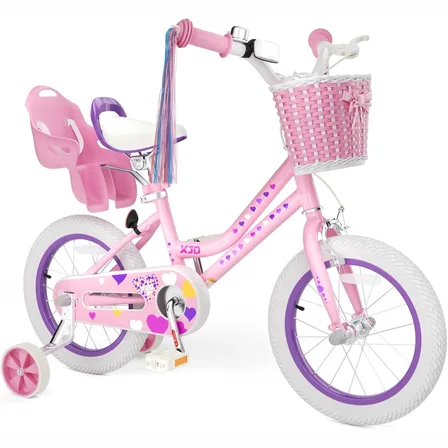
Light Pink XJD Girls' Bicycle with Basket & Training Wheels
The Light Pink XJD Girls' Bicycle with Basket & Training Wheels is a retro-style…$109.99
$129.99 -

Kids Bike Helmet by XJD for Girls – Pink
The XJD Kids Bike Helmet in Pink is a lightweight multi-sport helmet for girls r…$59.99
$99