

What size bike do i need for 12 year old
For a 12-year-old, start with a 20-inch bike at 48–60 in (122–152 cm) or a 24-inch bike at 54–64 in (137–163 cm). Measure first: the overlap means height alone does not settle the choice.
Choose the starting size from measured height
Have the child stand straight without shoes against a wall and measure from the floor to the top of the head. Compare that result with the XBikes starting points below. Age narrows the search, but the rider’s height, inseam, reach, brake control and confidence determine whether a particular bicycle actually fits.
| Wheel size | XBikes age starting point | Rider height |
|---|---|---|
| 20 Inch | Ages 7–12 | 48–60 in / 122–152 cm |
| 24 Inch | Ages 10–14 | 54–64 in / 137–163 cm |
| 26 Inch | Youth and adults over 60 in / 153 cm | Over 60 in / 153 cm |
A 12-year-old under 54 inches begins in the 20-inch range. From 54 to 60 inches, compare both 20- and 24-inch bicycles in person because the ranges overlap. From above 60 through 64 inches, begin with 24 inches while also assessing 26-inch options once the rider is over 60 inches. These are screening ranges, not a promise that every frame with that wheel size will fit identically.
Measure inseam before trying a bicycle
Height identifies likely wheel sizes; inseam helps reveal whether the frame is manageable. With shoes off, place a firm book level between the child’s legs as if it were a saddle, then measure from the floor to the top edge of the book. Keep that measurement available when checking the exact bicycle and its manual.
During the trial, ask the child to straddle the frame with both feet flat on the ground. There should be usable clearance rather than contact with the frame. Because frame shapes differ, do not convert the inseam into a universal wheel-size formula or assume that matching the table guarantees stand-over clearance.
Use control to decide within the overlap
The correct bicycle is the one the child can control now. Do not choose an oversized model merely to leave room for growth. On each candidate, check that the rider can mount, start, steer, stop and dismount without stretching, wobbling from the bicycle’s size or losing balance.
- Reach: The child should hold the bars and steer without locking the elbows or leaning excessively forward.
- Brake access: The rider must be able to reach and operate the fitted brake controls confidently. Follow the exact product manual for adjustment.
- Stand-over: Both feet should reach the ground while straddling the frame, with practical clearance.
- Confidence: Choose the smaller manageable candidate when the larger option makes starting, turning or stopping uncertain.
If controls need setup, assembly is uncertain or the trial exposes a fit problem, use the exact product manual or ask a qualified bicycle mechanic. Do not improvise compatibility, torque or assembly requirements.
How the supplied XBikes products relate
The supplied catalog choices are training-wheel bicycles offered in 12-, 14-, 16- and 20-inch SKU labels. Their 20-inch variants can therefore serve as relevant comparison options for a 12-year-old measuring 48–60 inches, provided the individual fit and control checks succeed. They do not include a supplied 24- or 26-inch option, so they are nearest-size comparison points—not substitutes—when the child needs either larger size.
 Pink 12/14/16/20" XJD Girls Bike with Training Wheels & Basket
Available in 12-, 14-, 16- and 20-inch labels. Its 20-inch variant is relevant for comparison when the rider measures 48–60 inches and passes an individual fit check.
 Light Pink XJD Girls' Bicycle with Basket & Training Wheels
This training-wheel bicycle is supplied in 12-, 14-, 16- and 20-inch labels. Consider only the 20-inch variant for the stated 12-year-old range, subject to fit and control checks.
 Girls' Training Wheel Bike by XJD, 12–20 Inch Wheels – Blue
Offered with 12-, 14-, 16- and 20-inch wheel labels. The 20-inch option can be compared for a rider measuring 48–60 inches; no supplied 24- or 26-inch variant is listed.
Pink 12/14/16/20" XJD Girls Bike with Training Wheels & Basket is available in those four wheel-size labels; only its 20-inch variant intersects the usual 12-year-old starting range. Light Pink XJD Girls' Bicycle with Basket & Training Wheels has the same supplied size-label range and should be assessed the same way. Girls' Training Wheel Bike by XJD, 12–20 Inch Wheels – Blue also tops out at a supplied 20-inch label.
Because all three are categorized as Training Wheel Bikes, their relevance also depends on the rider’s current confidence and needs. The catalog titles and category do not prove fit. A 12-, 14- or 16-inch variant should not be selected merely because it appears under the same product title; those sizes use different XBikes age and height starting points.
Complete the trial and make the decision
- Measure height and inseam without shoes.
- Use the table to shortlist 20, 24 or, above 60 inches, 26 inches.
- Have the child try each realistic candidate and verify stand-over clearance, reach, steering and brake operation.
- Reject any bicycle that feels oversized or cannot be controlled confidently today.
- Fit a bicycle helmet so it sits level and secure its straps according to the helmet manufacturer’s instructions.
For this 12-year-old, choose a supplied 20-inch product only if the child is within its 48–60-inch starting range and passes every hands-on check. If a 24- or 26-inch bicycle fits better, move to that exact size rather than treating one of these 20-inch catalog options as equivalent.
Bikes for your next adventure
-
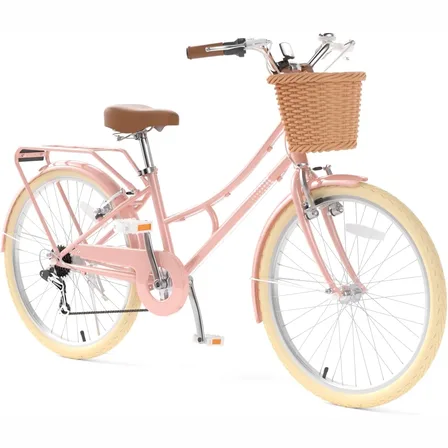
XJD Pink Beach Cruiser for Girls – Rear Rack & V-Brake
The XJD Pink Beach Cruiser for girls is the step-up bike for riders who've outgr…$179.99
$209.99 -

XJD Girls Bike for Kids Ages 3-8, 12/14/16 Inch with Training Wheels – Purple
The XJD Girls Bike in Purple is a training-wheel bicycle for kids ages 3 to 8, f…$149
$169 -
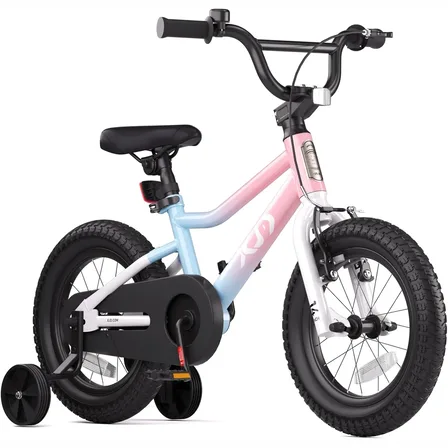
XJD Girls BMX Bike 12/14/16 Inch with Training Wheels – Pink Blue
The XJD Girls BMX Bike in Pink/Blue is built as a first pedal bike for kids roug…$99.99
$119.99