

What size bike do i need for 6 year old
Most 6-year-olds should start by comparing 14-, 16-, and 18-inch bikes, but height and fit decide the correct size—not age alone.
Start with height, then measure inseam
Measure your child without shoes, standing straight against a wall. Record total height from the floor to the top of the head. Next, measure inseam from the floor to the crotch while the child stands with feet slightly apart. Height identifies the useful wheel-size range; inseam helps you check whether the child can stand over the actual bicycle comfortably.
Use the following XBikes figures as starting points only:
| Wheel size | XBikes age guide | Rider-height guide |
|---|---|---|
| 14 Inch | Ages 3–6 | 37–45 in / 94–114 cm |
| 16 Inch | Ages 4–7 | 40–48 in / 102–122 cm |
| 18 Inch | Ages 5–9 | 43–52 in / 109–132 cm |
| 20 Inch | Ages 7–12 | 48–60 in / 122–152 cm |
A six-year-old between 40 and 45 inches tall overlaps the 14- and 16-inch ranges. Between 43 and 48 inches, the 16- and 18-inch ranges overlap. At 48 inches, 16-, 18-, and 20-inch ranges meet. An overlap means that several bikes deserve a fit check; it does not make them interchangeable.
Choose among overlapping sizes by trying the bike
Have your child try each realistic candidate. They should be able to stand over the bicycle without being forced onto tiptoes or pressed against the frame. Seated, they need a comfortable reach to the handlebar while remaining balanced and in control.
Ask the child to operate the brakes themselves. Their hands must reach and control the brake levers without stretching, twisting the wrists awkwardly, or releasing the handlebar. Also watch a start, stop, turn, and controlled dismount. Current confidence matters: a taller but hesitant beginner may handle a smaller fitting option more confidently than the largest size allowed by the height chart.
Do not buy an oversized bicycle solely to leave growing room. A bike that is difficult to mount, steer, brake, or stop today is not the right fit today.
How the supplied 12-, 14-, and 16-inch options help
The Flower Pink XJD Girls Bike with Doll Seat & Basket and the Purple XJD Girls' Bike with Doll Seat & Basket are both Training Wheel Bikes offered in 12 Inch, 14 Inch, and 16 Inch labels. For a six-year-old, their 14- and 16-inch versions provide relevant comparison points when the measured height falls within the corresponding XBikes ranges. Their 12-inch versions cover an XBikes starting range of ages 3–4 and 34–40 inches / 86–102 cm, so age alone does not support choosing that size for a six-year-old; only an individual fit check can establish whether a particular bike works.
These particular catalog options help answer the sizing question because they let you compare two supplied models across the same three wheel-size labels. They do not provide an 18- or 20-inch option, so if measurements point to either of those sizes, treat these products as smaller comparison points rather than substitutes.
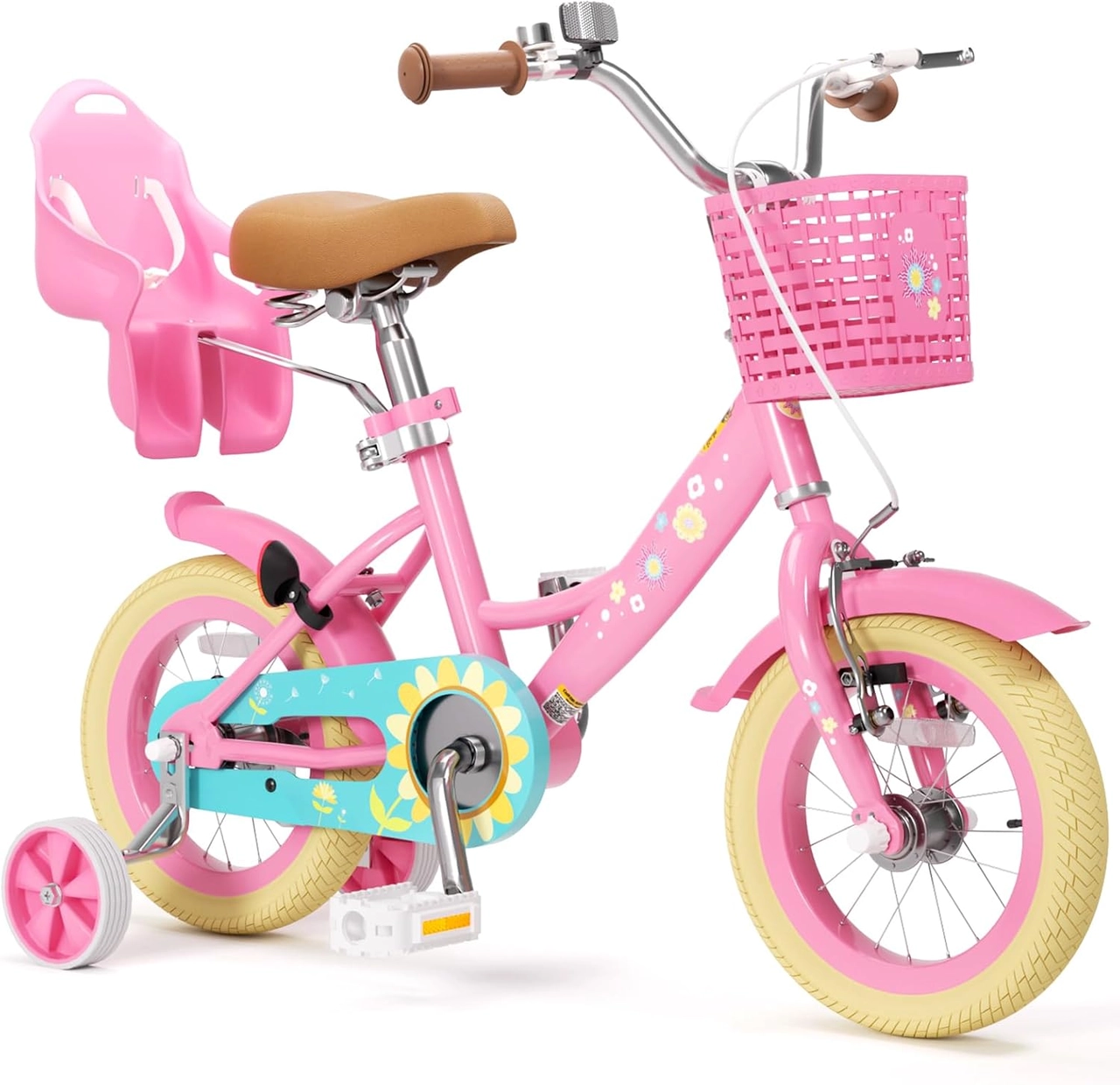 Flower Pink XJD Girls Bike with Doll Seat & Basket
Available in 12 Inch, 14 Inch, and 16 Inch labels. Its 14- and 16-inch versions are relevant comparison points for a six-year-old whose measured height falls within the corresponding XBikes ranges.
 Purple XJD Girls' Bike with Doll Seat & Basket
This Training Wheel Bike comes in 12 Inch, 14 Inch, and 16 Inch labels. Compare its 14- or 16-inch version only when the child's measured height and individual fit support that size.
What to compare on the actual bicycle
A wheel-size label does not specify every frame dimension. Even two bikes with the same wheel label can feel different, so check the complete fit rather than assuming the chart settles the decision.
- Stand-over: Confirm that your child can straddle the bicycle comfortably and manage it without losing balance.
- Reach: Check for a relaxed, controllable grip rather than locked arms or an uncomfortable forward stretch.
- Brake control: Make sure the child can reach and operate the brakes reliably with their own hands.
- Movement: Observe starting, steering, stopping, and getting off in a controlled manner.
- Confidence: Prefer the size the child can control now, provided it also passes the physical fit checks.
If assembly, adjustment, maintenance, load limits, compatibility, or torque information is needed, follow the exact product manual or ask a qualified bicycle mechanic. Do not guess settings or procedures.
Finish the fit with a helmet and a clear decision
A bicycle helmet must fit properly, sit level, and have its straps adjusted according to the helmet manufacturer's instructions. Recheck the helmet fit whenever it is adjusted or replaced.
For your six-year-old, measure height and inseam first, shortlist every wheel size whose height range includes that measurement, and then conduct the stand-over, reach, brake, movement, and confidence checks. Choose the bicycle that fits and can be controlled today. If the correct result is 18 or 20 inches, neither supplied XJD product offers that label, so continue looking for the measured size rather than sizing down or treating a 16-inch bike as equivalent.
Bikes for your next adventure
-
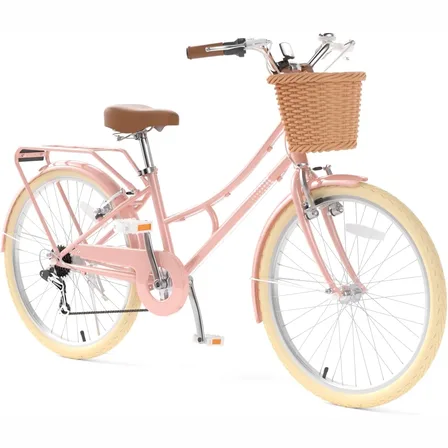
XJD Pink Beach Cruiser for Girls – Rear Rack & V-Brake
The XJD Pink Beach Cruiser for girls is the step-up bike for riders who've outgr…$179.99
$209.99 -

XJD Girls Bike for Kids Ages 3-8, 12/14/16 Inch with Training Wheels – Purple
The XJD Girls Bike in Purple is a training-wheel bicycle for kids ages 3 to 8, f…$149
$169 -
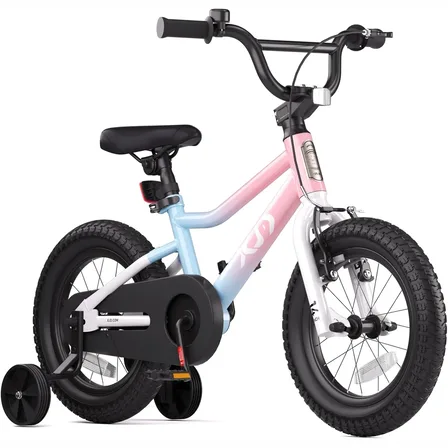
XJD Girls BMX Bike 12/14/16 Inch with Training Wheels – Pink Blue
The XJD Girls BMX Bike in Pink/Blue is built as a first pedal bike for kids roug…$99.99
$119.99