

What size bike does a 6 year old need
Most 6-year-olds should start by trying a 16-inch bike, but height and fit decide: 14-inch may suit 37–45 in, 16-inch 40–48 in, and 18-inch 43–52 in.
Choose the starting size from measured height
Measure your child without shoes, standing straight against a wall. Record the height from the floor to the top of the head. Then compare that measurement with the XBikes starting points below. Age identifies sizes worth trying; it does not confirm that a particular bicycle fits.
| Wheel size | XBikes age starting point | Rider height |
|---|---|---|
| 14 Inch | Ages 3–6 | 37–45 in / 94–114 cm |
| 16 Inch | Ages 4–7 | 40–48 in / 102–122 cm |
| 18 Inch | Ages 5–9 | 43–52 in / 109–132 cm |
| 20 Inch | Ages 7–12 | 48–60 in / 122–152 cm |
For a 6-year-old under 40 in / 102 cm, compare a 14-inch bike first. From 40–48 in / 102–122 cm, begin with 16-inch. At 43 in / 109 cm or taller, an 18-inch bike also enters the comparison. A child at or above 48 in / 122 cm may be tall enough to try 20-inch, despite being younger than its age starting point.
Overlapping ranges are intentional. They mean two wheel sizes may deserve a fit check; they do not mean both will control identically.
Measure inseam before the test ride
Height narrows the choices, while inseam helps reveal whether the frame leaves usable clearance. With the child barefoot or in thin socks, have them stand with feet slightly apart. Place a straight-edged book snugly upward between the legs, keeping it level, and measure from the floor to its top edge.
Compare that inseam with the actual stand-over clearance and lowest usable saddle position of the exact bicycle being considered. Those dimensions are not supplied here, so do not infer them from wheel size. Have the child straddle the bike and follow its product manual for adjustment. If the fit remains uncertain, use a qualified bicycle mechanic.
Check control, not just clearance
A suitable bike lets the child mount, start, steer, stop and dismount without being overwhelmed by its size. During an individual fit check, confirm that the child can:
- Straddle the bicycle with appropriate clearance rather than being pressed against the frame.
- Reach the handlebar without stretching, locking the elbows or losing a centered riding position.
- Turn the handlebar while remaining balanced and in control.
- Reach and operate the bicycle's braking controls confidently.
- Put feet down as needed for the child's current riding confidence and the bicycle's intended setup.
Do not move up merely to leave growing room. HealthyChildren guidance emphasizes trying the bicycle, avoiding an oversized purchase for growth, and checking stand-over, control and brake reach. If a larger candidate makes starting, steering or stopping harder, choose the smaller properly fitting option even when both sizes appear in the height range.
How the supplied bikes help with comparison
The three supplied catalog options are training-wheel bikes with available 12-inch, 14-inch and 16-inch SKU labels. That makes their 14-inch and 16-inch versions relevant comparison points for many 6-year-olds. They do not provide an available 18-inch SKU in the supplied facts, so a child whose measurements indicate 18-inch needs a separate exact-size candidate rather than treating 16-inch as equivalent.
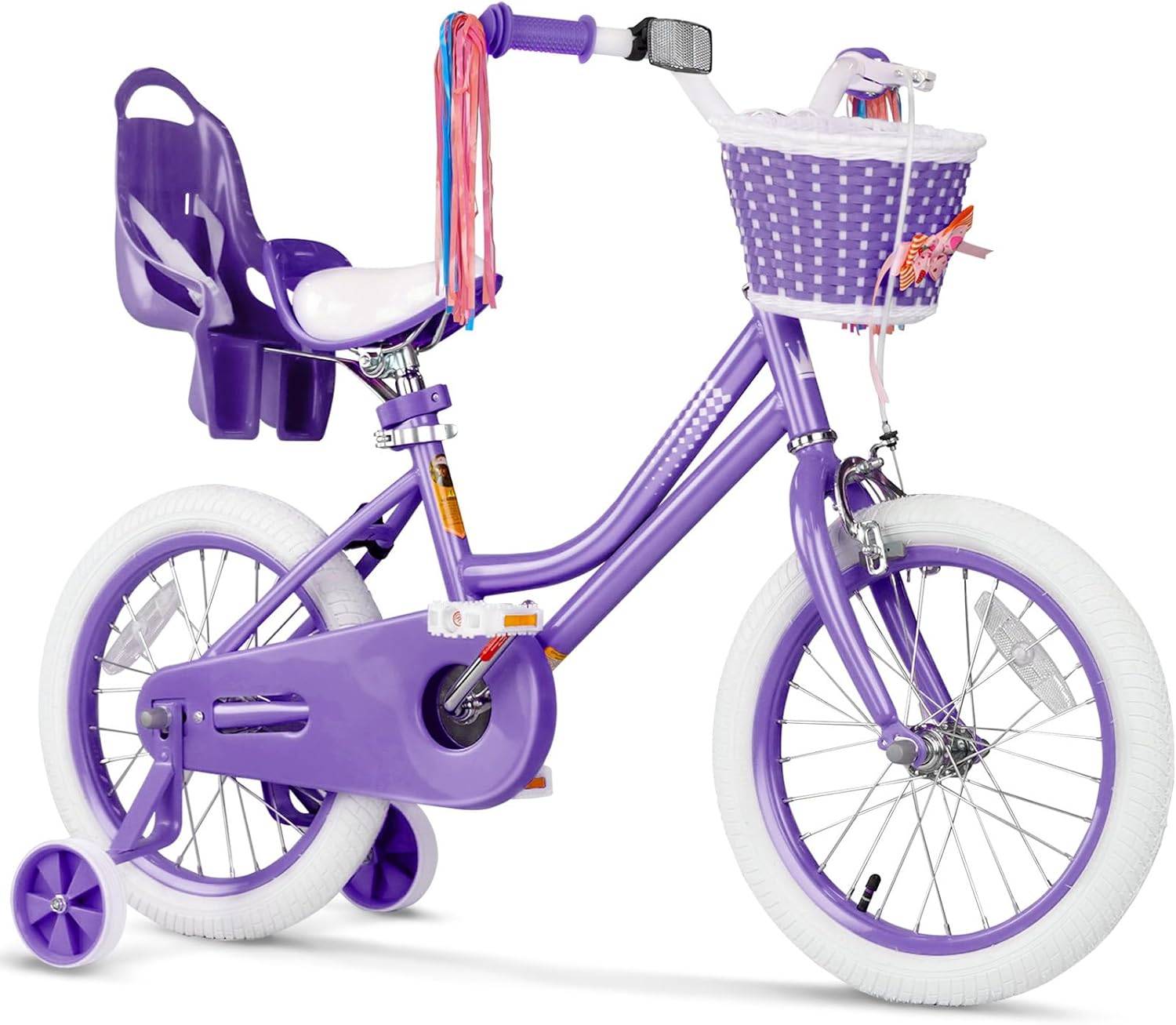 XJD Girls Bike for Kids Ages 3-8, 12/14/16 Inch with Training Wheels – Purple
A training-wheel bike with supplied 12-, 14- and 16-inch choices. Its 14- and 16-inch versions are relevant fit-check candidates for a 6-year-old, depending on measured height and control.
 Girls 12/14/16 Inch Kids Bike by XJD with Training Wheels – Peach
This Training Wheel Bikes option has supplied 12-, 14- and 16-inch SKU labels. Compare the 14- and 16-inch versions using the child's height, inseam, reach, braking ability and confidence.
 XJD Light Purple Girls Bike with Basket, Training Wheels, 12/14/16/20 Inch
A light purple training-wheel bike with basket and supplied 12-, 14- and 16-inch SKU labels. Although its title mentions 20 inch, that size is not among the supplied available labels.
XJD Girls Bike for Kids Ages 3-8, 12/14/16 Inch with Training Wheels – Purple offers supplied 12-inch, 14-inch and 16-inch choices. The age phrase in its title is only a catalog label; use the XBikes height ranges and an individual fit check instead.
Girls 12/14/16 Inch Kids Bike by XJD with Training Wheels – Peach has the same supplied wheel-size choices and belongs to the Training Wheel Bikes category. Compare its 14-inch and 16-inch versions according to measured height, inseam, reach, brake control and confidence.
XJD Light Purple Girls Bike with Basket, Training Wheels, 12/14/16/20 Inch includes “20 Inch” in its exact catalog title, but the supplied available SKU labels are only 12 Inch, 14 Inch and 16 Inch. Do not assume a 20-inch option is selectable without verifying the current product page.
Make the final decision
- Measure standing height and inseam.
- Use height to shortlist 14-inch, 16-inch, 18-inch or, for a sufficiently tall child, 20-inch.
- Have the child try each shortlisted bicycle and compare stand-over, reach, braking and control.
- Reject any size that the child cannot handle confidently, even if age or expected growth suggests it.
Before riding, add a properly fitting bicycle helmet. U.S. Consumer Product Safety Commission guidance says it should sit level and its straps should be used according to the helmet manufacturer's instructions. For bicycle assembly, adjustments, compatibility, maintenance or torque requirements, follow the exact product manual or consult a qualified bicycle mechanic.
For your 6-year-old, measure first, try 16-inch as the usual starting point, and compare 14-inch or 18-inch whenever the measured height range and real-world control indicate them.
Bikes for your next adventure
-

Light Purple XJD Toddler Bike Helmet, Adjustable, Size XS (46–51 cm)
This Light Purple XJD toddler bike helmet is made for the smallest riders — the …$20.39
-

XJD Boys 12/14/16" Training Wheel Bike – Blue
The XJD Boys Bike in Blue is a training wheel bike for riders 71–122 cm tall—rou…$169
$199 -

XJD 24-Inch Green Beach Cruiser Bike with U-Brake
This XJD 24-inch beach cruiser in green is made for riders about 4'8" to 5'4" ta…$159.99
$199.99