

What size bike does a 7 year old need
A 7-year-old may need a 16-, 18-, or 20-inch bike. Measure the child’s height and inseam, then confirm stand-over clearance, reach, braking and control on the actual bike.
Start with measured height, not age
Age narrows the possibilities, but it cannot select the size by itself. Compare the child’s current standing height with these XBikes starting points:
| Wheel size | Starting age range | Rider height |
|---|---|---|
| 16 Inch | Ages 4–7 | 40–48 in / 102–122 cm |
| 18 Inch | Ages 5–9 | 43–52 in / 109–132 cm |
| 20 Inch | Ages 7–12 | 48–60 in / 122–152 cm |
These ranges overlap because children of the same age differ in height, proportions and riding ability. A child measuring 47 inches, for example, falls within both the 16-inch and 18-inch starting ranges. That does not make the sizes equivalent; it means the next step is an individual fit check.
If the rider is below 48 inches, begin by comparing 16- and 18-inch bikes. At 48 inches or taller, include a 20-inch bike in the comparison. If the child is outside these ranges, use the complete sizing progression rather than forcing an age-based choice.
Measure height and inseam
For height, have the child stand upright without shoes against a wall, looking straight ahead. Mark the top of the head and measure vertically from the floor. Use the result—not an old medical record, clothing size or estimate—when checking the height ranges.
For inseam, keep the child barefoot with feet slightly apart. Place a firm, level book between the legs and raise it gently to simulate the contact of a saddle. Measure from the floor to the top edge of the book. The inseam helps assess stand-over and starting confidence, but the supplied wheel-size standard does not provide numerical inseam limits. Compare it with the actual bicycle rather than inventing a formula.
Check the bike with the child on it
The American Academy of Pediatrics advises having the child try the bicycle and avoiding an oversized bike bought merely for future growth. During the trial, check the following:
- Stand-over: With the child standing over the frame, there should be comfortable clearance and no need to balance on tiptoes.
- Starting and stopping: The rider should be able to get into position, set off and stop without the bicycle pulling them off balance.
- Reach: The child should hold the controls without stretching, locking the elbows or leaning excessively forward.
- Brake control: The rider must be able to reach and operate the brakes confidently. Do not assume that fitting the height range guarantees suitable brake reach.
- Steering: Ask the child to ride slowly, turn both ways and stop in a clear, supervised area. Watch for calm control rather than judging fit from appearance alone.
If two wheel sizes match the height chart, choose according to the fit trial and present confidence. The larger option is not automatically preferable, and the smaller option is not automatically more controllable.
How the supplied 12-, 14- and 16-inch options relate
The catalog includes the XJD Girls Bike for Kids Ages 3-8, 12/14/16 Inch with Training Wheels – Purple, with 12 Inch, 14 Inch and 16 Inch SKU labels. For this question, its 16-inch option is the relevant direct comparison when the rider measures 40–48 in / 102–122 cm. Its 12- and 14-inch options are starting points for shorter children, not equal substitutes for a 16-, 18- or 20-inch fit. The “Ages 3-8” wording is a catalog title, not individual fit evidence.
These catalog options help show where a 16-inch training-wheel bike sits beside smaller 12- and 14-inch versions. The supplied product does not include an 18- or 20-inch SKU, so it is not a substitute if the fit check points to either larger size.
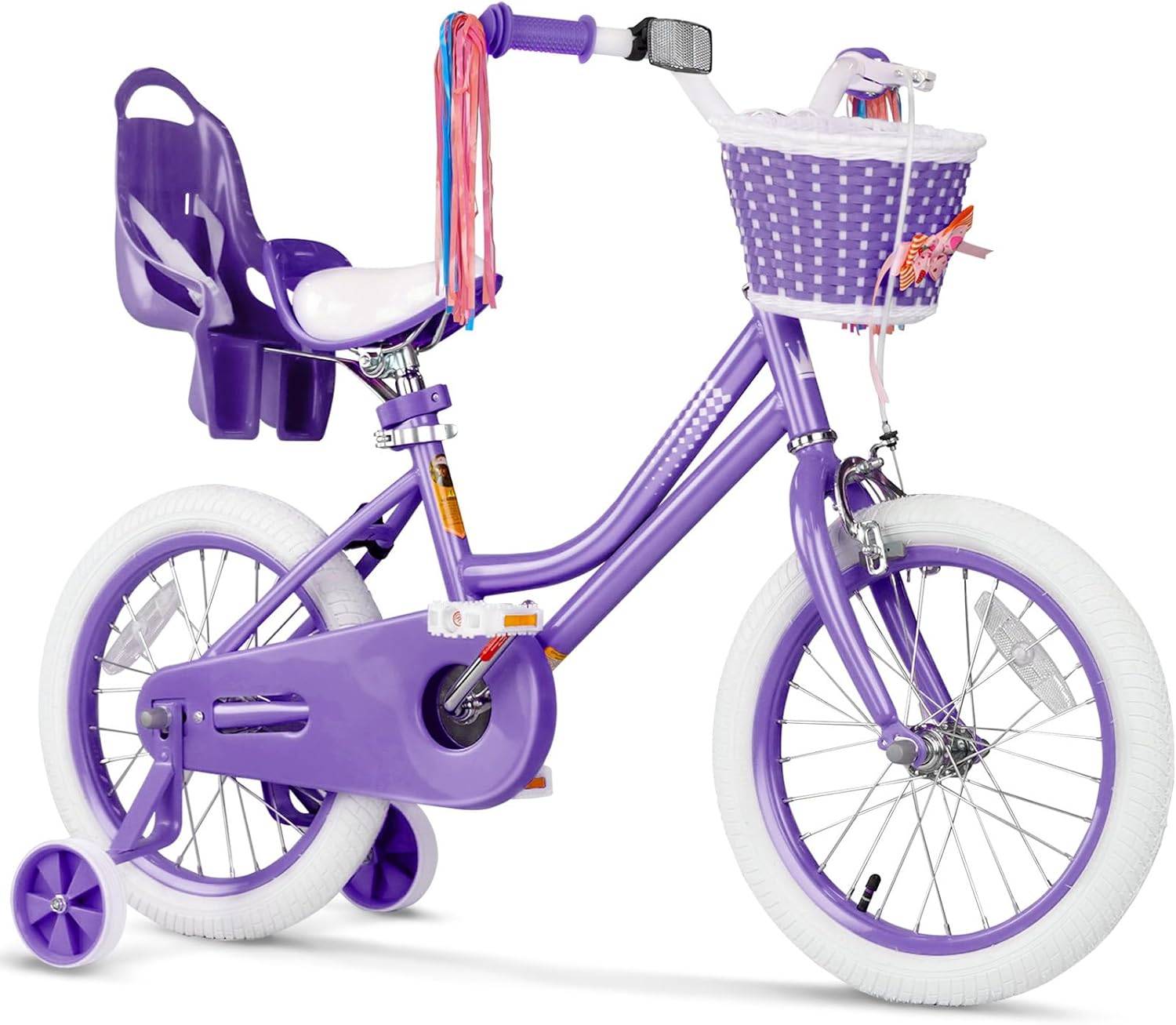
Training wheels do not correct a frame that is too large, excessive reach or inaccessible brakes. If assembly, adjustment, compatibility, load limits or maintenance information is needed, follow the exact product manual or ask a qualified bicycle mechanic; no unsupported procedure or specification should be assumed.
Finish the decision safely
Once a size passes the fit check, add a properly fitting bicycle helmet. The U.S. Consumer Product Safety Commission says the helmet should sit level and its straps should be used according to the manufacturer’s instructions. Recheck helmet fit rather than relying only on the label.
- Measure the child’s current height and inseam without shoes.
- Use height to shortlist 16, 18 or 20 inches from the XBikes ranges.
- Have the child try each plausible size and verify stand-over, reach, braking, steering and stopping.
- Reject any bike that requires stretching, tiptoe balancing or uncertain control, even if its age wording appears suitable.
For a 7-year-old, the practical decision is therefore: start with 16 inches below 48 inches in height, compare 18 inches throughout its 43–52-inch range, and add 20 inches from 48 inches upward—then buy only the size the child can comfortably control now.
Bikes for your next adventure
-

Light Purple XJD Toddler Bike Helmet, Adjustable, Size XS (46–51 cm)
This Light Purple XJD toddler bike helmet is made for the smallest riders — the …$20.39
-

XJD Boys 12/14/16" Training Wheel Bike – Blue
The XJD Boys Bike in Blue is a training wheel bike for riders 71–122 cm tall—rou…$169
$199 -

26-Inch XJD Beach Cruiser Bike for Girls – Purple, V-Brake
This XJD 26-inch purple beach cruiser is sized for big kids and teens — suggeste…$218.49
$229.99