

What size bike does my 6 year old need
A typical 6-year-old needs a 16-inch bike, but measure the child first. Compare height, inseam, reach, brake control and confidence before choosing.
Start with measured height, not the sixth birthday
For a six-year-old, the XBikes starting points overlap: a 14-inch bike corresponds to 37–45 in (94–114 cm), a 16-inch bike to 40–48 in (102–122 cm), and an 18-inch bike to 43–52 in (109–132 cm). The age ranges are also broad: 14-inch covers ages 3–6, 16-inch covers ages 4–7, and 18-inch covers ages 5–9.
That makes 16 inches the usual first size to try, not an automatic answer. A shorter child may fit a 14-inch bike better. A taller child may need to compare 16- and 18-inch bikes. A child already 48 in (122 cm) or taller can also begin comparing a 20-inch bike, whose XBikes starting range is 48–60 in (122–152 cm) and ages 7–12, but only an individual fit check can settle the choice.
Take two useful measurements
- Height: Have the child stand upright without shoes against a wall. Measure from the floor to the top of the head, then compare the result with the XBikes ranges.
- Inseam: With feet slightly apart, measure from the floor to the crotch. Use this measurement during an in-person stand-over check; wheel size alone does not reveal the frame’s exact clearance.
Do not infer fit from clothing size, a sibling’s bike or age alone. Frames with the same wheel diameter can differ in geometry, saddle adjustment and riding position.
Use this wheel-size comparison
| Wheel size | XBikes age starting point | XBikes rider-height starting point | Meaning for a 6-year-old |
|---|---|---|---|
| 14 Inch | Ages 3–6 | 37–45 in / 94–114 cm | Compare for a shorter rider or one who needs easier control. |
| 16 Inch | Ages 4–7 | 40–48 in / 102–122 cm | The usual first size to try at age six. |
| 18 Inch | Ages 5–9 | 43–52 in / 109–132 cm | Compare when height and physical control support the larger fit. |
| 20 Inch | Ages 7–12 | 48–60 in / 122–152 cm | Consider only for a child at least 48 in tall who passes every fit check. |
Height bands overlap deliberately. In an overlap, choose through hands-on control rather than assuming the larger wheel will last longer.
Check the bike with the child on it
Have the child try the exact bicycle. With the child straddling the frame, confirm there is comfortable stand-over clearance. Seated in a normal riding position, the child should reach the handlebar without stretching, turn it smoothly, and operate the brakes confidently with their hands.
Ask for a controlled start, straight ride, turn and stop in a suitable protected area. Watch for leaning or twisting to reach the controls, difficulty steering, or hesitation caused by the bike’s size. Current confidence matters: a fit that feels manageable can be more appropriate than a larger bike that technically falls within a height range.
Do not buy an oversized bicycle merely for the child to grow into. If stand-over, reach or brake operation is doubtful, compare the next smaller size.
How the supplied training-wheel bikes help
The two catalog options provide useful 14- and 16-inch comparison points for many six-year-olds, and one also offers a 20-inch option for a sufficiently tall rider. Their training-wheel category may be relevant when that style matches the child’s current confidence, but the catalog facts do not establish individual fit.
 XJD Kids' Training Wheel Bike for Boys & Girls, 12/14/16 Inch – White
Available in 12 Inch, 14 Inch and 16 Inch labels; its 14- and 16-inch versions provide relevant comparison points for a measured six-year-old needing a training-wheel bike.
 Girls' Training Wheel Bike by XJD, 12–20 Inch Wheels – Blue
Available in 12 Inch, 14 Inch, 16 Inch and 20 Inch labels; compare 14 and 16 inches first, with 20 inches relevant only from 48 in (122 cm) and after a full fit check.
XJD Kids' Training Wheel Bike for Boys & Girls, 12/14/16 Inch – White has 12 Inch, 14 Inch and 16 Inch SKU labels. For this question, compare its 14- and 16-inch versions against the child’s measured height and hands-on fit; do not choose from the title alone.
Girls' Training Wheel Bike by XJD, 12–20 Inch Wheels – Blue has 12 Inch, 14 Inch, 16 Inch and 20 Inch SKU labels. Its 14- and 16-inch versions cover the main comparison, while its 20-inch version is relevant only when the rider is at least 48 in (122 cm) tall and can control that exact bike.
Neither supplied product has an 18 Inch SKU label. If the fit check points to 18 inches, these products are nearest-size comparison points, not substitutes; a 16-inch or 20-inch bike is not equivalent to an 18-inch bike.
Make the final decision
- Under 40 in (102 cm): begin with 14 inches, provided the child falls within its 37–45 in range.
- 40–48 in (102–122 cm): try 16 inches first, then resolve overlap through stand-over, reach, braking and confidence.
- 43–52 in (109–132 cm): include an 18-inch comparison when the 16-inch fit is cramped or the larger bike remains easy to control.
- At least 48 in (122 cm): a 20-inch comparison becomes relevant, but age six does not override a poor fit.
Follow the exact product manual or ask a qualified bicycle mechanic about assembly, maintenance, torque, load limits or compatibility. Before riding, fit a bicycle helmet so it sits level and secure its straps according to the helmet manufacturer’s instructions.
For your six-year-old, measure height and inseam today, try a 16-inch bike first in most cases, and buy only the size on which the child can comfortably stand over, reach, steer and brake.
Bikes for your next adventure
-
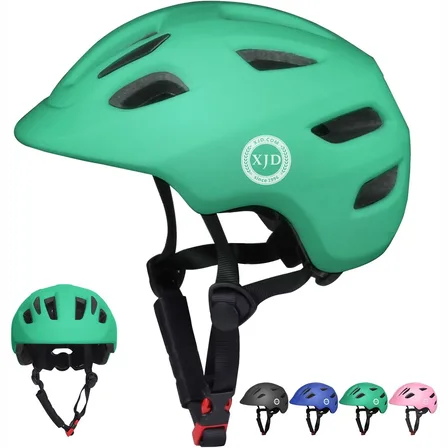
Green XJD Toddler Bike Helmet with Adjustable Fit, XS (46–51 cm)
The XJD toddler bike helmet in Green is built for the youngest riders — the size…$20.39
$23.99 -

Kids Bike Helmet by XJD for Boys & Girls – Black, Blue, Green, Pink, Purple
The XJD Kids Bike Helmet covers a wide 2-to-8-year age range thanks to two head-…$59.99
-

Kids Bike Helmet by XJD for Girls – Pink
The XJD Kids Bike Helmet in Pink is a lightweight multi-sport helmet for girls r…$59.99
$99