

What size bike does my 7 year old daughter need
Most 7-year-old girls should start by trying a 20-inch bike if they are 48–60 inches (122–152 cm) tall. If she is shorter, compare 16- and 18-inch bikes; choose only after checking her inseam, reach, brake control and confidence.
Measure her before choosing a wheel size
Age provides a starting point, but her measured height should guide the first comparison. Have her stand straight without shoes against a wall, then measure from the floor to the top of her head.
Measure her inseam as well. With her feet slightly apart, place a firm book between her legs so it gently meets her crotch, then measure from the floor to the book’s top edge. Record both measurements and take them when she tries a bike; wheel size alone cannot confirm stand-over clearance or riding position.
Compare her height with these starting points
| Wheel size | XBikes age starting point | Rider height starting point |
|---|---|---|
| 16 Inch | Ages 4–7 | 40–48 in / 102–122 cm |
| 18 Inch | Ages 5–9 | 43–52 in / 109–132 cm |
| 20 Inch | Ages 7–12 | 48–60 in / 122–152 cm |
| 24 Inch | Ages 10–14 | 54–64 in / 137–163 cm |
For a 7-year-old who is 48 inches (122 cm) or taller, begin with a 20-inch trial. Below that height, compare 16 and 18 inches according to the ranges above. Overlapping ranges are normal: they identify sizes worth trying, not an automatic answer.
Do not move her to a 24-inch bike merely because she will grow. Even when her height overlaps its range, she must be able to stand over, reach, steer and brake confidently. A smaller suitable bike is preferable to an oversized bike she cannot control.
Perform the fit check in this order
- Stand-over: Have her straddle the bicycle with both feet on the ground. She needs comfortable clearance rather than contact with the frame.
- Seat position: Confirm that the seat can be adjusted for a secure start and stop while following the exact bicycle manual.
- Reach: With hands on the controls, she should sit naturally rather than stretch, lock her elbows or lean excessively.
- Brake control: She must reach and operate the brakes reliably with her hands in a stable riding position.
- Handling: In a clear supervised area, check that she can start, steer, turn and stop without the bicycle feeling unwieldy.
If two sizes appear possible, compare them directly. Choose the one she controls now, not the larger one intended to extend the time before her next bike.
How the supplied bikes help with the comparison
The supplied catalog options are relevant because each offers 16-inch and 20-inch labels, the two sizes most likely to bracket this age-based decision. They also offer 12- and 14-inch versions, but those sizes are generally starting points for shorter, younger riders under the XBikes standard. None offers an 18-inch label, so these products are comparison options, not substitutes when an 18-inch bike proves to be the correct fit.
Girls' Training Wheel Bike by XJD, 12–20 Inch Wheels – Blue, XJD Girls' Bike with Training Wheels, 12/14/16/20 Inch – Purple, and XJD Kids Bike for Girls – Pink, 12/14/16/20 Inch with Training Wheels each have 12 Inch, 14 Inch, 16 Inch and 20 Inch SKU labels. Their supplied differences are their exact catalog titles and listed colors; the catalog facts do not establish differences in brakes, weight, materials, load limits or other fit dimensions.
These particular options let you compare the available 16- and 20-inch versions against her measurements and current need for training wheels.
 Girls' Training Wheel Bike by XJD, 12–20 Inch Wheels – Blue
Available in 12, 14, 16 and 20 Inch labels. Its 16- and 20-inch versions can support the fit comparison for a 7-year-old, while its training wheels are relevant only if they suit her confidence.
 XJD Girls' Bike with Training Wheels, 12/14/16/20 Inch – Purple
This purple training-wheel bike offers 12, 14, 16 and 20 Inch labels. Compare its 16- and 20-inch versions only after measuring the rider; it does not provide the 18-inch option that may fit some children.
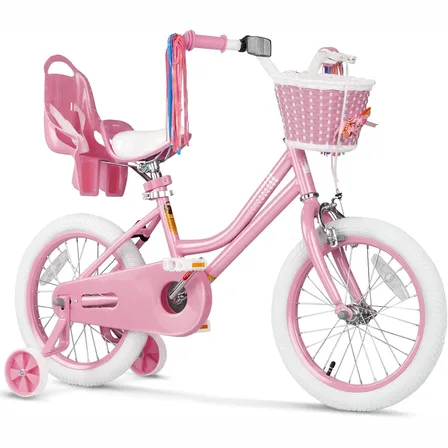
 XJD Kids Bike for Girls – Pink, 12/14/16/20 Inch with Training Wheels
This pink girls’ bike with training wheels is listed in 12, 14, 16 and 20 Inch sizes. The 16- and 20-inch versions are relevant comparison points, but an individual stand-over, reach, brake and handling check remains necessary.
When these training-wheel bikes are relevant
Consider one of the supplied products when her fit check points to 16 or 20 inches and training wheels suit her present confidence. Training wheels should not be used to justify a poorly fitting frame, difficult reach or inaccessible brakes.
If her measurements and trial indicate an 18-inch bicycle, none of the supplied products has that exact wheel size. Treat their 16- and 20-inch versions only as nearest-size comparison points and look for an actual 18-inch option; never assume either adjacent size is equivalent.
For assembly, adjustments, maintenance, compatibility, load limits and torque, follow the exact product manual or use a qualified bicycle mechanic. The supplied catalog information does not provide those specifications.
Make the final decision safely
Have her try the exact size and setup she would ride. Recheck stand-over clearance, comfortable reach, reliable braking and calm steering before deciding. Add a properly fitting bicycle helmet that sits level, with its straps used according to the helmet manufacturer’s instructions.
For your 7-year-old daughter, measure height and inseam today, start with 20 inches at 48–60 inches tall, compare 16 or 18 inches if she is shorter, and buy only the size she can confidently control during an individual fit check.
Bikes for your next adventure
-

Blue XJD Girls Bike with Training Wheels – 12/14/16 Inch
If you're shopping for a first pedal bike for a daughter roughly 3 to 8 years ol…$149
$169 -

XJD Kids Bike for Girls – Pink, 12/14/16/20 Inch with Training Wheels
The XJD Kids Bike for Girls in Pink is a training-wheel bike built to carry your…$139
$159 -
XJD Pink Girls' Bike – Kids 12/14/16 Inch Training Wheel Bicycle
The XJD Pink Girls' Bike is a training-wheel bicycle for girls ages 3 to 8 (ride…$149
$169