

What size bike does my toddler need
Measure your toddler’s standing height and inseam, then test the matching bike in person. Most toddlers will start by comparing 12-inch and 14-inch wheels, but the correct size is the one they can stand over, reach, steer and stop confidently.
Start with height, not age
Age ranges are only starting points because children of the same age can have very different proportions and confidence. Measure your child without shoes, standing straight against a wall. Record their total height from the floor to the top of the head.
Next, measure inseam. Have the child stand with feet slightly apart, then measure from the floor to the crotch. This helps you judge whether there is comfortable clearance when the child straddles the bicycle. Compare both measurements with the bike’s sizing information, but make the final decision through an individual fit check.
Compare the likely wheel sizes
| Wheel size | XBikes age starting point | Rider-height starting point |
|---|---|---|
| 12 Inch | Ages 3–4 | 34–40 in / 86–102 cm |
| 14 Inch | Ages 3–6 | 37–45 in / 94–114 cm |
| 16 Inch | Ages 4–7 | 40–48 in / 102–122 cm |
The ranges overlap intentionally. For example, a rider who is 39 inches tall falls within both the 12-inch and 14-inch starting ranges. That does not make the sizes equivalent. Try both and choose according to stand-over clearance, reach, brake control and current confidence.
A 16-inch bike may appear in searches for a growing child, but its XBikes starting range begins at age 4 and 40 inches / 102 cm. Do not move up merely to extend the time before the next purchase. The American Academy of Pediatrics advises having the child try the bicycle and avoiding an oversized bike bought for growth.
Perform a practical fit check
Have an adult stabilize the bicycle while your toddler performs these checks in ordinary riding clothes and suitable closed-toe shoes:
- Stand over it: The child should be able to straddle the bike without the frame pressing uncomfortably into the body.
- Sit and reach: From the riding position, the child should reach the handlebar without stretching, locking the elbows or leaning excessively forward.
- Steer: Ask the child to turn the handlebar in both directions while remaining balanced and in control.
- Operate the brakes: If the bicycle has hand controls, confirm that the child can reach and operate them. Check every fitted braking control rather than assuming it suits small hands.
- Start and stop: In a clear, level area under close adult supervision, confirm that the child can start, slow and stop without panic or loss of control.
If the child can technically reach the controls but looks tense, wobbly or frightened, the fit is not yet convincing. Current confidence matters alongside measurements.
How the supplied bikes help with comparison
The two catalog options cover the principal 12-, 14- and 16-inch comparison sizes discussed above. They are useful for narrowing the shortlist after measuring your child, but their wheel labels alone cannot confirm fit.
 Girls' Training Wheel Bike by XJD with Basket – Purple
Available in 14 Inch, 16 Inch and 20 Inch labels. The 14-inch option is the closest toddler-focused comparison; larger labels require their own height-based fit check.
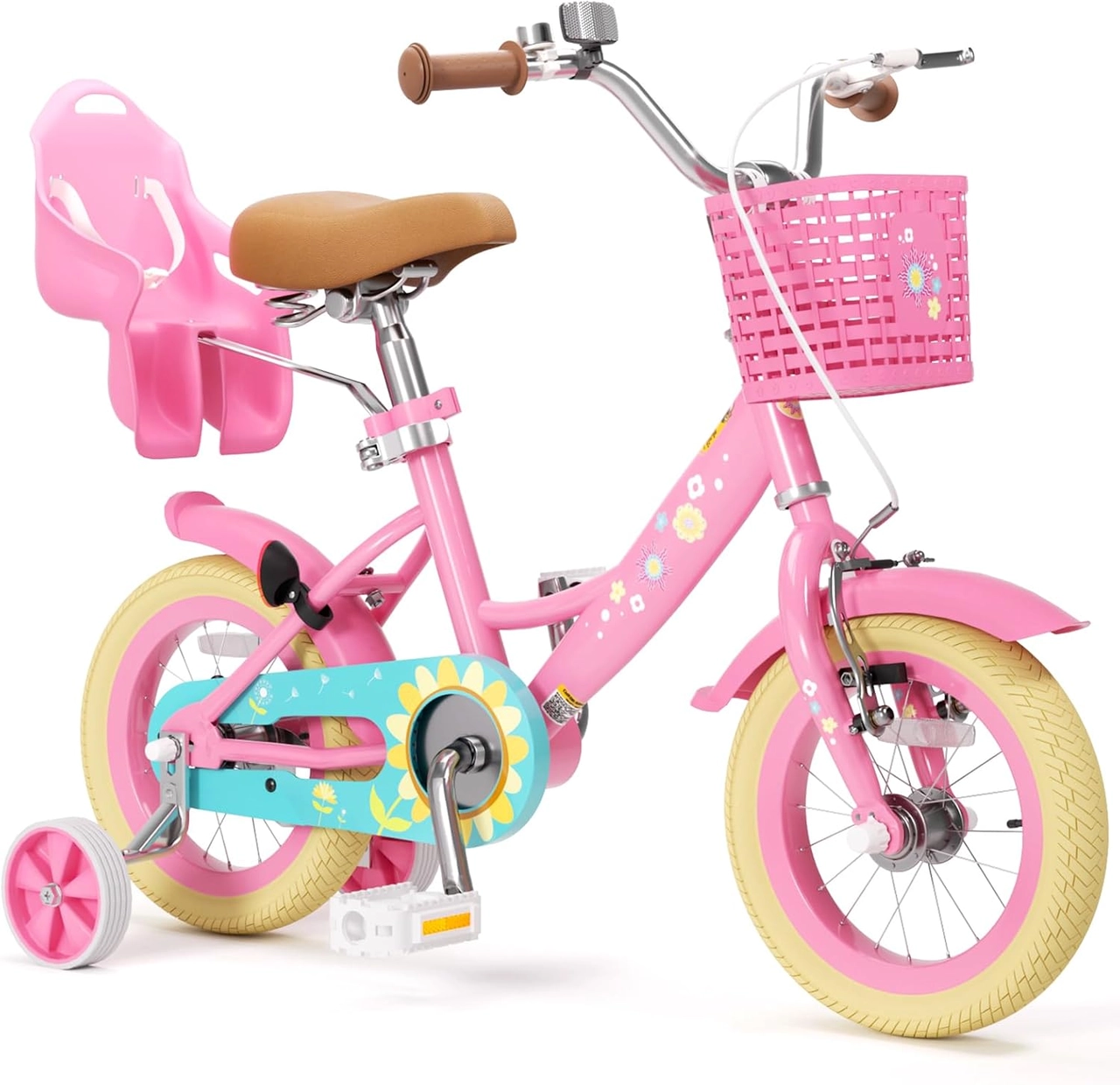 Flower Pink XJD Girls Bike with Doll Seat & Basket
Available in 12 Inch, 14 Inch and 16 Inch labels, allowing parents to compare the three relevant starting ranges after measuring height and inseam.
Flower Pink XJD Girls Bike with Doll Seat & Basket is offered in 12 Inch, 14 Inch and 16 Inch labels. It therefore provides all three likely comparison points shown in the toddler-focused table.
Girls' Training Wheel Bike by XJD with Basket – Purple is offered in 14 Inch, 16 Inch and 20 Inch labels. Its 14-inch option may be relevant within the toddler comparison; its 16-inch option should be considered only when the child meets that starting range and passes the fit check. The 20-inch label is not a toddler substitute: XBikes places it at ages 7–12 and 48–60 inches / 122–152 cm.
Both are cataloged as training-wheel bikes. Training wheels do not correct an oversized frame or controls that a child cannot reach. Follow the exact product manual for assembly, adjustment, maintenance, compatibility and load limits, or ask a qualified bicycle mechanic where the manual does not resolve a question.
Check the helmet separately
Bike size and helmet fit are separate decisions. The U.S. Consumer Product Safety Commission advises that a bicycle helmet fit properly, sit level and have its straps used according to the helmet manufacturer’s instructions. Do not try to make an unsuitable helmet work simply because it is already available.
Recheck the helmet after adjustment and before each ride. Supervise practice in a clear area away from traffic and other hazards while the child learns how the selected bicycle responds.
Make the final size decision
Write down height and inseam, use the XBikes ranges to select 12-inch and/or 14-inch candidates, and include 16 Inch only if its stated starting range is appropriate. Then have your toddler try each candidate. Choose the size they can straddle comfortably, reach without stretching, steer smoothly and stop reliably today—not the larger size you hope they will grow into.
Bikes for your next adventure
-

Green XJD Toddler Bike Helmet with Adjustable Fit, XS (46–51 cm)
The XJD toddler bike helmet in Green is built for the youngest riders — the size…$20.39
$23.99 -

Kids Bike Helmet by XJD for Boys & Girls – Black, Blue, Green, Pink, Purple
The XJD Kids Bike Helmet covers a wide 2-to-8-year age range thanks to two head-…$59.99
-

Kids Bike Helmet by XJD for Girls – Pink
The XJD Kids Bike Helmet in Pink is a lightweight multi-sport helmet for girls r…$59.99
$99