

What size bike for 3-5 year old
For most 3–5-year-olds, start by comparing 12-, 14- and 16-inch bikes. Measure height first, then confirm inseam clearance, reach and control on the actual bike.
Which wheel size should you check?
Age narrows the search, but it does not determine the fit. Use your child’s measured height to choose the first size to try:
| Wheel size | XBikes age starting point | Rider height |
|---|---|---|
| 12 Inch | Ages 3–4 | 34–40 in / 86–102 cm |
| 14 Inch | Ages 3–6 | 37–45 in / 94–114 cm |
| 16 Inch | Ages 4–7 | 40–48 in / 102–122 cm |
A shorter three-year-old will commonly begin with a 12-inch comparison. A child in the overlapping height ranges may need to try two adjacent sizes, especially 12 versus 14 inches or 14 versus 16 inches. A taller five-year-old may reach the 16-inch range. These are starting points, not a substitute for checking the individual rider on the bicycle.
Measure before choosing
- Measure standing height: Have the child stand without shoes, upright against a wall. Compare the result with the height ranges above.
- Measure inseam: With feet slightly apart, measure from the floor to the crotch. Use this measurement to assess clearance over the bicycle rather than trying to convert it into a wheel size.
- Note current confidence: A hesitant beginner may need a more manageable fit than a confident rider of the same age and height.
Do not choose a larger bicycle simply to leave growing room. An oversized bike can make starting, stopping, steering and reaching the controls harder. The right next step is always an in-person fit check or a careful comparison using the exact bicycle’s fit information.
What a proper fit should look like
Have the child try the bike while an adult steadies it. Check that the child has suitable stand-over clearance and can mount and dismount without struggling. Seated in a normal riding position, the child should reach the handlebars without an extreme forward stretch or cramped posture.
Ask the child to turn the handlebar both ways and operate the brakes. They should be able to steer while remaining balanced and reach and use the brake controls comfortably. If they cannot control the bike confidently, do not treat an age or height overlap as proof that the larger size fits.
How the supplied bikes help with comparison
All three supplied catalog options offer 12 Inch, 14 Inch and 16 Inch SKU labels, covering the wheel-size starting points most relevant to riders aged 3–5. They therefore make useful same-model or adjacent-size comparison options, but the label alone cannot confirm stand-over clearance, reach or brake control.
The catalog options below help you compare the three relevant sizes and two listed bike categories before carrying out the individual fit check.
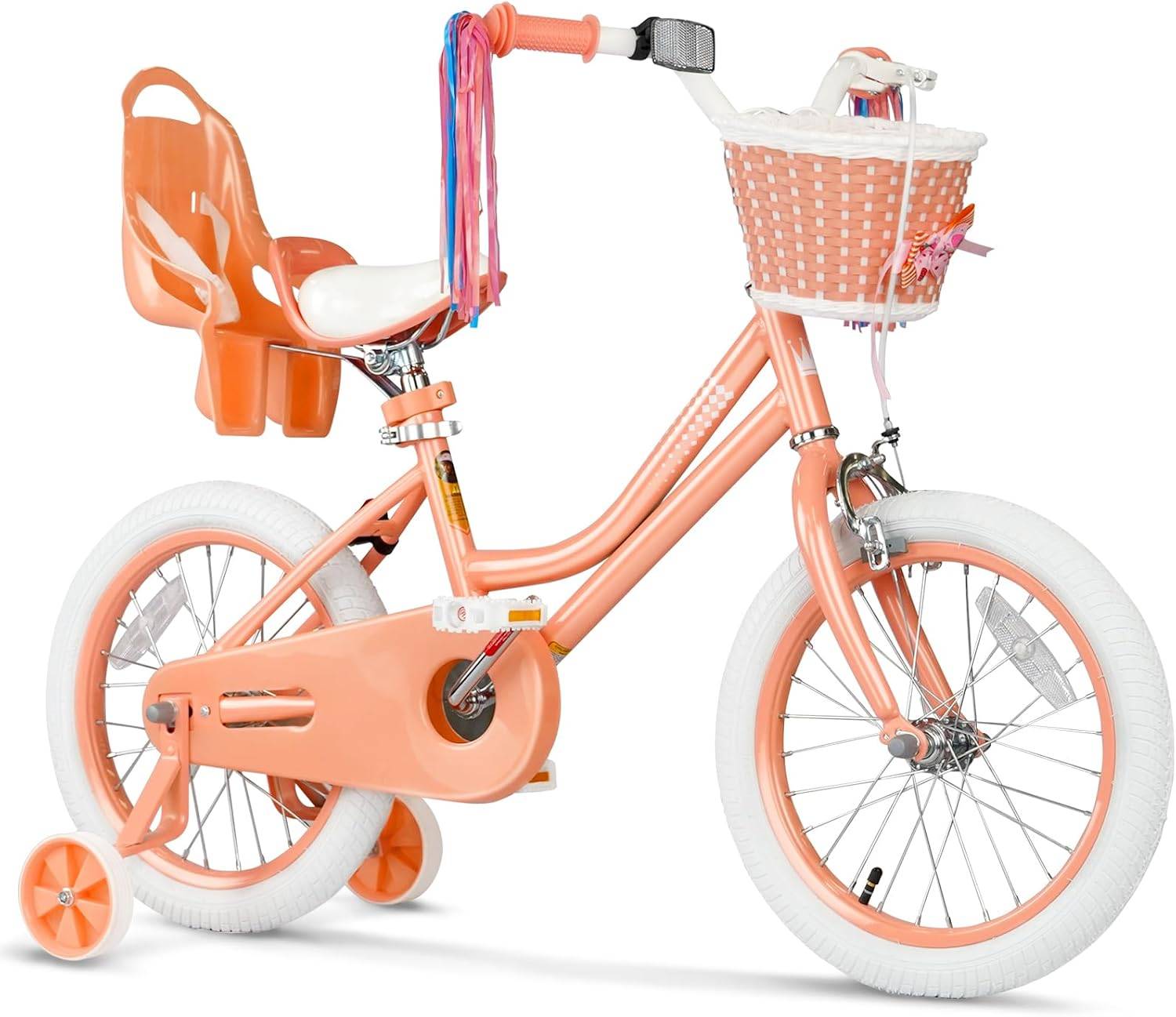 Girls 12/14/16 Inch Kids Bike by XJD with Training Wheels – Peach
A Training Wheel Bike offered in supplied 12 Inch, 14 Inch and 16 Inch SKU labels, making it relevant for comparing the main XBikes size starting points for a 3–5-year-old.
 XJD Light Purple Girls Bike with Basket, Training Wheels, 12/14/16/20 Inch
This Training Wheel Bike has supplied 12 Inch, 14 Inch and 16 Inch SKU labels. Despite “20 Inch” appearing in its exact title, only the supplied available labels should guide this comparison.
 XJD Girls BMX Bike 12/14/16 Inch with Training Wheels – Pink Blue
A Kids’ BMX Bike with supplied 12 Inch, 14 Inch and 16 Inch SKU labels, useful for comparing a different listed category across the same relevant size choices.
Training-wheel bike options
Girls 12/14/16 Inch Kids Bike by XJD with Training Wheels – Peach is categorized as a Training Wheel Bike and is supplied in 12 Inch, 14 Inch and 16 Inch labels. That makes it relevant when the height measurement points to any of the three main starting sizes.
XJD Light Purple Girls Bike with Basket, Training Wheels, 12/14/16/20 Inch is also categorized as a Training Wheel Bike. For the supplied catalog selection, the available SKU labels are 12 Inch, 14 Inch and 16 Inch. Although its exact title contains “20 Inch,” do not assume that size is available here; choose only from the supplied SKU labels.
A BMX-category option
XJD Girls BMX Bike 12/14/16 Inch with Training Wheels – Pink Blue is categorized as a Kids’ BMX Bike and has 12 Inch, 14 Inch and 16 Inch SKU labels. It provides a category comparison while retaining the same three relevant wheel-size choices. The category does not change the need to check the child’s individual fit and control.
Make the final size decision
First match measured height to the table. If only one range matches, try that size first. If two ranges overlap, compare both bikes directly and favor the one the child can stand over, reach, steer and brake on comfortably and confidently. Recheck the fit after adjustments according to the exact product manual; for uncertain assembly, adjustment, compatibility or maintenance questions, use a qualified bicycle mechanic.
Before riding, use a bicycle helmet that fits properly, sits level and has its straps secured according to the helmet manufacturer’s instructions. Supervise the fit check and initial rides.
For a 3–5-year-old, the practical decision is usually among 12, 14 and 16 inches: measure height, try the matching size or overlapping pair, and buy only when the child—not merely the age label—demonstrates comfortable clearance, reach, braking and control.
Bikes for your next adventure
-

Pink Girls' 12/14/16" Bike by XJD – Basket & Doll Seat
The XJD Pink Girls' Bike with Basket & Doll Seat is made for riders 71–122 cm ta…$75.99
$99.99 -

XJD Girls Bike for Kids Ages 3-8, 12/14/16 Inch with Training Wheels – Purple
The XJD Girls Bike in Purple is a training-wheel bicycle for kids ages 3 to 8, f…$149
$169 -

Light Purple XJD Toddler Bike Helmet, Adjustable, Size XS (46–51 cm)
This Light Purple XJD toddler bike helmet is made for the smallest riders — the …$20.39