

What size bike for child
Choose a child’s bike by measured height first, then confirm inseam clearance, comfortable reach, brake control and confidence on the actual bike.
Start with the child’s current measurements
Measure without shoes, using the child’s body today rather than the size you expect them to reach. For height, have them stand straight against a wall and measure from the floor to the top of the head.
For inseam, place a firm, thin book between the legs with its edge level, then measure from the floor to the book’s top edge. Record both height and inseam in inches or centimetres. Height gives you a starting wheel size; inseam helps you judge stand-over clearance when the child tries the complete bicycle.
Age is only a rough starting point. Two children of the same age can need different sizes, and an age printed in a catalog label does not prove that a bicycle fits a particular rider.
Compare height with the XBikes size chart
| Wheel size | Starting age | Rider height |
|---|---|---|
| 12 Inch | 3–4 | 34–40 in / 86–102 cm |
| 14 Inch | 3–6 | 37–45 in / 94–114 cm |
| 16 Inch | 4–7 | 40–48 in / 102–122 cm |
| 18 Inch | 5–9 | 43–52 in / 109–132 cm |
| 20 Inch | 7–12 | 48–60 in / 122–152 cm |
| 24 Inch | 10–14 | 54–64 in / 137–163 cm |
| 26 Inch | Youth and adults | Over 60 in / 153 cm |
Overlapping ranges are intentional starting points, not proof that either size will fit. When height falls in an overlap, compare both sizes in person if possible. The child’s control on the complete bicycle should decide—not a desire to choose the larger wheel.
Check the fit on the actual bicycle
Have the child try the bike. First check stand-over: with the child straddling the frame, their inseam must allow appropriate clearance rather than forcing contact with the frame. Because frame shapes differ, confirm the requirement in the exact product manual or ask a qualified bicycle mechanic.
Next, seat the child and check reach. They should be able to hold the handlebar naturally, steer without stretching or leaning excessively, and operate the brakes reliably with their hands in the normal riding position. Ask them to demonstrate starting, stopping and turning in a controlled area. Hesitation, poor balance or difficulty reaching the controls means the nominal size is not yet a good fit.
Do not buy an oversized bicycle simply to allow growth. A child who cannot comfortably stand over, steer or stop the bike needs a smaller or differently proportioned model, even if their age appears in the larger size range.
How the supplied 12, 14 and 16 Inch options compare
The three supplied catalog options are relevant when the height check points toward a 12, 14 or 16 Inch wheel and the child is currently learning with training wheels. Each offers those same three wheel-size labels, so the chart can narrow the choice before an individual fit check.
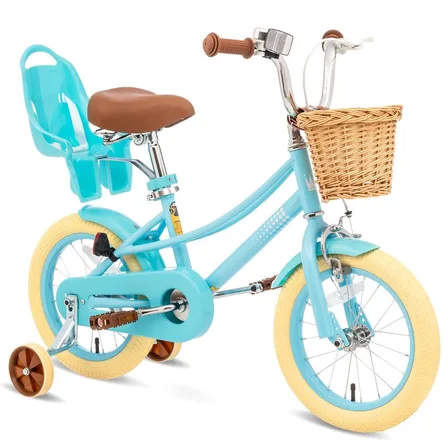
 Blue XJD Girls Bike with Training Wheels – 12/14/16 Inch
A Training Wheel Bike offered in 12 Inch, 14 Inch and 16 Inch SKU labels; relevant when measured height indicates one of those starting sizes and an individual fit check succeeds.
 XJD Boys 12/14/16" Training Wheel Bike – Blue
This blue Training Wheel Bike lists 12 Inch, 14 Inch and 16 Inch options. Use measured height to select a candidate, then verify stand-over, reach, brake control and confidence.
 XJD Kids' Training Wheel Bike for Boys & Girls, 12/14/16 Inch – White
A white Training Wheel Bike cataloged for boys and girls, with 12 Inch, 14 Inch and 16 Inch labels. Catalog wording does not replace measurement and an actual fit check.
Blue XJD Girls Bike with Training Wheels – 12/14/16 Inch, XJD Boys 12/14/16" Training Wheel Bike – Blue and XJD Kids' Training Wheel Bike for Boys & Girls, 12/14/16 Inch – White are all cataloged as Training Wheel Bikes and list 12 Inch, 14 Inch and 16 Inch SKUs. Their title wording and colour distinguish the listings, but neither establishes fit.
These products are relevant only if one of their listed sizes matches the child’s measured-height starting range and the complete bicycle passes the stand-over, reach, brake-control and confidence checks. They are not substitutes when the measurements and trial indicate an 18, 20, 24 or 26 Inch wheel. Consult each exact product manual or a qualified bicycle mechanic for assembly, maintenance, load limits, compatibility and torque information.
Make the final size decision
- Measure the child’s height and inseam now.
- Use measured height to identify one or two candidate wheel sizes in the table.
- Have the child straddle and sit on each candidate bicycle.
- Confirm comfortable stand-over clearance, natural reach, dependable brake operation and controlled starting, stopping and turning.
- Choose the size the child can control now; do not size up solely for future growth.
Before riding, add a properly fitting bicycle helmet. It should sit level and its straps should be adjusted according to the helmet manufacturer’s instructions. The right answer to “what size bike for child” is therefore the chart-based candidate that the child can comfortably stand over, reach, steer and stop today.
Bikes for your next adventure
-

XJD Girls Bike for Kids Ages 3-8, 12/14/16 Inch with Training Wheels – Purple
The XJD Girls Bike in Purple is a training-wheel bicycle for kids ages 3 to 8, f…$149
$169 -

Blue XJD Girls Bike with Training Wheels – 12/14/16 Inch
If you're shopping for a first pedal bike for a daughter roughly 3 to 8 years ol…$149
$169 -
Girls' Training Wheel Bike by XJD, 12–20 Inch Wheels – Blue
This XJD girls' training wheel bike in Blue covers one of the widest fit ranges …$139
$159