

What size bike for my 6 year old daughter
For most 6-year-old girls, compare a 16-inch bike first; also check 14-inch or 18-inch based on her measured height and individual fit.
Start with her height, not her age
At age 6, several wheel sizes overlap. Under the XBikes starting points, a 14-inch bike covers rider heights of 37–45 in (94–114 cm), a 16-inch bike covers 40–48 in (102–122 cm), and an 18-inch bike covers 43–52 in (109–132 cm). This makes 16 inches the sensible first comparison for many 6-year-olds, but it is not an automatic answer.
Measure your daughter without shoes, standing straight against a wall. Mark the top of her head and measure from the floor. Use that height to narrow the choices before considering how well she can stand over, reach and control a particular bicycle.
Measure her inseam as a fit check
Have her stand in socks with her feet naturally spaced. Place a firm book between her legs, bringing it up gently to simulate the position of a bicycle saddle. Measure from the floor to the top edge of the book.
The supplied wheel-size chart does not assign inseam ranges, so do not convert this measurement into a wheel size by itself. Instead, bring the measurement when checking the bicycle and compare it with the bike’s stand-over position and saddle adjustment instructions. Follow the exact product manual for adjustment limits; if anything is unclear, use a qualified bicycle mechanic.
Compare the likely wheel sizes
| Wheel size | XBikes starting point | How it applies at age 6 |
|---|---|---|
| 14 Inch | Ages 3–6; 37–45 in / 94–114 cm | Compare if she is within the height range, especially toward its lower portion, then verify control. |
| 16 Inch | Ages 4–7; 40–48 in / 102–122 cm | The first size to compare for many 6-year-olds, subject to a complete fit check. |
| 18 Inch | Ages 5–9; 43–52 in / 109–132 cm | Compare if her measured height falls in range and she can comfortably control it. |
| 20 Inch | Ages 7–12; 48–60 in / 122–152 cm | Relevant only if her height is already in this range and the individual fit works; do not size up merely for growth. |
Where height ranges overlap, the larger wheel is not automatically preferable. Her current confidence and ability to handle the whole bicycle should settle the decision.
Have her try the bicycle
A height chart narrows the search; a hands-on check decides whether the bike fits. The American Academy of Pediatrics advises having the child try the bicycle and avoiding an oversized bike bought mainly for future growth.
- Stand-over: Ask her to straddle the bicycle in the position directed by its manual. She should be able to stand securely rather than balance awkwardly against the frame.
- Reach: With her seated in a normal riding position, check that she reaches the handlebar without stretching, locking her arms or losing a stable posture.
- Brake control: Confirm that she can reach and operate the bike’s braking controls confidently. Do not assume a control is suitable solely because the wheel size matches.
- Confidence: Watch her start, steer, slow and stop in a controlled practice area. Hesitation caused by the bicycle feeling too tall, long or difficult to manage is a reason to compare another size.
How the supplied catalog option helps
The Pink Girls' 12/14/16" Bike by XJD – Basket & Doll Seat is listed in the Training Wheel Bikes category and offers 12 Inch, 14 Inch and 16 Inch SKU labels. Its 14-inch and 16-inch versions provide relevant comparison points for a 6-year-old whose measured height falls within those XBikes ranges. The 12-inch version starts at ages 3–4 and 34–40 in (86–102 cm), so it is generally not the first age-based comparison at six; assess it only from her actual measurements and fit.
These catalog options are useful because they let you compare two overlapping sizes relevant to many 6-year-olds within the same supplied product listing, while still requiring a hands-on fit decision.
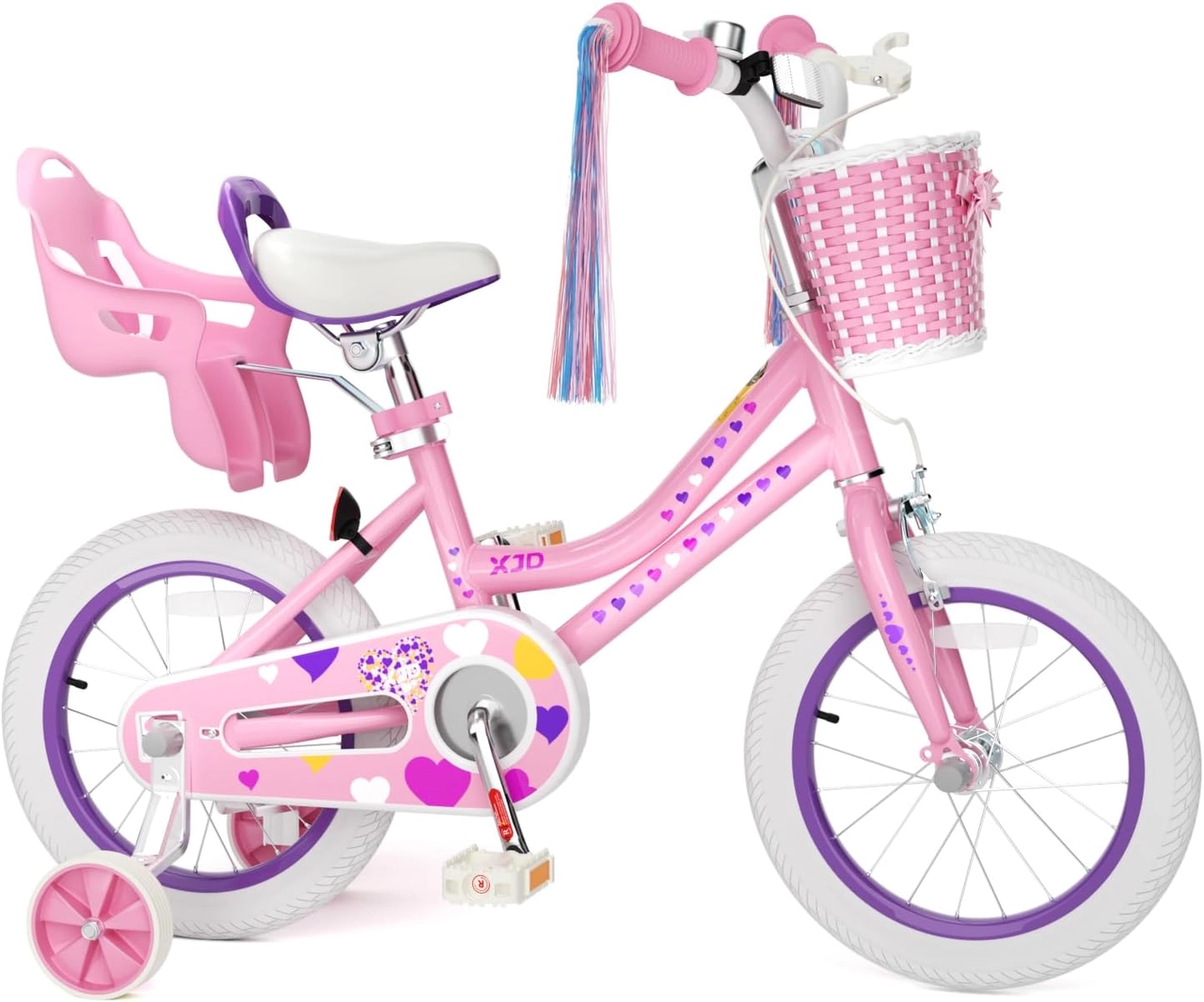
This product does not offer an 18-inch or 20-inch SKU in the supplied catalog facts. If her measurements and trial point to either size, treat the listed 14-inch and 16-inch versions only as comparison points, not equivalent substitutes.
Make the final decision
- Measure her standing height and inseam.
- Use height to compare 14, 16 and, when applicable, 18 inches.
- Have her try the candidate bike and check stand-over, reach, braking control and confidence.
- Reject any size that she cannot control now, even if it promises more growing room.
- Fit a bicycle helmet that sits level and uses its straps according to the helmet manufacturer’s instructions, as advised by the U.S. Consumer Product Safety Commission.
For your 6-year-old daughter, begin with a 16-inch trial, move to 14 inches if her height or control points smaller, and compare 18 inches only when her height and hands-on fit support it.
Bikes for your next adventure
-

XJD Kids Bike for Girls – Pink, 12/14/16/20 Inch with Training Wheels
The XJD Kids Bike for Girls in Pink is a training-wheel bike built to carry your…$139
$159 -

Blue XJD Girls Bike with Training Wheels – 12/14/16 Inch
If you're shopping for a first pedal bike for a daughter roughly 3 to 8 years ol…$149
$169 -

Light Pink XJD Girls' Bicycle with Basket & Training Wheels
The Light Pink XJD Girls' Bicycle with Basket & Training Wheels is a retro-style…$109.99
$129.99