

What size bike is a 16 inch frame
A 16-inch bike frame is not the same as a 16-inch kids bike. Confirm whether “16 inch” describes the frame or the wheels before choosing a size.
What “16 inch” means
On many adult bicycles, a 16-inch measurement refers to part of the frame, commonly the seat-tube area. That number alone does not establish a reliable rider height because frame geometry and measuring methods can differ. Use the manufacturer’s size chart for the exact model, then verify stand-over clearance, reach and control.
On children’s bicycles, “16 Inch” usually identifies wheel size rather than frame size. Under the XBikes wheel-size starting points, a 16-inch-wheel bike is intended as an initial comparison for riders about 40–48 inches (102–122 cm) tall, with ages 4–7 offered only as a rough starting range. A measured fit matters more than age.
Measure the child before comparing bikes
Start with current measurements rather than clothing size, a previous bicycle or expected growth. Have the child wear the shoes normally used for riding.
- Measure height: Have the child stand straight against a wall and measure from the floor to the top of the head.
- Measure inseam: With feet slightly apart, measure from the floor to the crotch. This helps assess whether the child can stand over the bicycle comfortably.
- Observe reach: On the actual bike, the child should reach the handlebar without being forced into an overstretched position.
- Check the controls: The child must be able to operate the brakes and steering controls confidently from the riding position.
Do not convert inseam directly into a wheel size using an unsupported formula. Compare height with the starting range, then use inseam and an in-person fit check to judge stand-over clearance.
Compare the 16-inch starting point
| Wheel label | Starting age | Rider height | How to use it |
|---|---|---|---|
| 14 Inch | 3–6 | 37–45 in / 94–114 cm | Compare when the rider is below or near the lower part of the 16-inch range. |
| 16 Inch | 4–7 | 40–48 in / 102–122 cm | The requested wheel-size starting point; confirm fit on the actual bicycle. |
| 20 Inch | 7–12 | 48–60 in / 122–152 cm | Compare only when the rider’s measured height reaches this range and control remains comfortable. |
The overlap between ranges is intentional: height does not settle the decision by itself. At a boundary, choose according to the child’s stand-over clearance, reach, brake access and present confidence. Do not buy an oversized bicycle merely to leave room for growth.
How the catalog option helps
The XJD Kids Bike for Girls – Pink, 12/14/16/20 Inch with Training Wheels is relevant because its supplied options include 12 Inch, 14 Inch, 16 Inch and 20 Inch labels. That makes its 16 Inch option directly relevant if the title is being used to ask about a child’s wheel size, while the adjacent labels provide comparison points. The catalog does not establish that “16 Inch” is a 16-inch frame measurement.
These particular options help answer the sizing question by letting you compare the requested 16 Inch wheel label with smaller and larger wheel labels within one listed product, while still requiring a fit check for the chosen option.

Do not infer frame dimensions, weight, materials, brake type, load limits or assembly details from the size labels. For those details, adjustment procedures and compatibility questions, follow the manual for the exact product and size, or ask a qualified bicycle mechanic.
Perform the fit check
Have the child try the exact bicycle rather than relying on the label. Check that the child can mount and dismount, stand over it with appropriate clearance, sit in a controllable position, turn the handlebar without strain and reach and operate the brakes. The bicycle should feel manageable at the child’s current skill level, including when starting, stopping and steering.
If the child is within the 40–48 inch (102–122 cm) starting range but cannot control the 16-inch-wheel bicycle comfortably, the label does not override the failed fit check. Compare an appropriate smaller option. If the child is already at or above the upper boundary, compare the next applicable range rather than assuming a 16-inch model will still fit.
Make the size decision
First identify the measurement: if it is truly a 16-inch frame, consult the exact bicycle maker’s geometry and size chart because the kids wheel-size table cannot translate it into a rider fit. If it is a 16-inch wheel label, begin with the 40–48 inch (102–122 cm) height range, then approve the bike only after stand-over, reach, brake control and confidence checks succeed.
Before riding, provide a properly fitting bicycle helmet. It should sit level and its straps should be used according to the helmet manufacturer’s instructions. The final decision is simple: choose the 16 Inch option only when both the label’s height starting point and the child’s real-world control agree.
Bikes for your next adventure
-
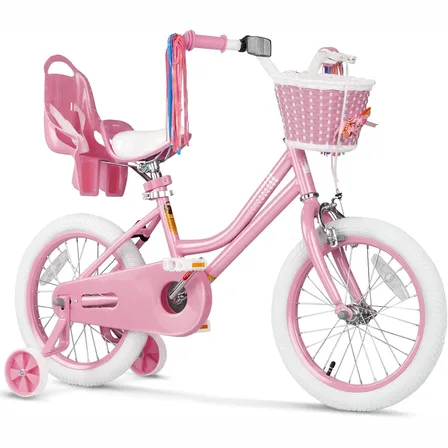
XJD Pink Girls' Bike – Kids 12/14/16 Inch Training Wheel Bicycle
The XJD Pink Girls' Bike is a training-wheel bicycle for girls ages 3 to 8 (ride…$149
$169 -

Black XJD Kids Bike for Boys – 12, 14 & 16 Inch Sizes
For a son between roughly 3 and 8 years old, the XJD Kids Bike in Black covers t…$169
$199 -
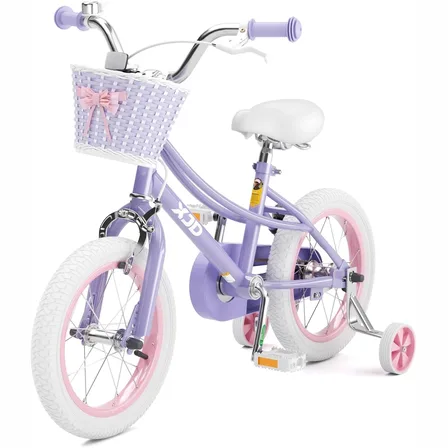
Girls' Training Wheel Bike by XJD with Basket – Purple
If you're shopping for a first bike for a girl roughly 3 to 12 years old (91–152…$75.99