

What size bike is best for a 12 year old
For most 12-year-olds, start by comparing a 20-inch and 24-inch bike: use 24 inches at 54–64 in (137–163 cm), or 20 inches at 48–60 in (122–152 cm). A rider over 60 in (153 cm) may need a 26-inch bike. Height narrows the choice, but the correct size is the one the child can stand over, reach, steer and brake confidently.
Measure the rider before choosing
Measure the child’s current height without shoes, standing straight against a wall. Then measure inseam from the floor to the crotch. Record both measurements rather than relying on age, clothing size or a growth estimate.
Height provides the XBikes wheel-size starting point. Inseam helps you judge stand-over clearance when the child tries the actual bicycle. Frame shapes and adjustment ranges can differ even when two bikes share a wheel size, so wheel diameter alone cannot confirm fit.
Compare the likely wheel sizes
| Wheel size | XBikes age starting point | Rider height starting point | Relevance at age 12 |
|---|---|---|---|
| 20 Inch | Ages 7–12 | 48–60 in / 122–152 cm | Compare if the measured height is within this range. |
| 24 Inch | Ages 10–14 | 54–64 in / 137–163 cm | A common starting comparison for this age. |
| 26 Inch | Youth and adults | Over 60 in / 153 cm | Consider when height exceeds the stated threshold. |
The ranges overlap intentionally. A 12-year-old between 54 and 60 in (137–152 cm) may fall within both the 20-inch and 24-inch starting points. Do not settle that overlap by choosing the larger bike for future growth; compare both through an individual fit check.
Perform the fit check
Have the child try the complete bicycle in a controlled setting. Confirm these points before choosing:
- Stand-over: the child can straddle the bicycle securely rather than being forced onto tiptoes or against the frame.
- Starting and stopping: mounting, setting off and putting a foot down feel controlled.
- Reach: the child can hold the bars and steer without stretching, locking the arms or leaning excessively.
- Brake control: the child can reach and operate the brake controls reliably while maintaining a stable grip.
- Confidence: turning, stopping and handling the bicycle do not make the rider visibly hesitant or overextended.
If the larger option compromises any of these checks, it is oversized now. The American Academy of Pediatrics advises having the child try the bicycle and not buying an oversized model merely for growth.
How the supplied bikes relate to a 12-year-old
The catalog options below help mainly as smaller-wheel comparison points. The XJD Girls' Bike with Training Wheels, 12/14/16/20 Inch – Purple and XJD Kids Bike for Girls – Pink, 12/14/16/20 Inch with Training Wheels both list 12-, 14-, 16- and 20-inch choices. The XJD Light Purple Girls Bike with Basket, Training Wheels, 12/14/16/20 Inch lists available SKU labels only in 12, 14 and 16 inches, despite “20 Inch” appearing in its exact catalog title.
 XJD Girls' Bike with Training Wheels, 12/14/16/20 Inch – Purple
A 20-inch SKU is listed alongside 12-, 14- and 16-inch choices. It is relevant only when the rider’s measured height and individual fit check support a 20-inch bike.
 XJD Kids Bike for Girls – Pink, 12/14/16/20 Inch with Training Wheels
This training-wheel bike includes a listed 20-inch choice as well as 12-, 14- and 16-inch options. Compare the 20-inch version only for a rider who fits that height starting point.
 XJD Light Purple Girls Bike with Basket, Training Wheels, 12/14/16/20 Inch
Although “20 Inch” appears in the exact catalog title, the supplied available SKU labels list only 12, 14 and 16 inches. It is therefore a smaller-size comparison, not a verified 20-inch option.
For a 12-year-old within the 20-inch height range, the first two products can provide 20-inch candidates for an actual fit check. They are categorized as training-wheel bikes, so also consider whether that configuration matches the rider’s present balance and confidence. The third product has no supplied available 20-inch SKU label and is therefore a smaller-size comparison, not a 20-inch substitute.
None of these supplied products offers a verified 24- or 26-inch option. If measurements point to either size, these products are not substitutes; compare an actual bicycle in the indicated wheel size elsewhere in the XBikes range.
Check setup and helmet fit
Once a bicycle passes the fit check, follow its exact product manual for assembly, adjustments, maintenance, compatibility, load limits and torque. If anything is unclear or the controls cannot be adjusted appropriately, use a qualified bicycle mechanic rather than improvising.
Add a properly fitting bicycle helmet. It should sit level and be secured with its straps according to the helmet manufacturer’s instructions. Recheck the fit rather than assuming an older helmet still fits.
Make the final size decision
Measure first, shortlist 20, 24 or 26 inches from the stated height ranges, and have the 12-year-old try every serious candidate. Choose the size that gives secure stand-over, comfortable reach, dependable brake control and present-day confidence—even when that means rejecting a larger bike intended for growth.
Bikes for your next adventure
-
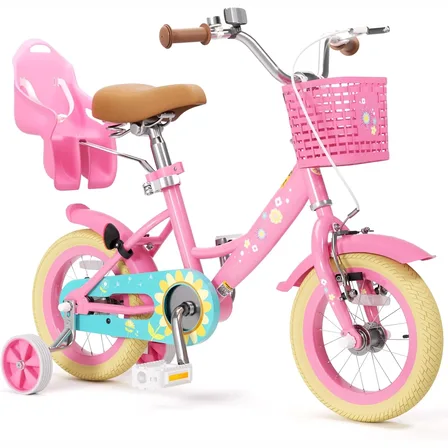
Flower Pink XJD Girls Bike with Doll Seat & Basket
The XJD Flower Pink girls' bike is made for riders 71–122 cm tall (roughly ages …$69.99
-

XJD Girls Bike for Kids Ages 3-8, 12/14/16 Inch with Training Wheels – Purple
The XJD Girls Bike in Purple is a training-wheel bicycle for kids ages 3 to 8, f…$149
$169 -

Pink Girls' 12/14/16" Bike by XJD – Basket & Doll Seat
The XJD Pink Girls' Bike with Basket & Doll Seat is made for riders 71–122 cm ta…$75.99
$99.99