

What size bike is best for a 5 year old
For most 5-year-olds, start by comparing 14-, 16-, and 18-inch bikes. Choose by measured height and an in-person fit check, not age alone.
Quick size decision
Measure your child’s standing height without shoes. Then use these XBikes starting points:
| Wheel size | XBikes age guide | Rider height |
|---|---|---|
| 14 Inch | Ages 3–6 | 37–45 in / 94–114 cm |
| 16 Inch | Ages 4–7 | 40–48 in / 102–122 cm |
| 18 Inch | Ages 5–9 | 43–52 in / 109–132 cm |
A 14-inch bike is the first comparison for a 5-year-old measuring 37–45 inches. A 16-inch bike is the first comparison at 40–48 inches, while an 18-inch bike enters the comparison at 43–52 inches. The ranges overlap deliberately: height narrows the options, but it does not confirm fit.
If your child falls within two ranges, compare both sizes in person. Do not automatically select the larger bike for extra growing room. A bicycle that is difficult to stand over, steer, stop, or balance can undermine control and confidence.
Measure height and inseam
For height, have the child stand straight against a wall without shoes. Place a flat object level on the head, mark the wall, and measure from the floor to the mark.
For inseam, have the child stand in socks with feet slightly apart. Hold a firm, thin book upward between the legs to represent the saddle, then measure from the floor to the book’s top edge. There is no supplied universal inseam-to-wheel-size formula, so use this measurement during the actual stand-over and saddle check rather than converting it into a wheel size.
Check the bike in person
The American Academy of Pediatrics advises having a child try the bicycle and avoiding an oversized model bought merely for growth. With an adult stabilizing the bike, check these points:
- Stand-over: The child should be able to straddle the frame with stable footing and without the frame pressing into the body.
- Reach: Hands should reach the handlebar without an uncomfortable stretch, locked arms, or a forced forward lean.
- Brake control: If the bike has hand controls, the child must be able to reach and operate them while keeping control of the handlebar.
- Steering and balance: The child should turn the handlebar comfortably and remain composed when starting, stopping, and changing direction.
- Confidence: Hesitation caused by the bike feeling tall, long, or difficult to control is a reason to compare another size.
Repeat these checks after any permitted saddle or handlebar adjustment. Follow the exact product manual for assembly, adjustment limits, maintenance, compatibility, load limits, and torque. Use a qualified bicycle mechanic when the instructions are unclear or the bike cannot be adjusted appropriately.
How the supplied XBikes options compare
The supplied catalog includes two training-wheel bikes with 14- and 16-inch choices, the sizes many 5-year-olds will compare after measuring height. One also offers a 20-inch choice. Neither product has an 18-inch option, so if the fit check points to 18 inches, these products are nearest-size comparison points rather than substitutes.
 XJD Kids' Training Wheel Bike for Boys & Girls, 12/14/16 Inch – White
A training-wheel bike offered in 12 Inch, 14 Inch, and 16 Inch labels. Its 14- and 16-inch choices are relevant comparison points after measuring the child and completing an individual fit check.
 Girls' Training Wheel Bike by XJD, 12–20 Inch Wheels – Blue
A training-wheel bike offered in 12 Inch, 14 Inch, 16 Inch, and 20 Inch labels. The 14- and 16-inch choices may be relevant; it has no 18-inch option.
XJD Kids' Training Wheel Bike for Boys & Girls, 12/14/16 Inch – White
This training-wheel bike is offered in 12 Inch, 14 Inch, and 16 Inch labels. For this question, its relevant comparisons are 14 Inch and 16 Inch. The 12 Inch starting range is ages 3–4 and 34–40 in / 86–102 cm, so age alone does not make it the expected starting choice for a 5-year-old.
Girls' Training Wheel Bike by XJD, 12–20 Inch Wheels – Blue
This training-wheel bike is offered in 12 Inch, 14 Inch, 16 Inch, and 20 Inch labels. Its 14- and 16-inch choices are relevant to many measured 5-year-olds. The 20 Inch starting point is ages 7–12 and 48–60 in / 122–152 cm, so it should not be chosen for growth when the child cannot pass the individual fit check.
The training-wheel category may be relevant when that format matches the child’s current confidence and the family’s intended setup. The catalog facts do not establish which model fits better, and they provide no 18-inch choice. Compare the exact selected SKU on the child rather than relying on the product name or the overall size span.
Helmet and final check
A properly fitting bicycle helmet is part of every ride. The U.S. Consumer Product Safety Commission advises that the helmet sit level and that its straps be used according to the helmet manufacturer’s instructions. A helmet cannot correct a poorly fitting bicycle.
For your 5-year-old, measure height and inseam today, shortlist 14, 16, or 18 inches from the table, and let stand-over, reach, brake control, and confidence decide the final size.
Bikes for your next adventure
-
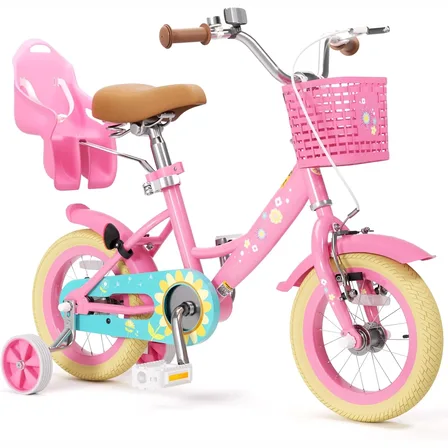
Flower Pink XJD Girls Bike with Doll Seat & Basket
The XJD Flower Pink girls' bike is made for riders 71–122 cm tall (roughly ages …$69.99
-

XJD Girls Bike for Kids Ages 3-8, 12/14/16 Inch with Training Wheels – Purple
The XJD Girls Bike in Purple is a training-wheel bicycle for kids ages 3 to 8, f…$149
$169 -

Pink Girls' 12/14/16" Bike by XJD – Basket & Doll Seat
The XJD Pink Girls' Bike with Basket & Doll Seat is made for riders 71–122 cm ta…$75.99
$99.99