

What size bike is for a 13 year old
For most 13-year-olds, start with a 24-inch bike if they are 54–64 in (137–163 cm) tall; consider a 26-inch bike once they are over 60 in (153 cm). Height, inseam, reach, brake control and confidence must confirm the choice.
Which wheel size should you check first?
Age narrows the search, but it does not determine fit. Under the XBikes starting points, a 24-inch bicycle covers ages 10–14 and heights of 54–64 in (137–163 cm). A 26-inch bicycle is a starting point for youth and adults over 60 in (153 cm).
A shorter 13-year-old may still fall within the 20-inch height range of 48–60 in (122–152 cm), although its age starting point is 7–12. At the boundaries—especially around 60 in—compare actual fit rather than choosing the larger wheel automatically.
| Wheel size | XBikes starting height | Relevance at age 13 |
|---|---|---|
| 20 Inch | 48–60 in / 122–152 cm | Check only if the rider's measured height and fit support it |
| 24 Inch | 54–64 in / 137–163 cm | The usual first size to try |
| 26 Inch | Over 60 in / 153 cm | Compare when the rider clears the height threshold |
Measure before comparing bikes
Measure the rider without shoes, standing straight against a wall. Record total height. Then measure inseam from the floor to the crotch using a firm, level book to represent the saddle area. The supplied standard gives height ranges, not inseam limits, so use inseam during the physical stand-over check rather than converting it into an invented wheel-size rule.
Bring these measurements when shopping, but have the child try the bicycle. Do not buy an oversized bicycle merely to allow room for growth. A bike that is difficult to mount, balance, steer or stop is not made suitable by the expectation that the rider will grow into it.
Perform a practical fit check
With the child standing over the bicycle, confirm that they can straddle it without being forced onto the frame. Seated in a normal riding position, they should not look stretched toward the handlebar or cramped between the saddle and controls.
Ask the rider to demonstrate each of these points in a controlled area:
- Mount and dismount without needing the bicycle held upright.
- Start, steer and make a controlled turn while looking ahead.
- Reach and operate the brakes without shifting the hands into an unstable position.
- Stop predictably and place a foot down with confidence.
- Maintain control at a slow speed rather than relying on momentum for balance.
If reach, stand-over clearance or brake use is doubtful, try a different size or configuration. A qualified bicycle mechanic can help assess fit and adjustments. Follow the exact product manual for assembly, maintenance, compatibility, load limits and torque requirements.
How the supplied cruiser options compare
The catalog provides one useful comparison family: the 26-Inch XJD Beach Cruiser Bike for Girls – Purple, V-Brake. Its available labels include 20-inch, 24-inch and 26-inch variants in specified colors, so parents can compare the three wheel-size starting points most likely to arise for a 13-year-old. These labels help narrow choices, but they do not establish individual fit.
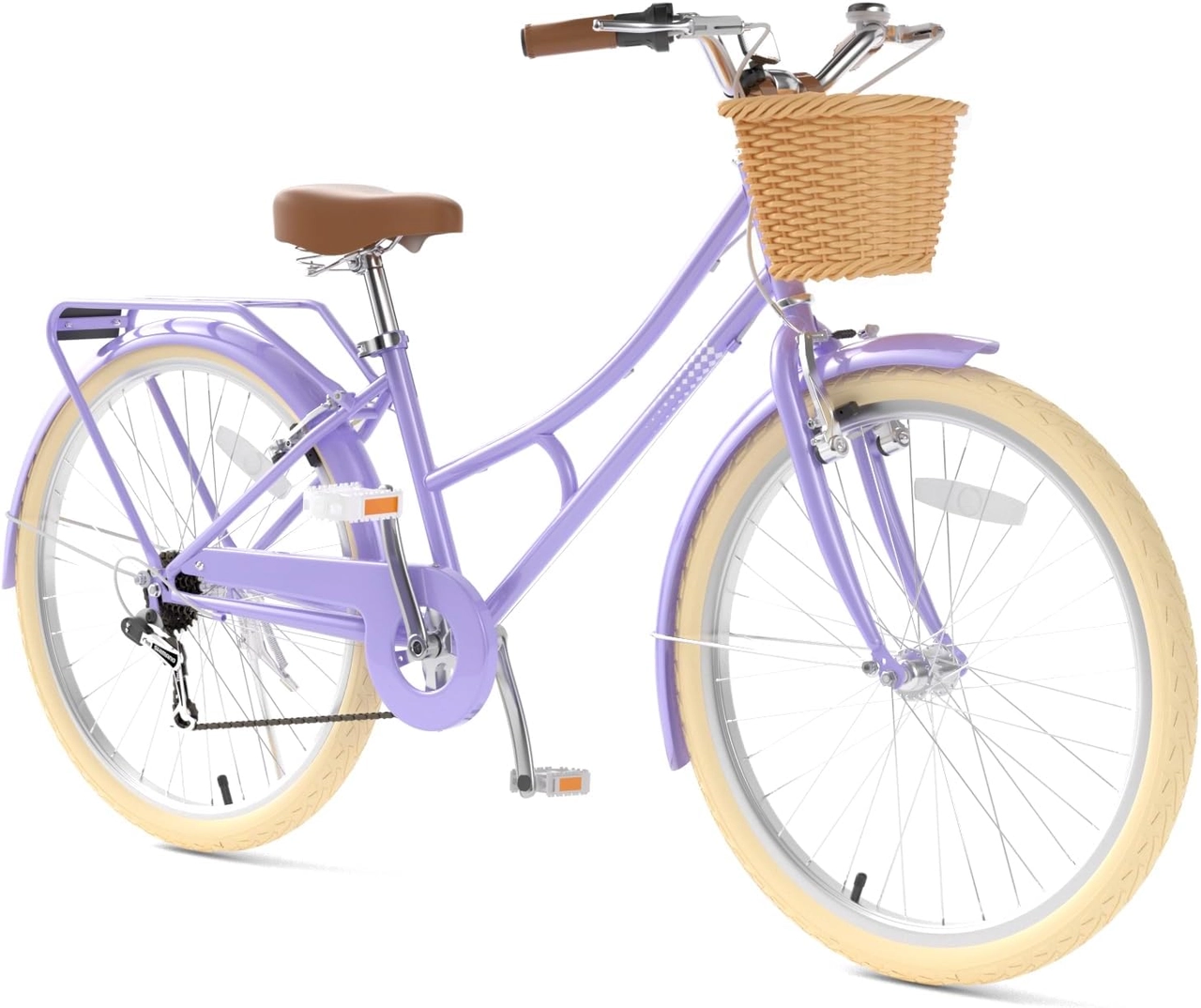
The 24-inch labels align with the XBikes 54–64 in (137–163 cm) starting range. The 26-inch labels become relevant when the rider is over 60 in (153 cm). The 20-inch labels may be worth checking for a rider within 48–60 in (122–152 cm), but that size is not equivalent to a 24-inch or 26-inch bicycle.
The exact product title identifies the purple 26-inch version and its V-brake. Available labels also list Mint Green in 20, 24 and 26 inches; Pink in 20, 24 and 26 inches; and Purple in 26 inches. Color and wording such as “for Girls” are catalog distinctions, not evidence that the bicycle fits a particular child. Confirm brake reach and control during the try-out.
Do not finish the decision at wheel size
Wheel size is only the first filter. Two riders of the same height can differ in inseam, arm reach, coordination and confidence. A child moving up from a smaller bicycle may need time to show controlled starts and stops on the next size. If the larger candidate makes those actions harder, do not select it simply because the rider falls within an overlapping height range.
Also fit a bicycle helmet for every ride. It should fit properly, sit level on the head and have its straps adjusted according to the helmet manufacturer's instructions. A helmet cannot correct a poorly fitting bicycle, so check both separately.
Make the final choice
For a 13-year-old measuring 54–60 in, try a 24-inch bicycle first while keeping a 20-inch comparison available only if their size and control indicate it. From over 60 through 64 in, compare 24-inch and 26-inch bicycles directly. Above 64 in, begin with the 26-inch starting point. Choose only after the rider can straddle, reach, steer and brake confidently—never by age or growth room alone.
Bikes for your next adventure
-

Light Purple XJD Toddler Bike Helmet, Adjustable, Size XS (46–51 cm)
This Light Purple XJD toddler bike helmet is made for the smallest riders — the …$20.39
-

Pink Girls' 12/14/16" Bike by XJD – Basket & Doll Seat
The XJD Pink Girls' Bike with Basket & Doll Seat is made for riders 71–122 cm ta…$75.99
$99.99 -

XJD Girls Bike for Kids Ages 3-8, 12/14/16 Inch with Training Wheels – Purple
The XJD Girls Bike in Purple is a training-wheel bicycle for kids ages 3 to 8, f…$149
$169