

What size bike should i buy for my toddler
Measure your toddler’s standing height and inseam, then start with a 12-inch or 14-inch bike only if the measurements and a hands-on fit check agree. Never buy a larger bike simply for room to grow.
Start with measured height, not age
Have your child stand straight against a wall without bulky headwear and measure from the floor to the top of the head. Measure inseam from the floor to the crotch while the child wears the shoes normally used for riding. These measurements give you a starting point, but they do not prove that a particular frame will fit.
| Wheel size | XBikes age starting point | Rider height starting point |
|---|---|---|
| 12 Inch | Ages 3–4 | 34–40 in / 86–102 cm |
| 14 Inch | Ages 3–6 | 37–45 in / 94–114 cm |
| 16 Inch | Ages 4–7 | 40–48 in / 102–122 cm |
The ranges overlap because wheel size alone does not determine fit. If your toddler is under 34 in / 86 cm, this table does not provide a suitable bicycle starting point. Do not automatically move to a 12-inch bike; seek an appropriately designed option and verify its fit in person.
Use inseam to check stand-over room
Wheel size labels do not tell you the frame’s stand-over height. With the bicycle upright, have your child straddle the top tube with both feet supported securely on the ground. The frame must not press against the child, and the child should be able to mount and dismount without being trapped or tipping the bike.
Compare the measured inseam with the exact bicycle’s dimensions and fitting instructions in its product manual. If those dimensions are unavailable or unclear, use a qualified bicycle mechanic. Do not assume that every 12-inch or 14-inch frame has identical geometry.
Check reach, brakes and present control
Place the child in the intended riding position while an adult stabilizes the bicycle. The child should reach the handlebar without stretching, locking the elbows or leaning excessively forward. Ask the child to turn the handlebar both ways and show that steering remains controlled.
If the bicycle has hand-operated brakes, the child must be able to reach and operate them as intended while keeping control of the handlebar. Confirm any other braking method using the exact product manual. The child should also be able to start, stop, balance and put a foot down confidently. Training wheels may support early practice, but they do not correct excessive frame size, poor reach or inaccessible controls.
How the supplied XBikes options compare
The three supplied catalog options are useful comparison points because their verified available SKU labels cover 12 Inch, 14 Inch and 16 Inch—the sizes that overlap the youngest ranges in the XBikes chart. They help you compare the wheel-size starting point with your child’s measurements before completing an individual fit check.
 Girls 12/14/16 Inch Kids Bike by XJD with Training Wheels – Peach
A Training Wheel Bike offered in supplied 12 Inch, 14 Inch and 16 Inch labels; compare the appropriate label with measured height, then verify the exact frame’s stand-over, reach and controls.
 XJD Light Purple Girls Bike with Basket, Training Wheels, 12/14/16/20 Inch
A Training Wheel Bike with supplied available labels of 12 Inch, 14 Inch and 16 Inch. Its title mentions 20 Inch, but the supplied SKU list does not verify that option.
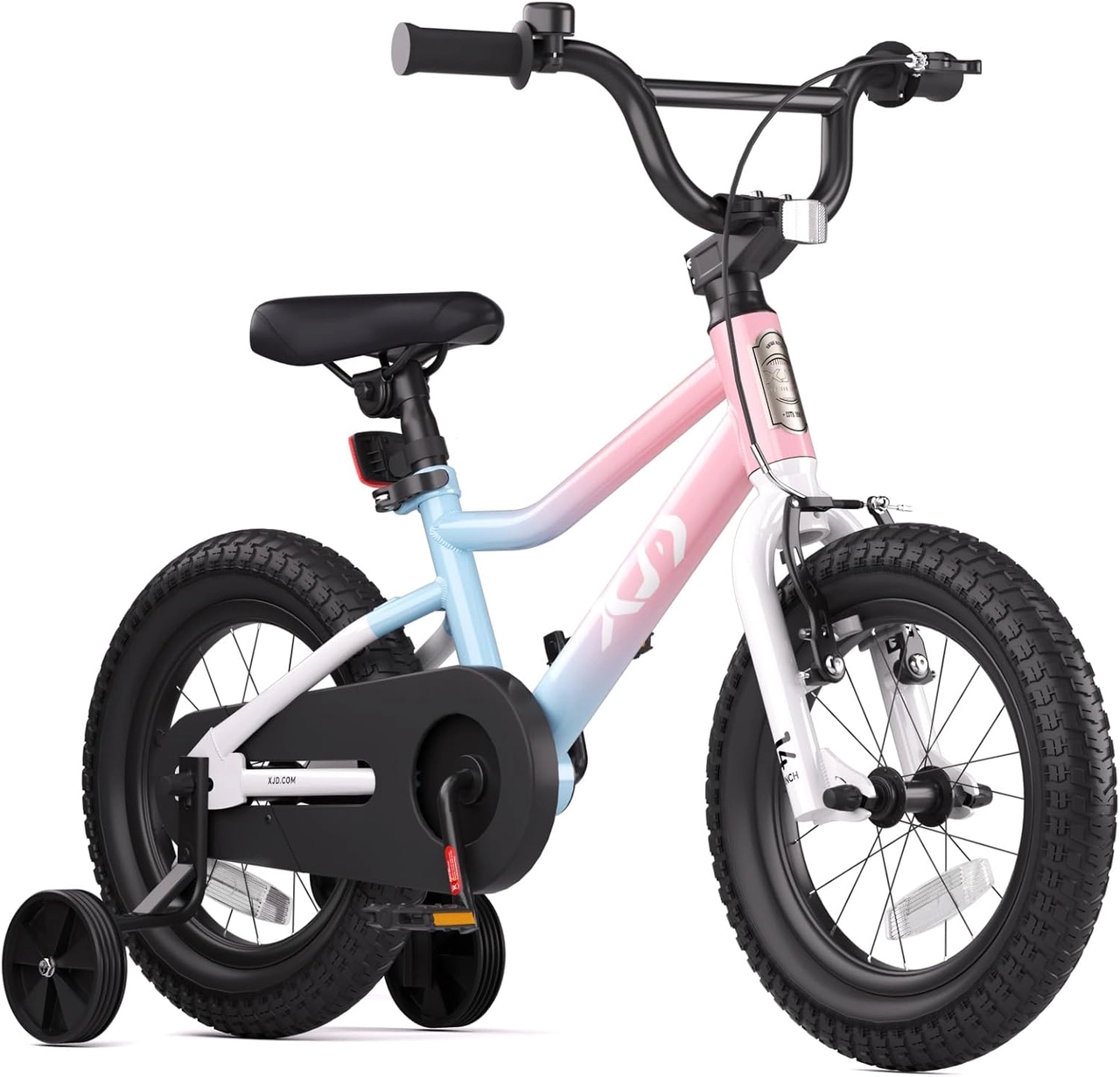 XJD Girls BMX Bike 12/14/16 Inch with Training Wheels – Pink Blue
A Kids’ BMX Bike with training wheels and supplied 12 Inch, 14 Inch and 16 Inch labels. Its category and wheel label do not replace an individual stand-over, reach and brake-control check.
Girls 12/14/16 Inch Kids Bike by XJD with Training Wheels – Peach is categorized as a Training Wheel Bike and has supplied available labels of 12 Inch, 14 Inch and 16 Inch.
XJD Light Purple Girls Bike with Basket, Training Wheels, 12/14/16/20 Inch is also categorized as a Training Wheel Bike. Although 20 Inch appears in its exact catalog title, the supplied available SKU labels are only 12 Inch, 14 Inch and 16 Inch, so availability of another size should not be inferred.
XJD Girls BMX Bike 12/14/16 Inch with Training Wheels – Pink Blue is categorized as a Kids’ BMX Bike and likewise has supplied available labels of 12 Inch, 14 Inch and 16 Inch.
These facts identify categories and size labels only. They do not establish frame dimensions, brake reach, stock, construction or suitability for an individual child. Consult the exact product manual for assembly, maintenance, compatibility, load limits and torque information, or ask a qualified bicycle mechanic.
Make the final size decision in person
- Use standing height to identify a possible wheel size from the table.
- Use inseam to rule out a frame that lacks comfortable stand-over room.
- Have your child try the exact bicycle and check mounting, reach, steering, braking, starting and stopping.
- If two sizes appear possible, choose the one your child can control now rather than the larger one intended for future growth.
This follows the American Academy of Pediatrics guidance to have a child try the bicycle, avoid buying an oversized bike for growth, and check stand-over, control and brake reach. Once the bicycle fits, add a properly fitting helmet that sits level and has its straps adjusted according to the helmet manufacturer’s instructions, consistent with U.S. Consumer Product Safety Commission guidance.
Your next step is simple: record height and inseam, shortlist 12 Inch or 14 Inch only when the chart supports it, and buy only after your toddler demonstrates comfortable control of the exact bike.
Bikes for your next adventure
-

XJD Girls BMX Bike 12/14/16 Inch with Training Wheels – Pink Blue
The XJD Girls BMX Bike in Pink/Blue is built as a first pedal bike for kids roug…$99.99
$119.99 -

Blue XJD Kids Bike Helmet for Boys & Girls
The Blue XJD Kids Bike Helmet is a lightweight, adjustable multi-sport helmet fo…$59.99
$99 -

Kids Bike Helmet by XJD for Boys & Girls – Black, Blue, Green, Pink, Purple
The XJD Kids Bike Helmet covers a wide 2-to-8-year age range thanks to two head-…$59.99