

What size bike should my 10 year old have
Most 10-year-olds should start by trying a 20-inch or 24-inch bike, depending on measured height: 20-inch fits 48–60 in (122–152 cm), while 24-inch fits 54–64 in (137–163 cm). Age is only a starting point; the correct choice also depends on inseam clearance, reach, brake control and confidence.
Measure your child before choosing
Measure your child’s standing height without shoes, with their back straight against a wall. Then measure inseam: have them stand with feet slightly apart and measure from the floor to the crotch. Record both measurements in inches or centimetres.
Use standing height to identify likely wheel sizes. Use inseam during an actual fit check to judge whether the child can stand over the bicycle comfortably. Wheel size does not establish stand-over clearance by itself because frame shapes can differ.
Compare the two likely wheel sizes
| Wheel size | XBikes starting range | What it means for a 10-year-old |
|---|---|---|
| 20 Inch | Ages 7–12; 48–60 in / 122–152 cm | A starting point when the rider falls within this height range, especially if a smaller, more manageable fit supports current confidence. |
| 24 Inch | Ages 10–14; 54–64 in / 137–163 cm | A starting point when the rider is at least 54 in / 137 cm and can comfortably control the specific bicycle. |
| 26 Inch | Youth and adults over 60 in / 153 cm | Consider only when the rider is over 60 in / 153 cm and passes the complete fit check; age ten alone does not justify it. |
The ranges overlap. A child between 54 and 60 in (137 and 152 cm) may need to compare both 20-inch and 24-inch bicycles in person. Do not automatically choose the larger wheel for growth.
Perform the fit check on the actual bike
Have your child try the assembled bicycle under close adult supervision. The right wheel-size range narrows the search, but the particular frame and controls determine whether the bike truly fits.
- Check stand-over: with both feet on the ground and the bicycle upright, confirm that the child can stand over the frame without being pressed against it.
- Check starting and stopping: the rider should be able to get on, start, stop and put a foot down without struggling or tipping from lack of control.
- Check reach: while seated, the child should reach the handlebar naturally rather than stretching, locking the elbows or leaning excessively.
- Check braking: confirm that the child can reach and operate the brake controls reliably while maintaining steering control.
- Check confidence: choose the bicycle the child can handle now. An oversized bike can make mounting, steering and stopping harder.
If adjustments, assembly details or compatibility questions arise, follow the exact product manual or ask a qualified bicycle mechanic. Do not improvise settings or procedures.
How the supplied XBikes options help
The catalog options below provide 20-inch, 24-inch and 26-inch comparison points—the sizes most relevant around age ten once height is known. Their listed size labels help narrow what to try, but they do not replace the individual fit check.
 Pink 12/14/16/20" XJD Girls Bike with Training Wheels & Basket
The 20 Inch option is relevant for a 10-year-old measuring 48–60 in (122–152 cm); the available 12, 14 and 16 Inch labels serve shorter XBikes height ranges.
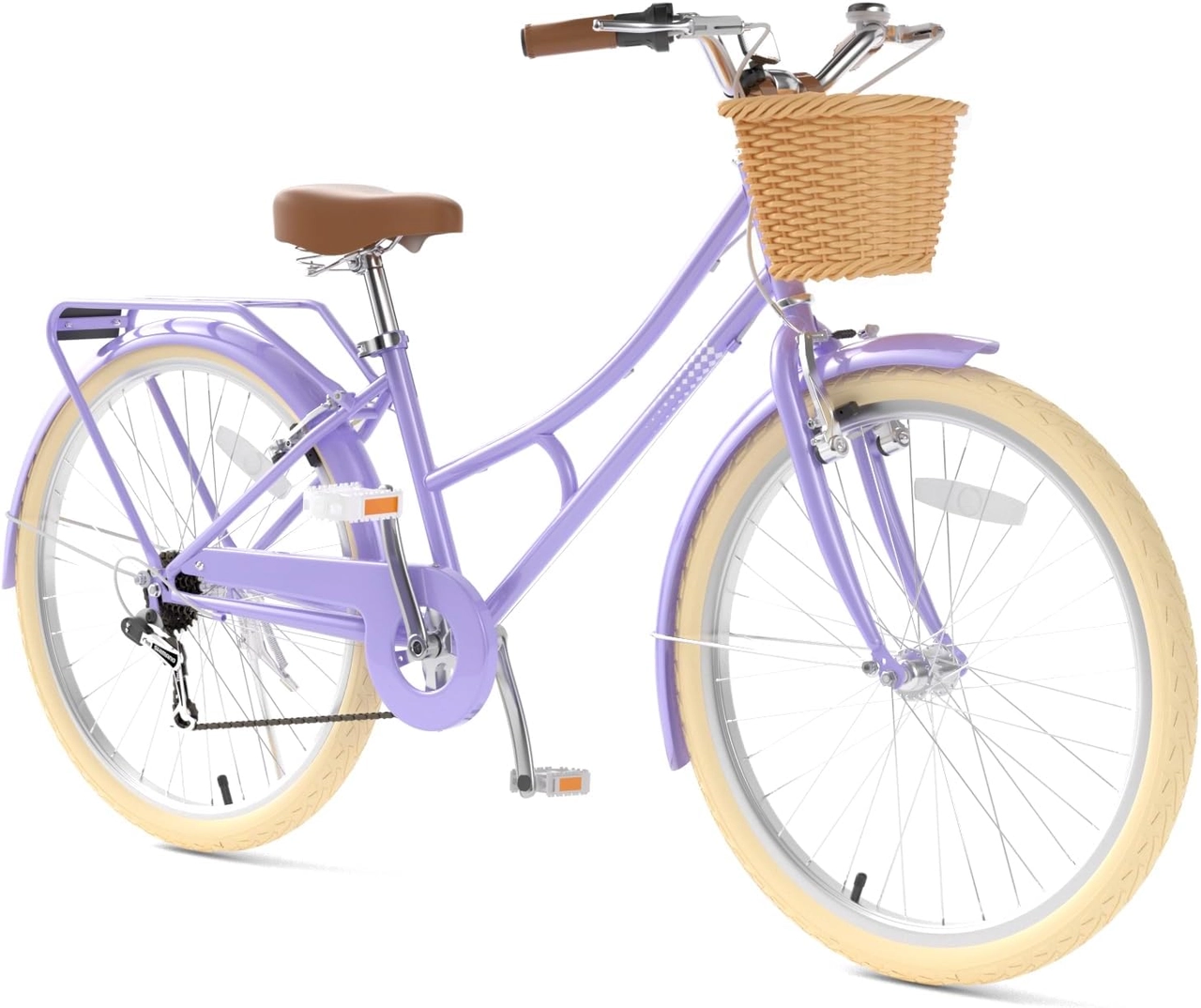 26-Inch XJD Beach Cruiser Bike for Girls – Purple, V-Brake
Its available 20 Inch and 24 Inch labels support an adjacent-size comparison for riders in the overlapping height range; 26 Inch is relevant only above 60 in / 153 cm after a fit check.
The Pink 12/14/16/20" XJD Girls Bike with Training Wheels & Basket is available in 12 Inch, 14 Inch, 16 Inch and 20 Inch labels. For this question, its 20 Inch option is the relevant starting point for a rider measuring 48–60 in (122–152 cm). Its smaller options correspond to shorter XBikes height ranges and should not be selected merely because they share the same product listing.
The 26-Inch XJD Beach Cruiser Bike for Girls – Purple, V-Brake has available labels covering 20 Inch, 24 Inch and 26 Inch in specified colours. Its 20-inch and 24-inch labels let a child in the overlapping height range compare adjacent sizes. The 26-inch labels are relevant only for a rider over 60 in / 153 cm who can comfortably stand over, reach and control the actual bike.
Make the decision
If your 10-year-old is 48–53 in (122–136 cm), begin with a 20-inch bike. At 54–60 in (137–152 cm), try both 20-inch and 24-inch bikes and choose by control and confidence. At 61–64 in (155–163 cm), begin with 24 Inch while checking whether a 26-inch comparison is appropriate under the over-60-inch standard. A rider at 60 in / 153 cm is not yet “over 60 in,” so do not treat that measurement as automatic 26-inch eligibility.
Before riding, provide a properly fitting bicycle helmet. It should sit level, and its straps should be used according to the helmet manufacturer’s instructions. Your next step is simple: measure height and inseam, identify the starting sizes above, then have your child try those exact bicycles and choose the one they can stand over, reach, brake and control today.
Bikes for your next adventure
-

Green XJD Toddler Bike Helmet with Adjustable Fit, XS (46–51 cm)
The XJD toddler bike helmet in Green is built for the youngest riders — the size…$20.39
$23.99 -

Kids Bike Helmet by XJD for Boys & Girls – Black, Blue, Green, Pink, Purple
The XJD Kids Bike Helmet covers a wide 2-to-8-year age range thanks to two head-…$59.99
-

Kids Bike Helmet by XJD for Girls – Pink
The XJD Kids Bike Helmet in Pink is a lightweight multi-sport helmet for girls r…$59.99
$99