

What size bike should my 11 year old have
Most 11-year-olds need a 20-inch or 24-inch bike: start with measured height, then confirm inseam clearance, reach and brake control in person.
Choose the starting size by height
Age narrows the search, but it does not determine fit. Measure your child without shoes, standing straight against a wall. Compare that height with the XBikes starting points below.
| Wheel size | XBikes age guide | Rider height |
|---|---|---|
| 20 Inch | 7–12 | 48–60 in / 122–152 cm |
| 24 Inch | 10–14 | 54–64 in / 137–163 cm |
| 26 Inch | Youth and adults | Over 60 in / 153 cm |
An 11-year-old measuring under 54 inches may begin with a 20-inch bike. From 54 to 60 inches, the 20-inch and 24-inch ranges overlap, so the individual fit check decides. From 60 to 64 inches, start with 24 inches. Above 60 inches, 26-inch bicycles also enter the XBikes starting range, but wheel size alone still cannot confirm fit.
Measure inseam as well as overall height
To measure inseam, have the child stand in socks with feet slightly apart. Place a firm, thin book between the legs and raise it gently to simulate a saddle. Measure vertically from the floor to the top edge of the book.
Compare that measurement with the bicycle’s stand-over height, using the exact model information or an in-person check. When the child straddles the bike with both feet flat, the frame should not press into the body. Because frame shapes vary even when wheel sizes match, do not assume every 20-inch or every 24-inch bike will fit identically.
Perform the fit and control check
Have your child try the actual bicycle. Do not choose an oversized model solely to leave room for growth. With the seat adjusted within the manufacturer’s permitted range, check that the rider can start, stop and balance without stretching or leaning excessively.
- Stand-over: The child can straddle the frame comfortably with feet flat.
- Reach: The handlebars can be held while the arms remain comfortably controlled, without the torso being pulled far forward.
- Brake control: The child can reach and operate the brake controls reliably from the normal riding position.
- Confidence: The rider can look ahead, steer, turn and stop without appearing intimidated by the bicycle’s size.
If either adjacent wheel size passes the height screen, prefer the one on which the child has better control. A technically plausible size is still wrong if the rider cannot operate it confidently.
How the supplied 20-inch options apply
The catalog options help because both include a 20 Inch size, the smaller of the two common starting points for an 11-year-old. The XJD Girls' Bike with Training Wheels, 12/14/16/20 Inch – Purple and the XJD Kids Bike for Girls – Pink, 12/14/16/20 Inch with Training Wheels are both categorized as Training Wheel Bikes and offer 12, 14, 16 and 20 Inch labels. They are relevant only when the 20-inch height range and an individual fit check support that choice.
 XJD Girls' Bike with Training Wheels, 12/14/16/20 Inch – Purple
Offered in 12, 14, 16 and 20 Inch labels. Its 20 Inch option is relevant when an 11-year-old measures 48–60 inches and passes an individual fit check; it is not a 24-inch substitute.
 XJD Kids Bike for Girls – Pink, 12/14/16/20 Inch with Training Wheels
This pink Training Wheel Bike offers 12, 14, 16 and 20 Inch labels. Consider the 20 Inch option only when the rider’s measured height, stand-over clearance, reach, braking and confidence confirm the fit.
The two products provide the same supplied size choices; their exact titles distinguish purple from pink. No supplied fact establishes differences in frame geometry, brakes, weight, components or adjustability, so those points should not be inferred.
Neither supplied product has a 24 Inch or 26 Inch option. If your child fits those starting ranges, these 20-inch products are nearest-size comparison points, not substitutes for the required larger size. A 20-inch bike is not equivalent to a 24-inch bike.
What to do before buying
- Measure the child’s standing height and inseam rather than relying on age.
- Use height to shortlist 20, 24 or 26 inches from the XBikes ranges.
- Have the child straddle and ride the exact model, checking reach, braking and confidence.
- Reject any bike that is intentionally oversized or difficult to control.
- For assembly, adjustment limits, maintenance, compatibility, load limits or torque, follow the exact product manual or ask a qualified bicycle mechanic.
Finish the setup with a properly fitting bicycle helmet. It should sit level and its straps should be used according to the helmet manufacturer’s instructions.
For your 11-year-old, choose 20 inches only if measured height is 48–60 inches and the complete fit check succeeds; choose a suitable 24-inch or 26-inch model instead when the measurements and control check point upward.
Bikes for your next adventure
-
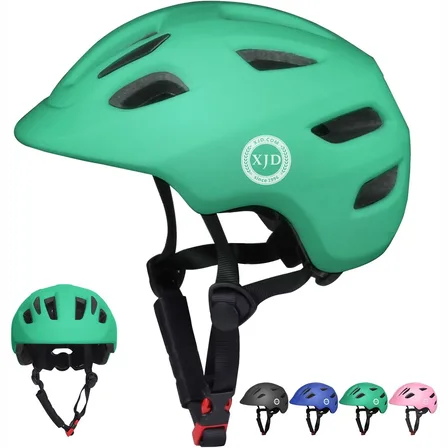
Green XJD Toddler Bike Helmet with Adjustable Fit, XS (46–51 cm)
The XJD toddler bike helmet in Green is built for the youngest riders — the size…$20.39
$23.99 -

Kids Bike Helmet by XJD for Boys & Girls – Black, Blue, Green, Pink, Purple
The XJD Kids Bike Helmet covers a wide 2-to-8-year age range thanks to two head-…$59.99
-

Kids Bike Helmet by XJD for Girls – Pink
The XJD Kids Bike Helmet in Pink is a lightweight multi-sport helmet for girls r…$59.99
$99