

What size bike should my 9 year old ride
Most 9-year-olds should compare 18-inch and 20-inch bikes first: choose by measured height and actual fit, not age alone. An 18-inch bike starts at 43–52 in (109–132 cm), while a 20-inch bike starts at 48–60 in (122–152 cm).
Which wheel size fits a 9-year-old?
Age nine falls at the upper end of the XBikes 18-inch starting range and within the 20-inch range. The child’s height narrows the choice:
| Wheel size | XBikes age starting point | Rider height | Relevance at age 9 |
|---|---|---|---|
| 18 Inch | Ages 5–9 | 43–52 in / 109–132 cm | Compare when the rider is within this height range, especially if a smaller, more manageable fit supports current confidence. |
| 20 Inch | Ages 7–12 | 48–60 in / 122–152 cm | The usual first comparison for many 9-year-olds, subject to the complete fit check. |
| 24 Inch | Ages 10–14 | 54–64 in / 137–163 cm | Consider only when measured height and an in-person fit support it; do not size up merely for growth. |
| 26 Inch | Youth and adults | Over 60 in / 153 cm | Relevant only for a rider over this height who can comfortably control the bicycle. |
The height bands overlap, so a measurement cannot make the final decision by itself. Inseam, reach, brake operation and confidence determine whether the bicycle is genuinely manageable.
Measure height and inseam before shopping
- Measure standing height: Have the child stand upright without shoes against a wall. Mark the top of the head and measure from the floor.
- Measure inseam: With feet naturally spaced, place a firm book level between the legs to represent the saddle area. Measure from the floor to the top edge of the book.
- Record both measurements: Use height to select the starting wheel-size range, then take the inseam measurement to the bicycle fit check.
Do not estimate from clothing size, school year or a previous bike. Growth varies, and two children of the same age can need different sizes.
Check the bicycle with the child present
Have the child try the exact bicycle rather than treating its wheel label as proof of fit. With the child standing over it, confirm that the frame does not interfere with comfortable stand-over. Follow the exact product manual for the intended stand-over and adjustment guidance because those details are not supplied here.
Next, check whether the child can reach the handlebar without stretching or becoming cramped. They should be able to steer steadily, keep control during starts and stops, and operate the brakes reliably. Brake levers that are difficult to reach or squeeze are a reason to reject that fit, even if height appears to match the table.
Confidence matters too. If a 20-inch bicycle makes the rider hesitant or unable to control stops, compare an 18-inch model within the matching height band. If an 18-inch bike is cramped or restricts control, compare 20-inch options. Never buy an oversized bike solely to leave room for growth.
How the supplied XBikes options help
The catalog options provide useful 20-, 24- and 26-inch comparison points. They can help a family compare a common size for a 9-year-old with larger next-step sizes, but the child must still try the selected configuration and pass the full fit check.
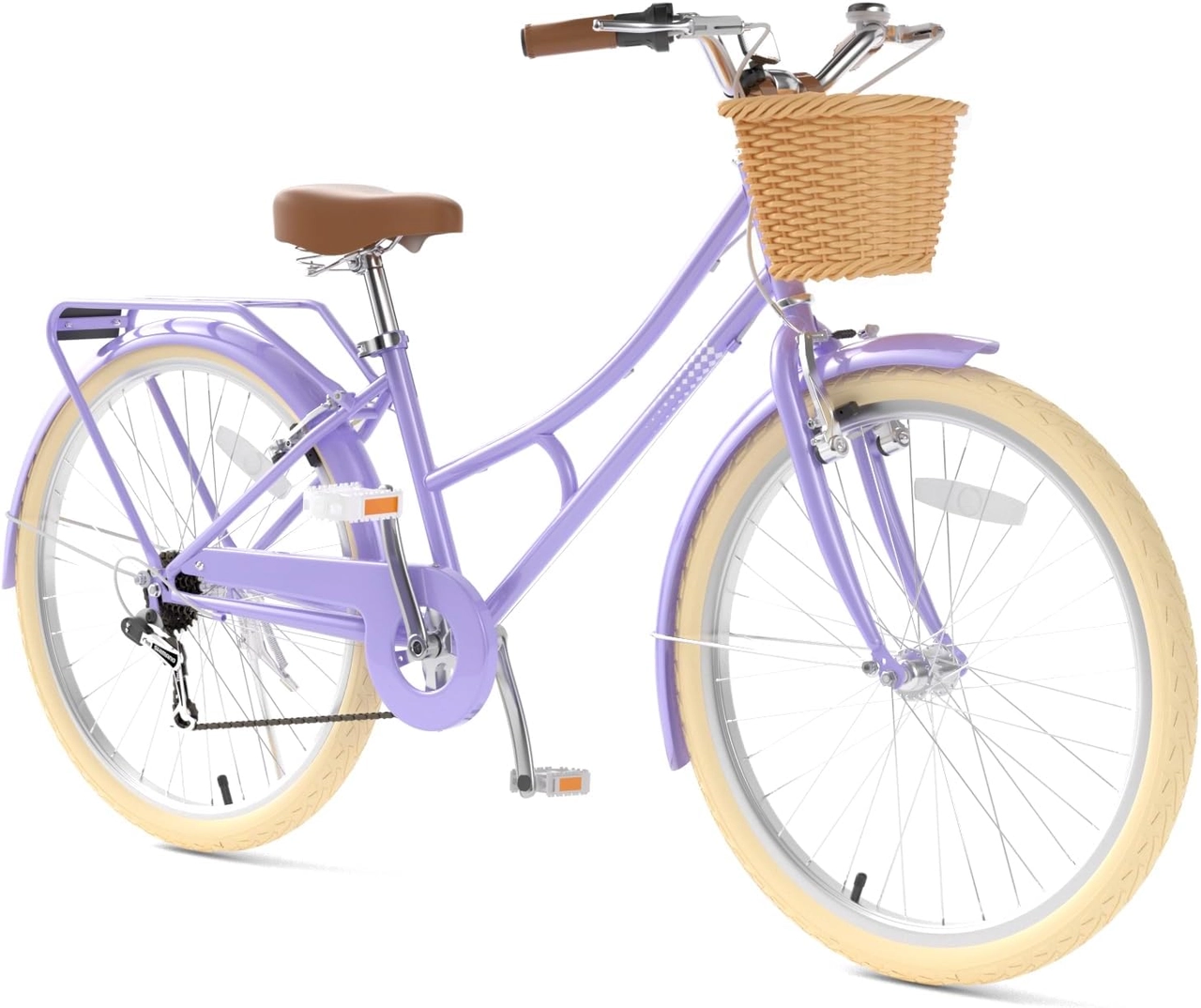 26-Inch XJD Beach Cruiser Bike for Girls – Purple, V-Brake
Selected configurations provide 20, 24 and 26 Inch comparison points. For a 9-year-old, measured height and hands-on control must determine relevance; the larger configurations should not be chosen merely for growth.
 Light Pink XJD Girls' Bicycle with Basket & Training Wheels
The 20 Inch configuration is relevant to the XBikes age-nine height comparison. The supplied 12, 14 and 16 Inch configurations are smaller options, while no 18 Inch configuration is listed.
The Light Pink XJD Girls' Bicycle with Basket & Training Wheels is offered in 12 Inch, 14 Inch, 16 Inch and 20 Inch. For this question, only its 20-inch option aligns with the usual age-nine comparison range. Its smaller configurations are not equivalent substitutes for an 18-inch bike.
The 26-Inch XJD Beach Cruiser Bike for Girls – Purple, V-Brake has available configurations labeled 20 Inch, 24 Inch and 26 Inch in selected colors. The 20-inch configurations are relevant to riders measuring 48–60 in (122–152 cm). The 24-inch and 26-inch versions are larger comparison points, not automatic choices for a 9-year-old.
Neither supplied product has an 18-inch configuration. If the measurements and trial indicate 18 Inch, these products are nearest-size comparison points rather than substitutes; continue looking for the exact indicated size.
Before deciding
- Confirm the child’s measured height falls within the selected starting range.
- Check stand-over, inseam compatibility, reach and brake control on the exact bicycle.
- Ask the child to demonstrate controlled steering, starting and stopping in an appropriate supervised area.
- Follow the exact product manual or use a qualified bicycle mechanic for assembly, adjustments, compatibility and maintenance details not supplied here.
A properly fitting bicycle helmet is also essential: it should fit the child, sit level and have its straps used according to the helmet manufacturer’s instructions.
The age-nine decision
Measure first, then compare 18 Inch with 20 Inch unless the child’s height clearly points elsewhere. Choose only the bicycle on which the child has suitable stand-over, comfortable reach, dependable brake operation and confident control. If those checks fail, change size rather than expecting the child to grow into it.
Bikes for your next adventure
-

Green XJD Toddler Bike Helmet with Adjustable Fit, XS (46–51 cm)
The XJD toddler bike helmet in Green is built for the youngest riders — the size…$20.39
$23.99 -

Kids Bike Helmet by XJD for Boys & Girls – Black, Blue, Green, Pink, Purple
The XJD Kids Bike Helmet covers a wide 2-to-8-year age range thanks to two head-…$59.99
-

Kids Bike Helmet by XJD for Girls – Pink
The XJD Kids Bike Helmet in Pink is a lightweight multi-sport helmet for girls r…$59.99
$99