

What size bike takes 12 1 2 inch tires
A bike with 12 1/2-inch tires is generally a 12-inch kids’ bike. For fit, compare the rider with the 12-inch starting range: 34–40 in (86–102 cm) tall, usually ages 3–4, then check the individual bike and child.
Why 12 1/2-inch tires are called 12-inch
The wording can be confusing because a tire’s printed size and a bicycle’s named wheel-size category are not always written identically. A tire marked “12 1/2” will commonly be found on a bicycle sold in the 12-inch category. It does not mean the child needs a 14-inch bike, nor does it describe the frame size.
If you are identifying an existing bicycle, read the complete size marking molded into the tire sidewall. Do not rely only on “12 1/2,” because the remaining numbers are important when choosing a replacement tire or tube. Copy the entire marking and compare it exactly with the bicycle or component manual. If the markings are missing, unclear or different, ask a qualified bicycle mechanic to identify a compatible replacement.
Measure the rider before choosing the bike
For a new bicycle, measure the child without shoes while they stand straight against a wall. Record total height. Also measure inseam from the floor to the crotch, using a book held level to approximate the position of a saddle.
XBikes uses these starting points for the nearby sizes:
| Bike size | Starting age | Rider height |
|---|---|---|
| 12 Inch | 3–4 | 34–40 in / 86–102 cm |
| 14 Inch | 3–6 | 37–45 in / 94–114 cm |
| 16 Inch | 4–7 | 40–48 in / 102–122 cm |
Height is more useful than age alone, and these ranges are only starting points. Children of the same age can have different leg length, reach and confidence. Do not move to a larger bicycle merely to leave room for growth.
Perform an individual fit check
Have the child try the exact bicycle with adult supervision. A suitable label on a box cannot confirm fit by itself. Check that the rider can:
- stand over the bicycle with appropriate clearance rather than being pressed against it;
- reach the handlebar without stretching or losing a comfortable posture;
- hold and steer the bicycle with control;
- reach and operate its brakes confidently, where applicable; and
- start, stop and place their feet as required for their present skill level.
If the rider is inside the height range but cannot manage these checks, that particular bicycle is not a good fit yet. Conversely, age alone should not rule a bicycle in or out. Compare the child’s measured height and inseam with the actual bicycle, then consider reach, brake control and current confidence.
How the supplied 12-inch options are relevant
The catalog options below each offer a “12 Inch” SKU, so they are relevant examples when shopping for the category commonly associated with a 12 1/2-inch tire marking. Their 14-inch and 16-inch SKUs are distinct sizes for comparison, not equivalents. A SKU label also does not prove that a replacement tire fits an existing bicycle; use the complete sidewall marking and exact product manual for that decision.
 XJD Boys & Girls BMX Bike with Training Wheels, 12/14/16" – Blue
A Kids’ BMX Bike offered with 12 Inch, 14 Inch and 16 Inch SKU labels. Its 12 Inch option is relevant for comparison, subject to the rider’s measurements and an individual fit check.
 Flower Pink XJD Girls Bike with Doll Seat & Basket
A Training Wheel Bike available with 12 Inch, 14 Inch and 16 Inch SKU labels. The 12 Inch option is relevant to the query, while the larger labels are separate sizes rather than equivalents.
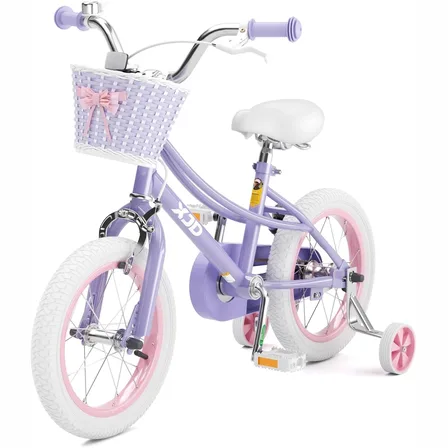
 Purple XJD Girls' Bike with Doll Seat & Basket
A Training Wheel Bike with 12 Inch, 14 Inch and 16 Inch SKU labels. Its 12 Inch option provides a relevant complete-bike comparison but does not establish replacement-tire compatibility.
XJD Boys & Girls BMX Bike with Training Wheels, 12/14/16" – Blue is categorized as a Kids’ BMX Bike and is offered with 12 Inch, 14 Inch and 16 Inch SKU labels. Select the 12 Inch SKU only when the rider’s measurements and hands-on fit check support that size.
Flower Pink XJD Girls Bike with Doll Seat & Basket is categorized as a Training Wheel Bike, with 12 Inch, 14 Inch and 16 Inch SKU labels. Its 12 Inch version is the title-relevant comparison; the other labels represent larger wheel-size choices.
Purple XJD Girls' Bike with Doll Seat & Basket is also categorized as a Training Wheel Bike and has 12 Inch, 14 Inch and 16 Inch SKU labels. As with the other options, the exact SKU must be confirmed before purchase and fit must be checked on the individual rider.
Decide whether you need a bike or a tire
If you are buying a complete bike, begin with the 12-inch category when the child is about 34–40 in (86–102 cm) tall, then confirm stand-over clearance, reach, control and brake access in person. Compare 14-inch or 16-inch models only if the child’s measured height and actual fit support moving up.
If you are replacing a worn tire or tube, “12 1/2 inch” alone is not enough information. Record every part of the sidewall marking and follow the exact bicycle or component manual. Do not assume that any tire described simply as 12-inch will fit. When compatibility, installation or torque instructions are unavailable, use a qualified bicycle mechanic.
Before riding, provide a bicycle helmet that fits properly, sits level and has its straps adjusted according to the helmet manufacturer’s instructions. The practical next step is simple: identify whether the task is complete-bike sizing or tire replacement, then either fit-check a 12-inch bike or match the tire’s full sidewall code exactly.
Bikes for your next adventure
-

XJD Girls BMX Bike 12/14/16 Inch with Training Wheels – Pink Blue
The XJD Girls BMX Bike in Pink/Blue is built as a first pedal bike for kids roug…$99.99
$119.99 -
Girls' Training Wheel Bike by XJD with Basket – Purple
If you're shopping for a first bike for a girl roughly 3 to 12 years old (91–152…$75.99
-

Flower Pink XJD Girls Bike with Doll Seat & Basket
The XJD Flower Pink girls' bike is made for riders 71–122 cm tall (roughly ages …$69.99