

What size bike to buy 6 year old
For most 6-year-olds, start by comparing 16-inch and 18-inch bikes. Choose by measured height and an in-person fit check—not age alone.
Which wheel size should you check first?
Measure your child’s height without shoes, then use the XBikes starting points below. A 6-year-old who is 40–48 inches (102–122 cm) tall should usually try a 16-inch bike first. At 43–52 inches (109–132 cm), an 18-inch bike also becomes a relevant option.
There is deliberate overlap because height cannot confirm fit by itself. If your child falls within both ranges, compare the two sizes in person and favor the bike they can stand over, steer, start, stop and brake confidently. Do not buy the larger size merely to allow room for growth.
| Wheel size | XBikes age starting point | Rider height starting point |
|---|---|---|
| 14 Inch | Ages 3–6 | 37–45 in / 94–114 cm |
| 16 Inch | Ages 4–7 | 40–48 in / 102–122 cm |
| 18 Inch | Ages 5–9 | 43–52 in / 109–132 cm |
| 20 Inch | Ages 7–12 | 48–60 in / 122–152 cm |
Measure height and inseam before shopping
Record standing height first because it lets you identify the sensible wheel-size range. Then measure inseam: with the child barefoot and standing straight, measure from the floor to the top of the inside leg. Use that measurement to assess stand-over clearance on the actual bicycle rather than trying to convert it into a wheel size.
Wheel labels describe wheel diameter, not the complete dimensions of a bike. Frames, saddle positions and handlebar reach can differ even when two bicycles carry the same wheel-size label. That is why the inseam must be compared with the bicycle itself.
Do this fit check on the actual bike
- Check stand-over: Have the child straddle the bicycle with both feet on the ground. They should not be forced onto tiptoes or pressed uncomfortably against the frame.
- Check the start and stop: Ask them to get into position, push off and stop while remaining balanced. Watch for hesitation caused by the bike feeling too tall or unwieldy.
- Check reach: Their hands should reach the handlebar without a strained stretch, locked elbows or loss of steering control.
- Check braking: They must be able to operate the bicycle’s braking controls comfortably and reliably. Do not assume a control is reachable just because the height range matches.
- Check confidence: Ask for turns and controlled stops in a clear, supervised area. A size that produces obvious fear or poor control is not the right choice today.
The American Academy of Pediatrics advises having a child try the bicycle, checking stand-over and control, and avoiding an oversized bike bought for future growth. Those checks should decide between overlapping wheel sizes.
When 14, 16, 18 or 20 inches makes sense
A 14-inch bike remains a comparison point for a smaller 6-year-old within the 37–45 inch (94–114 cm) range, but the child must still pass every control check. A 16-inch bike is the central starting point for many riders this age because its height range is 40–48 inches (102–122 cm).
Try an 18-inch bike when the child is at least 43 inches (109 cm) tall and the fit check confirms comfortable control. Consider 20 inches only when the rider is at least 48 inches (122 cm) tall; its XBikes starting age is seven, so a tall, capable 6-year-old still needs an especially careful individual assessment. A size range match never overrides poor reach, braking or confidence.
How the supplied catalog option helps
The Black XJD Kids Bike for Boys – 12, 14 & 16 Inch Sizes is a Training Wheel Bikes catalog option offered in 12 Inch, 14 Inch and 16 Inch labels. Its 14-inch and 16-inch choices let parents compare two sizes relevant to some 6-year-olds against the measurements and fit checks above. If measurement points to 18 inches, this product is only a nearest-size comparison point; its 16-inch version is not an equivalent or substitute for an 18-inch bike.

The product title and available size labels do not prove individual fit. Confirm the exact configuration, assembly, adjustment, maintenance, load limits and control setup in the product manual, or ask a qualified bicycle mechanic when those details are unclear.
Make the final decision
Measure height and inseam today, shortlist the matching 16-inch or 18-inch range—or 14 or 20 inches only when the stated height range supports it—and have your child try the bicycle. Buy only when stand-over, reach, steering, braking and current confidence all work together. Add a properly fitting bicycle helmet that sits level, with straps adjusted according to the helmet manufacturer’s instructions.
Bikes for your next adventure
-

Blue XJD Kids Bike Helmet for Boys & Girls
The Blue XJD Kids Bike Helmet is a lightweight, adjustable multi-sport helmet fo…$59.99
$99 -
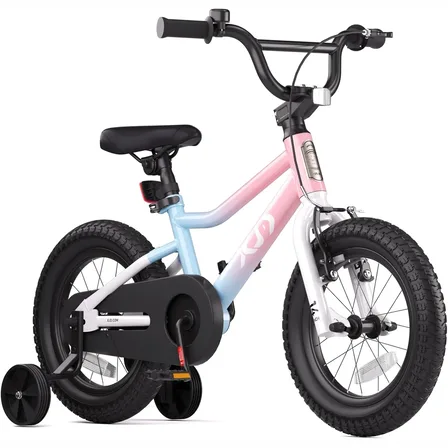
XJD Girls BMX Bike 12/14/16 Inch with Training Wheels – Pink Blue
The XJD Girls BMX Bike in Pink/Blue is built as a first pedal bike for kids roug…$99.99
$119.99 -

Kids Bike Helmet by XJD for Boys & Girls – Black, Blue, Green, Pink, Purple
The XJD Kids Bike Helmet covers a wide 2-to-8-year age range thanks to two head-…$59.99