

What size bike to buy for 10 year old
Most 10-year-olds should start by trying a 20-inch or 24-inch bike: use 20 inches for a measured height of 48–60 in (122–152 cm), and 24 inches for 54–64 in (137–163 cm). If the rider is over 60 in (153 cm), include 26-inch bikes in the fit comparison. Height ranges overlap, so the right choice is the bike the child can stand over, reach, steer and brake confidently—not the largest bike they can grow into.
Measure the rider before choosing
Record the child's current height without shoes. Then measure inseam: have the child stand straight with feet slightly apart, place a firm book level between the legs to represent the saddle area, and measure from the floor to the top edge of the book. Do not convert inseam into a wheel size using an unsupplied formula; use it during an actual stand-over and saddle-position check.
Also note the child's present riding confidence. A child who is still learning to start, stop or balance may need a more manageable fit than a confident rider of the same height.
Compare the relevant wheel sizes
| Wheel size | XBikes starting range | What it means at age 10 |
|---|---|---|
| 20 Inch | Ages 7–12; 48–60 in / 122–152 cm | A valid starting point when the measured height is within this range. |
| 24 Inch | Ages 10–14; 54–64 in / 137–163 cm | Also a valid starting point within its range, but only if control and reach are comfortable. |
| 26 Inch | Youth and adults over 60 in / 153 cm | Worth trying when the rider is above the stated height threshold. |
The overlap between 20- and 24-inch ranges is deliberate: age and height narrow the options, but they cannot settle the decision. Never move up solely because the child has turned 10 or because a larger bike may last longer.
Perform the fit check
Have the child try the exact bicycle while wearing the shoes normally used for riding. Check these points before buying:
- Stand-over: The child can straddle the bike with appropriate clearance and without being forced onto tiptoes.
- Starting and stopping: The rider can set off and come to a controlled stop without the bike feeling unwieldy.
- Reach: The handlebars are reachable without an exaggerated stretch or cramped posture.
- Braking: The child can reach and operate the brake controls confidently.
- Steering: The rider can turn, look around and maintain control at low speed.
If either size is awkward in these checks, reject it even when the age or height chart appears to match. Do not buy an oversized bicycle for future growth.
How the supplied XBikes options are relevant
The three supplied catalog options are training-wheel bikes offered in 12-, 14-, 16- and 20-inch labels. For this question, their useful comparison point is the available 20-inch version. They can be relevant to a 10-year-old whose measured height and individual fit support a 20-inch bike and whose current confidence makes a training-wheel model appropriate. They are not substitutes when the fit check indicates 24 or 26 inches.
 Light Pink XJD Girls' Bicycle with Basket & Training Wheels
Available in 12-, 14-, 16- and 20-inch labels. Its 20-inch option may be relevant when the rider measures 48–60 inches and passes an individual fit check; it includes training wheels and a basket.
 Girls' Training Wheel Bike by XJD, 12–20 Inch Wheels – Blue
This blue training-wheel bike is offered in 12-, 14-, 16- and 20-inch labels. Only the 20-inch option falls within a supplied age range that includes 10, subject to measured height and fit.
 XJD Girls' Bike with Training Wheels, 12/14/16/20 Inch – Purple
This purple training-wheel model has 12-, 14-, 16- and 20-inch choices. The 20-inch version is a comparison option for riders measuring 48–60 inches, but not a substitute for a required 24- or 26-inch fit.
Light Pink XJD Girls' Bicycle with Basket & Training Wheels, Girls' Training Wheel Bike by XJD, 12–20 Inch Wheels – Blue, and XJD Girls' Bike with Training Wheels, 12/14/16/20 Inch – Purple all share the same supplied wheel-size choices: 12, 14, 16 and 20 inches. The catalog facts distinguish their titles and colors, but provide no basis for claiming differences in brakes, materials, weight, load limits or ride quality.
Because the smaller labels fall below the supplied age starting points relevant to most 10-year-olds, do not choose one merely because training wheels are desired. First establish the correct wheel-size range, then decide whether this type of bicycle suits the child's present skills.
Complete the safety and setup checks
Choose a bicycle helmet that fits properly, sits level on the child's head and has straps adjusted according to its manufacturer's instructions. A helmet cannot correct a bicycle that is too large or difficult to control.
Before riding, follow the exact bicycle manual for assembly, adjustment, maintenance, compatibility and any load or torque requirements. Where instructions are unavailable or the setup is uncertain, use a qualified bicycle mechanic rather than guessing.
Make the decision
Measure height and inseam today, shortlist 20 inches at 48–60 in or 24 inches at 54–64 in, and add 26 inches only above 60 in. Then let the 10-year-old try the exact bike. Buy only the size on which stand-over, reach, braking and low-speed control all work now.
Bikes for your next adventure
-
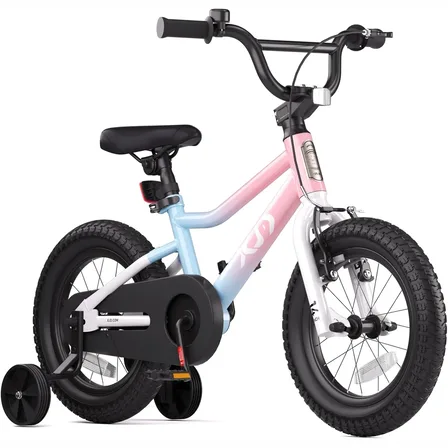
XJD Girls BMX Bike 12/14/16 Inch with Training Wheels – Pink Blue
The XJD Girls BMX Bike in Pink/Blue is built as a first pedal bike for kids roug…$99.99
$119.99 -

Blue XJD Kids Bike Helmet for Boys & Girls
The Blue XJD Kids Bike Helmet is a lightweight, adjustable multi-sport helmet fo…$59.99
$99 -

Kids Bike Helmet by XJD for Boys & Girls – Black, Blue, Green, Pink, Purple
The XJD Kids Bike Helmet covers a wide 2-to-8-year age range thanks to two head-…$59.99