

What size bike to buy toddler
For most toddlers, start by comparing a measured height with a 12 Inch or 14 Inch bike, then confirm stand-over space, reach, brakes and confidence in person. Do not choose by age alone or buy an oversized bike for future growth.
Measure before choosing a wheel size
Measure your child’s height without shoes, standing straight against a wall. Also measure the inseam from the floor to the crotch. Height places the rider in an initial wheel-size range; inseam helps you judge whether the child can stand over the actual bicycle comfortably.
Record both measurements rather than estimating from clothing size. Bicycle geometry can vary even when two models use the same wheel label, so an individual fit check remains necessary after consulting the size chart.
Compare height with the XBikes starting points
| Wheel size | Starting age range | Rider height |
|---|---|---|
| 12 Inch | Ages 3–4 | 34–40 in / 86–102 cm |
| 14 Inch | Ages 3–6 | 37–45 in / 94–114 cm |
| 16 Inch | Ages 4–7 | 40–48 in / 102–122 cm |
A 12 Inch bike is the first comparison for a child measuring 34–40 inches. A 14 Inch bike becomes another possibility from 37 inches, while 16 Inch begins at 40 inches. Where height ranges overlap, do not automatically select the larger wheel. Use the real bike’s stand-over clearance, reach and controls to decide.
If the child is shorter than 34 inches, the supplied XBikes standard does not place them in the 12 Inch range. Wait, seek an appropriately sized alternative, or have a qualified bicycle shop assess the fit; do not assume the smallest catalog option must fit.
Perform the fit check on the actual bike
Have the child try the bicycle. While standing over it, they should have practical clearance rather than being pressed against the frame. In the riding position, they need to reach the handlebar without an exaggerated stretch or awkward posture.
Ask the child to operate the brakes. They must be able to reach and control them reliably rather than merely touch them. Watch whether they can start, steer, stop and get off without panic or constant adult correction. Current confidence matters alongside physical dimensions.
- Too large: difficult stand-over, stretched reach, inaccessible controls or hesitant stopping.
- Worth comparing: manageable clearance, natural reach, usable brakes and controlled starts and stops.
- Still uncertain: compare adjacent sizes directly or ask a qualified bicycle mechanic to assess the child on the bike.
How the supplied bikes help with the decision
These catalog options provide 12 Inch, 14 Inch and 16 Inch training-wheel comparisons, covering the wheel sizes most relevant to the supplied toddler and early-childhood height ranges. Their wheel labels narrow the shortlist, but neither training wheels nor accessories prove that a frame fits a particular child.
 Girls' Training Wheel Bike by XJD with Basket – Purple
Available in 14 Inch, 16 Inch and 20 Inch labels. Its smaller two sizes can serve as fit comparisons for children whose measured heights enter those XBikes ranges.
 Flower Pink XJD Girls Bike with Doll Seat & Basket
Available in 12 Inch, 14 Inch and 16 Inch labels, providing three adjacent training-wheel size options to compare against measured height and an individual fit check.
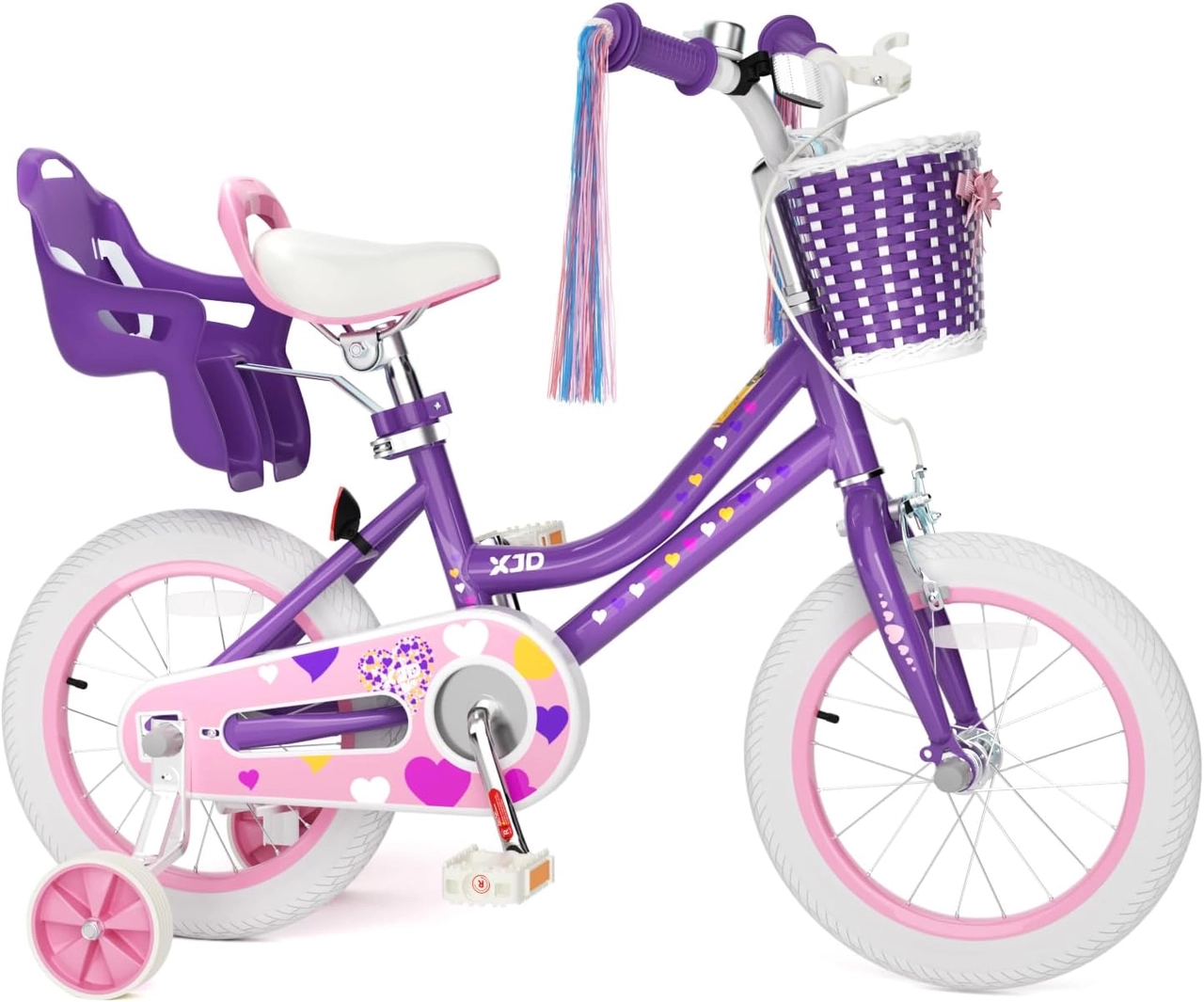 Purple XJD Girls' Bike with Doll Seat & Basket
Its 12 Inch, 14 Inch and 16 Inch labels make it relevant for comparing the supplied early-childhood size ranges; the doll seat and basket do not determine fit.
The Flower Pink XJD Girls Bike with Doll Seat & Basket and Purple XJD Girls' Bike with Doll Seat & Basket each have 12 Inch, 14 Inch and 16 Inch SKU labels. They allow comparison across all three sizes shown above. Their doll seats and baskets are catalog features, not sizing evidence.
The Girls' Training Wheel Bike by XJD with Basket – Purple is offered in 14 Inch, 16 Inch and 20 Inch labels. Its 14 Inch version may be relevant when the measured child falls within 37–45 inches, while its 16 Inch version starts as a comparison at 40 inches. Its 20 Inch option corresponds to ages 7–12 and heights 48–60 inches, so it is generally outside a toddler-size search unless the rider’s actual measurements place them there.
Do not size up for growth
An oversized bicycle can make stand-over, steering and braking harder now. Follow the measured child rather than choosing extra wheel size to extend future use. Age is only a starting point: two children of the same age can differ in height, proportions, reach and confidence.
For saddle or handlebar adjustment, assembly, maintenance, compatibility, load limits and torque, follow the exact product manual or use a qualified bicycle mechanic. Do not improvise an adjustment to make an unsuitable size appear workable.
Complete the decision
Begin with 12 Inch at 34–40 inches or compare 14 Inch at 37–45 inches. Move to 16 Inch only when the child measures at least 40 inches and passes the same hands-on checks. Before riding, add a properly fitting bicycle helmet that sits level, with straps used according to the helmet manufacturer’s instructions. Buy only after the child can stand over, reach, brake and control the exact bike confidently.
Bikes for your next adventure
-

Blue XJD Kids Bike Helmet for Boys & Girls
The Blue XJD Kids Bike Helmet is a lightweight, adjustable multi-sport helmet fo…$59.99
$99 -

XJD Girls BMX Bike 12/14/16 Inch with Training Wheels – Pink Blue
The XJD Girls BMX Bike in Pink/Blue is built as a first pedal bike for kids roug…$99.99
$119.99 -

Kids Bike Helmet by XJD for Boys & Girls – Black, Blue, Green, Pink, Purple
The XJD Kids Bike Helmet covers a wide 2-to-8-year age range thanks to two head-…$59.99