

What size bike to get my 6 year old
For most 6-year-olds, start by comparing a 14, 16 and 18 Inch bike. Measure your child’s height and inseam, then confirm fit on the actual bike.
Choose the starting size from measured height
Age narrows the search, but it does not determine the correct size. For a 6-year-old, the XBikes starting ranges overlap: 14 Inch covers 37–45 in (94–114 cm), 16 Inch covers 40–48 in (102–122 cm), and 18 Inch covers 43–52 in (109–132 cm). This makes 16 Inch a sensible first comparison for many children, while shorter riders may need 14 Inch and taller riders may need 18 Inch.
| Wheel size | XBikes age starting point | Rider-height starting point |
|---|---|---|
| 14 Inch | Ages 3–6 | 37–45 in / 94–114 cm |
| 16 Inch | Ages 4–7 | 40–48 in / 102–122 cm |
| 18 Inch | Ages 5–9 | 43–52 in / 109–132 cm |
| 20 Inch | Ages 7–12 | 48–60 in / 122–152 cm |
These are starting points, not a substitute for trying the bicycle. A child near an overlap should compare both neighboring sizes. Do not automatically move up to a 20 Inch bike because it will last longer; oversized bikes can make starting, stopping and steering harder.
Measure height and inseam correctly
- Height: Have your child stand barefoot against a wall, looking straight ahead. Measure from the floor to the top of the head.
- Inseam: With feet slightly apart, place a firm book upright between the legs to represent the saddle. Measure from the floor to the top edge of the book.
Use standing height to select the sizes worth trying. Use inseam during the hands-on check: the child needs practical clearance and must be able to get on, get off and stabilize the bike without struggling. Frame shapes differ, so wheel diameter alone cannot confirm stand-over fit.
Check the actual bike before deciding
Have your child try the bicycle while wearing the shoes normally used for riding. The American Academy of Pediatrics recommends trying the bike rather than buying an oversized model for growth. During the check, look for all of the following:
- The child can straddle the frame with usable clearance rather than pressing against it.
- They can start, stop and put a foot down without panic or a large sideways lean.
- Their arms remain comfortably bent while holding the handlebar; they are not stretching or crowding themselves.
- They can steer through a gentle turn while staying balanced and looking ahead.
- They can reach and operate the bicycle’s brakes with control. Brake reach and operation must be checked on the exact model.
If one of these checks fails, do not treat an age chart or a labeled wheel size as permission to proceed. Compare the neighboring size or another frame design.
When the supplied XBikes options are relevant
The supplied catalog choices help when your measurements point to 14 or 16 Inch and you want to compare training-wheel bikes. They are also useful for seeing the difference between those two wheel sizes. None is offered in 18 Inch or 20 Inch in the supplied facts, so they are not substitutes when the fit check indicates either of those sizes.
 XJD Pink Girls' Bike – Kids 12/14/16 Inch Training Wheel Bicycle
A training-wheel bicycle offered in 12, 14 and 16 Inch labels. Its 14 and 16 Inch variants are relevant comparison points when the rider’s measurements fall within those XBikes starting ranges.
 XJD Girls Bike for Kids Ages 3-8, 12/14/16 Inch with Training Wheels – Purple
Offered as a purple training-wheel bike in 12, 14 and 16 Inch choices. The age wording in its title is only a catalog label; measured height and an individual fit check should determine relevance.
 Girls 12/14/16 Inch Kids Bike by XJD with Training Wheels – Peach
A peach training-wheel bike with supplied 12, 14 and 16 Inch options. Compare its 14 or 16 Inch variant only when the child’s height, stand-over clearance, reach, brake control and confidence support that size.
XJD Pink Girls' Bike – Kids 12/14/16 Inch Training Wheel Bicycle is listed as a training-wheel bike with 12, 14 and 16 Inch options. For this question, its 14 and 16 Inch variants are the relevant comparisons.
XJD Girls Bike for Kids Ages 3-8, 12/14/16 Inch with Training Wheels – Purple also provides 12, 14 and 16 Inch choices and is categorized as a training-wheel bike. “Ages 3-8” is part of its catalog title, not proof that it fits a particular 6-year-old; use the measured-height ranges and an individual fit check.
Girls 12/14/16 Inch Kids Bike by XJD with Training Wheels – Peach has the same supplied wheel-size choices in the training-wheel category. Its 14 and 16 Inch variants can be compared when those sizes match the child’s measurements.
If assembly, adjustment, load limits, compatibility, maintenance or torque information is needed, follow the exact product manual or ask a qualified bicycle mechanic. Those details are not established by the supplied catalog facts.
Match the size to current confidence
Two children of the same height may not handle the same bike equally well. A confident rider may control a correctly fitted larger option within an overlapping range, while a cautious learner may be more comfortable on the smaller correctly fitted option. Training wheels do not repair poor reach, inadequate clearance or inaccessible brakes.
Finish the decision with a properly fitted bicycle helmet. It should sit level and use its straps according to the helmet manufacturer’s instructions. For your 6-year-old, measure first, try the likely 14, 16 or 18 Inch candidates, and buy only the size they can straddle, reach, steer, brake and stop confidently today.
Bikes for your next adventure
-
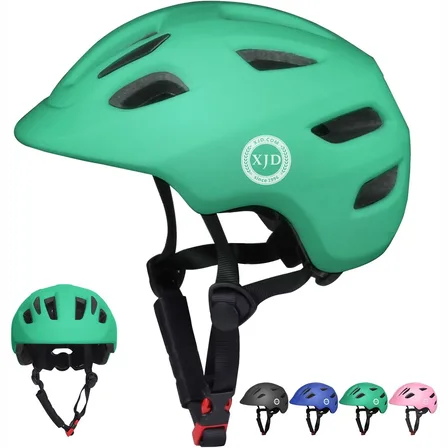
Green XJD Toddler Bike Helmet with Adjustable Fit, XS (46–51 cm)
The XJD toddler bike helmet in Green is built for the youngest riders — the size…$20.39
$23.99 -

Kids Bike Helmet by XJD for Boys & Girls – Black, Blue, Green, Pink, Purple
The XJD Kids Bike Helmet covers a wide 2-to-8-year age range thanks to two head-…$59.99
-

Kids Bike Helmet by XJD for Girls – Pink
The XJD Kids Bike Helmet in Pink is a lightweight multi-sport helmet for girls r…$59.99
$99