

What size bike to get my 9 year old
Most 9-year-olds should start with a 20-inch bike, but measure your child first: 18, 20 or 24 inches may fit depending on height and control.
Start with measured height, not age
Have your child stand barefoot against a wall and measure from the floor to the top of the head. Compare that result with the XBikes starting points below. Age narrows the search, but height, inseam, reach, brake control and confidence decide whether a bike actually fits.
| Wheel size | XBikes age starting point | Rider-height starting point |
|---|---|---|
| 18 Inch | Ages 5–9 | 43–52 in / 109–132 cm |
| 20 Inch | Ages 7–12 | 48–60 in / 122–152 cm |
| 24 Inch | Ages 10–14 | 54–64 in / 137–163 cm |
For a 9-year-old measuring 48–54 inches (122–137 cm), begin the in-person check with a 20-inch bike. A shorter child may need an 18-inch bike. A child at least 54 inches (137 cm) tall may be ready to compare a 24-inch bike, even though the age starting point is 10. The overlapping ranges are deliberate starting points, not proof that every listed size fits equally well.
Measure inseam for stand-over clearance
Measure inseam while your child wears the shoes normally used for riding. Have them stand straight with feet slightly apart, place a firm book upright between the legs, and measure from the floor to the top edge of the book.
Then have the child straddle the actual bicycle with both feet flat on the ground. There should be comfortable clearance between the child and the top tube. Do not rely on wheel diameter alone: frame shapes and proportions can differ, and the supplied catalog facts do not provide frame measurements.
Check reach, brakes and confidence
Seat the child on the bicycle and watch their upper body. They should reach the handlebar without stretching, locking their elbows or leaning awkwardly. Ask them to turn the bar both ways while remaining balanced.
They must also be able to reach and operate the bicycle's brakes confidently. Because brake types and adjustment details are not supplied here, follow the exact product manual or ask a qualified bicycle mechanic to set up and inspect the bicycle.
Finally, let the child try the bike in a controlled area. Look for a comfortable start, straight steering, deliberate stopping and an easy dismount. If the larger candidate makes any of these actions hesitant, choose the smaller properly fitting option. Do not buy an oversized bike merely to leave room for growth.
How the supplied 20-inch options help
The catalog includes two training-wheel bike listings that can help you compare sizes near the usual 9-year-old starting point. The XJD Kids Bike for Girls – Pink, 12/14/16/20 Inch with Training Wheels has supplied SKU labels for 12, 14, 16 and 20 Inch, so its 20-inch version is relevant when your child's measurements and test ride support that size.
The XJD Light Purple Girls Bike with Basket, Training Wheels, 12/14/16/20 Inch has supplied SKU labels for 12, 14 and 16 Inch only. Despite the exact catalog title containing “20 Inch,” the supplied SKU list does not confirm a 20-inch option. Its listed sizes are generally below the likely starting point for a typical 9-year-old, though a 16-inch version can serve as a smaller comparison during fitting.
These particular catalog options clarify the difference between a confirmed 20-inch SKU and smaller training-wheel choices; neither replaces an individual fit check.
 XJD Kids Bike for Girls – Pink, 12/14/16/20 Inch with Training Wheels
Its supplied SKU labels include 20 Inch, the usual starting comparison for many 9-year-olds, plus 12, 14 and 16 Inch options. Confirm the individual child's height, inseam, reach, brake control and confidence.
 XJD Light Purple Girls Bike with Basket, Training Wheels, 12/14/16/20 Inch
Its supplied SKU labels confirm 12, 14 and 16 Inch only, although its exact catalog title also says 20 Inch. The verified sizes are mainly smaller comparison points for this question and still require a fit check.
When these products are not the right match
If measurements and an in-person check point to an 18-inch or 24-inch bike, neither supplied product has a verified SKU label in that exact size. Treat their listed sizes only as nearest-size comparison points, not substitutes: 16 inches is not equivalent to 18 inches, and 20 inches is not equivalent to 24 inches.
Training wheels are relevant only if they suit the child's current confidence and learning needs. Their presence does not make an incorrectly sized frame fit. For assembly, maintenance, compatibility, load limits and torque settings, use the exact product manual or a qualified bicycle mechanic.
Make the final decision
- Measure standing height and inseam.
- Use 20 inches as the first comparison for most 9-year-olds, moving to 18 or 24 inches only when measured height indicates it.
- Have your child straddle and ride the exact bicycle.
- Confirm comfortable clearance, reach, steering, braking, starting and stopping.
- Choose the size they control now rather than one intended for future growth.
Before riding, add a properly fitting bicycle helmet. It should sit level and its straps should be used according to the helmet manufacturer's instructions. For your 9-year-old, the answer is therefore the smallest suitable candidate they can control confidently—usually a 20-inch bike, but only after the measurements and hands-on checks agree.
Bikes for your next adventure
-
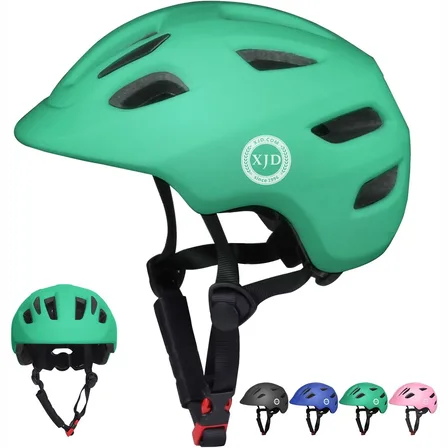
Green XJD Toddler Bike Helmet with Adjustable Fit, XS (46–51 cm)
The XJD toddler bike helmet in Green is built for the youngest riders — the size…$20.39
$23.99 -

Kids Bike Helmet by XJD for Boys & Girls – Black, Blue, Green, Pink, Purple
The XJD Kids Bike Helmet covers a wide 2-to-8-year age range thanks to two head-…$59.99
-

Kids Bike Helmet by XJD for Girls – Pink
The XJD Kids Bike Helmet in Pink is a lightweight multi-sport helmet for girls r…$59.99
$99