

What size bike wheel for 6 year old
For most 6-year-olds, start by comparing 14-, 16-, and 18-inch bike wheels. Measure the child’s height first: 16 inches is the usual starting point at 40–48 in (102–122 cm), but the correct choice depends on individual fit and control.
Choose the starting size from measured height
Age points you toward a comparison range; it does not determine the final size. Use the child’s current height, without shoes, against these XBikes starting points:
| Wheel size | Starting age range | Rider height | Relevance at age 6 |
|---|---|---|---|
| 14 Inch | 3–6 | 37–45 in / 94–114 cm | Compare for a shorter six-year-old |
| 16 Inch | 4–7 | 40–48 in / 102–122 cm | Usual first comparison |
| 18 Inch | 5–9 | 43–52 in / 109–132 cm | Compare for a taller six-year-old |
| 20 Inch | 7–12 | 48–60 in / 122–152 cm | Consider only if height and fit support it |
The ranges overlap deliberately. A child measuring 44 inches, for example, falls within the height guidance for 14-, 16-, and 18-inch wheels. That means a real fit check—not a larger number—is what settles the decision.
Measure height and inseam before comparing bikes
- Measure standing height: Have the child stand straight against a wall without shoes. Mark the top of the head and measure from the floor.
- Measure inseam: With feet slightly apart, place a firm, thin book upward between the legs to simulate a saddle. Measure from the floor to the book’s top edge.
- Record both measurements: Use height to identify likely wheel sizes, then bring the inseam measurement when checking stand-over clearance and saddle adjustment on the exact bicycle.
Wheel diameter alone cannot reveal frame height, reach, or how low a particular saddle can be adjusted. Consult the exact product manual for adjustment limits and assembly instructions, or ask a qualified bicycle mechanic when those details are unavailable.
Make the child-fit check
Have the child try the bicycle rather than buying from an age label alone. While standing over the frame, the child should have appropriate clearance and should not be pressed against the bicycle. Seated, the rider must be able to start, stop, steer, and place a foot down with confidence.
Next, watch the upper body. The child should reach the handlebar without stretching, locking the elbows, or leaning so far forward that steering becomes awkward. If the bicycle has hand brakes, confirm that the child can comfortably reach and operate the controls. Brake reach and control matter more than choosing a bike with room to grow.
- Reject a size if mounting or dismounting looks difficult.
- Reject it if the child cannot steer smoothly at low speed.
- Reject it if stopping requires an uncomfortable reach or excessive effort.
- Do not buy an oversized bicycle solely to extend future use.
How the supplied XBikes options help
The catalog options provide useful 14- and 16-inch comparisons, the two central starting sizes for many six-year-olds. They also show adjacent 12- and 20-inch choices, helping you compare the measured child against the published height ranges before completing an individual fit check.
 Pink 12/14/16/20" XJD Girls Bike with Training Wheels & Basket
Available in 12, 14, 16, and 20 Inch SKU labels. Its 14- and 16-inch versions are useful comparison points for many six-year-olds, subject to measured height and an individual fit check.
 Black XJD Kids Bike for Boys – 12, 14 & 16 Inch Sizes
Available in 12, 14, and 16 Inch SKU labels. The 14- and 16-inch choices cover relevant starting comparisons for a six-year-old, but the child’s measurements, reach, control, and confidence determine fit.
Pink 12/14/16/20" XJD Girls Bike with Training Wheels & Basket is listed in 12 Inch, 14 Inch, 16 Inch, and 20 Inch SKU labels. For this question, its 14- and 16-inch versions are the most immediate comparison points; its 20-inch version is relevant only when the child reaches the 48–60 in (122–152 cm) starting range and passes the full fit check.
Black XJD Kids Bike for Boys – 12, 14 & 16 Inch Sizes is available with 12 Inch, 14 Inch, and 16 Inch SKU labels. Its 14- and 16-inch choices let a parent compare two overlapping ranges for a six-year-old. Wording within the product title is a catalog label, not proof of fit.
Neither supplied product has an 18 Inch SKU label. If measurement and an in-person check indicate an 18-inch bicycle, these products are nearest-size comparison points, not substitutes; a 16- or 20-inch wheel is not equivalent to an 18-inch wheel.
Match wheel size to current confidence
Two children of equal height may need different handling characteristics because confidence and control differ. A hesitant or new rider should demonstrate stable starts, predictable steering, and controlled stops on the exact bike. Training wheels do not correct a frame that is too large, excessive reach, or inaccessible brake controls.
If the child is between overlapping size ranges, compare the candidate bicycles directly. Favor the one the child can control now while still meeting stand-over, reach, and braking checks. Do not move up merely because the larger wheel also appears in an age range.
Complete the decision safely
Before riding, provide a bicycle helmet that fits properly, sits level, and has straps adjusted according to its manufacturer’s instructions. Follow the exact bicycle manual for assembly, maintenance, compatibility, load limits, and any required torque settings; use a qualified bicycle mechanic if correct setup cannot be confirmed.
For a 6-year-old, measure height and inseam today, begin with a 16-inch comparison, and also try 14 or 18 inches when the measured height falls in those ranges. Choose only the exact bicycle on which the child can stand over, reach, steer, brake, start, and stop comfortably.
Bikes for your next adventure
-

XJD Girls Bike for Kids Ages 3-8, 12/14/16 Inch with Training Wheels – Purple
The XJD Girls Bike in Purple is a training-wheel bicycle for kids ages 3 to 8, f…$149
$169 -

Pink Girls' 12/14/16" Bike by XJD – Basket & Doll Seat
The XJD Pink Girls' Bike with Basket & Doll Seat is made for riders 71–122 cm ta…$75.99
$99.99 -
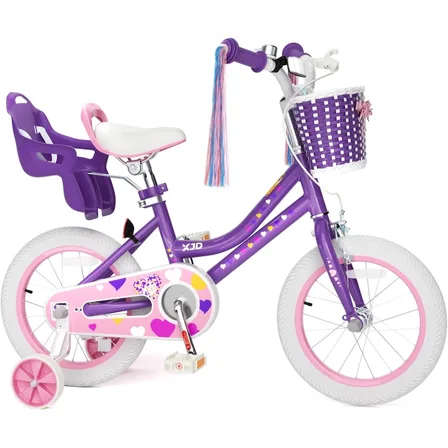
Purple XJD Girls' Bike with Doll Seat & Basket
For girls 71–122 cm tall (about ages 3–7), this XJD girls' bike in Purple pairs …$75.99
$99.99