

What size bike would a 5 year old ride
Most 5-year-olds should start by trying a 14-inch, 16-inch or 18-inch bike, depending on measured height—not age alone. Measure your child, then check stand-over space, reach, brake control and confidence on the actual bike.
Choose the starting size from height
Have the child stand straight without shoes against a wall and measure from the floor to the top of the head. Compare that height with the XBikes starting points below. A five-year-old can fall within three overlapping ranges, so age cannot identify one correct wheel size.
| Wheel size | XBikes age starting point | Rider-height starting point |
|---|---|---|
| 14 Inch | Ages 3–6 | 37–45 in / 94–114 cm |
| 16 Inch | Ages 4–7 | 40–48 in / 102–122 cm |
| 18 Inch | Ages 5–9 | 43–52 in / 109–132 cm |
For example, a child measuring 39 inches fits the 14-inch starting range, while a child measuring 46 inches fits both the 16-inch and 18-inch ranges. Overlap means both are candidates to try; it does not mean they will fit equally well.
Measure inseam as well as height
Measure inseam with the child standing in socks, feet slightly apart and back against a wall. Place a book firmly between the legs as if it were a bicycle saddle, keep it level, and measure from the floor to the top edge of the book.
Compare that measurement with the bicycle’s stand-over height and saddle adjustment information. Those dimensions are not supplied here, so check the exact product manual or ask a qualified bicycle mechanic. When the child straddles the bicycle, there should be comfortable clearance rather than contact with the frame.
Confirm the fit on the actual bicycle
A height chart narrows the search; a hands-on fit check makes the decision. The American Academy of Pediatrics advises having the child try the bicycle and avoiding an oversized bike bought only for future growth.
- Stand-over: Ask the child to straddle the frame with both feet planted and confirm comfortable clearance.
- Reach: Check that the child can hold the handlebar without stretching, locking the elbows or losing a balanced riding position.
- Brake control: Confirm that the child can reach and operate the bicycle’s braking controls reliably. Follow the product manual for the specific braking system.
- Confidence: Let the child start, steer, stop and get off in a controlled setting. Hesitation or loss of control can outweigh a chart match.
If two sizes match the measured height, compare both in person. Choose the one the child can control now, rather than assuming the larger option is better value because it may last longer.
How the supplied XBikes option helps
The Pink 12/14/16/20" XJD Girls Bike with Training Wheels & Basket is listed in Training Wheel Bikes and has 12 Inch, 14 Inch, 16 Inch and 20 Inch SKU labels. Its 14-inch and 16-inch options provide relevant comparison points for many five-year-olds; the available sizes also make it easier to see why the SKU label must be matched to the child’s measurements.

The 12-inch option is a starting point for ages 3–4 and heights 34–40 in / 86–102 cm, so it may overlap only for a shorter five-year-old and still requires a fit check. The 20-inch option starts at ages 7–12 and heights 48–60 in / 122–152 cm; do not choose it merely to allow room for growth.
This product does not have an 18-inch SKU label. If the child’s measurement and hands-on comparison point toward an 18-inch bicycle, the listed 14-inch and 16-inch versions are comparison points, not equivalent substitutes for an 18-inch model.
Do not overlook helmet fit
Use a bicycle helmet every ride. The U.S. Consumer Product Safety Commission advises that it must fit properly, sit level on the head and have its straps adjusted according to the helmet manufacturer’s instructions. A larger helmet is not a substitute for correct adjustment, just as an oversized bicycle is not a suitable growth strategy.
What to do next
Measure height and inseam first, then shortlist 14, 16 or 18 inches from the XBikes ranges. Have the five-year-old try each plausible size and compare stand-over clearance, handlebar reach, brake operation and present confidence. Select the wheel size the child can comfortably control today; if no candidate passes every check, keep looking rather than sizing up for growth.
Bikes for your next adventure
-
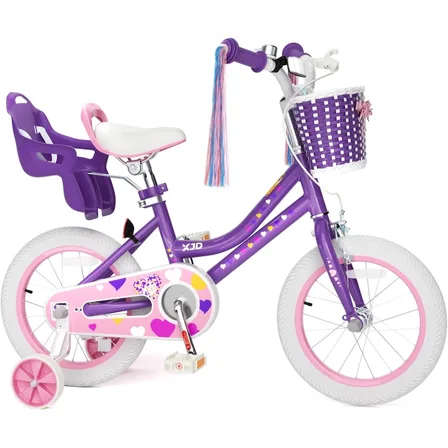
Purple XJD Girls' Bike with Doll Seat & Basket
For girls 71–122 cm tall (about ages 3–7), this XJD girls' bike in Purple pairs …$75.99
$99.99 -
XJD 24-Inch Green Beach Cruiser Bike with U-Brake
This XJD 24-inch beach cruiser in green is made for riders about 4'8" to 5'4" ta…$159.99
$199.99 -

Kids Bike Helmet by XJD for Boys & Girls – Black, Blue, Green, Pink, Purple
The XJD Kids Bike Helmet covers a wide 2-to-8-year age range thanks to two head-…$59.99