

What size bike would a 6 year old need
Most 6-year-olds should start by trying a 16-inch or 18-inch bike, based on measured height—not age alone. Use 16 inches for 40–48 in (102–122 cm) and 18 inches for 43–52 in (109–132 cm), then confirm the child can stand over, reach, steer and brake comfortably.
Measure before choosing a wheel size
Measure the child without shoes, standing straight against a wall. Record total height from the floor to the top of the head. Then measure inseam from the floor to the crotch; this helps you judge stand-over clearance when the child tries the actual bicycle.
Compare measured height with these XBikes starting points:
| Wheel size | Starting age | Rider height |
|---|---|---|
| 14 Inch | 3–6 | 37–45 in / 94–114 cm |
| 16 Inch | 4–7 | 40–48 in / 102–122 cm |
| 18 Inch | 5–9 | 43–52 in / 109–132 cm |
| 20 Inch | 7–12 | 48–60 in / 122–152 cm |
A 6-year-old near a boundary may overlap two ranges. That means both sizes are candidates to try, not that they fit equally well. Height narrows the choice; the on-bike checks decide it.
Choose between 14, 16 and 18 inches
A 14-inch bike can remain relevant for a shorter 6-year-old measuring 37–45 in (94–114 cm), especially if the child needs an easy-to-control starting point. Do not dismiss it merely because the rider is at the upper end of its age starting range.
A 16-inch bike is the first comparison for many children this age because its starting range covers ages 4–7 and heights of 40–48 in (102–122 cm). An 18-inch bike becomes another candidate at 43–52 in (109–132 cm). Try both when height falls between 43 and 48 inches.
A 20-inch bike generally starts at ages 7–12 and 48–60 in (122–152 cm). A tall 6-year-old may reach that height range, but age does not justify sizing up. Select it only if the individual fit and control checks succeed.
Confirm the fit on the actual bike
Have the child try the bicycle rather than relying on the wheel label. The American Academy of Pediatrics advises against buying an oversized bike for future growth. While the exact clearance depends on the bicycle, the child should be able to straddle it without the frame pressing into the crotch.
- Stand-over: The child can get on and off without catching or leaning precariously.
- Reach: Hands reach the controls while the rider remains balanced, without an uncomfortable stretch.
- Brake control: The child can operate the bicycle’s braking controls reliably. Follow the exact product manual for their use and adjustment.
- Handling: The child can start, steer, turn and stop without the bike feeling unwieldy.
- Confidence: The size supports current ability rather than demanding skills the child does not yet have.
If either candidate fails one of these checks, it is not the right fit even when the height chart includes the child.
How the supplied XBikes options are relevant
The supplied catalog options help compare 12-, 14- and 16-inch choices, including a likely 16-inch candidate for many 6-year-olds and a 14-inch option for shorter riders. Neither supplied product lists an available 18-inch SKU, so these are not substitutes when an individual fit check points to 18 inches.
 Girls 12/14/16 Inch Kids Bike by XJD with Training Wheels – Peach
A training-wheel bike with supplied 12-, 14- and 16-inch SKU labels. Its 14- and 16-inch variants can be compared with a 6-year-old’s measured height and individual fit.
 XJD Light Purple Girls Bike with Basket, Training Wheels, 12/14/16/20 Inch
This training-wheel bike has supplied available SKU labels of 12, 14 and 16 inches. Despite the sizes embedded in its exact title, availability of a 20-inch SKU is not supplied.
Girls 12/14/16 Inch Kids Bike by XJD with Training Wheels – Peach is categorized as a training-wheel bike and has supplied available SKU labels of 12 Inch, 14 Inch and 16 Inch. For this question, compare its 14- and 16-inch variants with the child’s measured height and actual control.
XJD Light Purple Girls Bike with Basket, Training Wheels, 12/14/16/20 Inch is also categorized as a training-wheel bike. Although its exact catalog title contains several sizes, the supplied available SKU labels are only 12 Inch, 14 Inch and 16 Inch; do not assume a 20-inch option is available from the title alone.
Training wheels may be relevant to current confidence, but their presence does not correct a poor frame fit. For assembly, adjustment, compatibility, maintenance, load limits or torque, follow the exact product manual or ask a qualified bicycle mechanic.
What to do next
- Measure the child’s height and inseam.
- Use the table to shortlist the applicable wheel sizes.
- Have the child try each candidate and check stand-over, reach, braking, handling and confidence.
- Reject any bike that is deliberately oversized for growth.
- Fit a bicycle helmet that sits level and uses its straps according to the helmet manufacturer’s instructions.
For a 6-year-old, begin with 16 and 18 inches unless measured height points to 14 or 20 inches; then choose the bike the child can control comfortably today.
Bikes for your next adventure
-
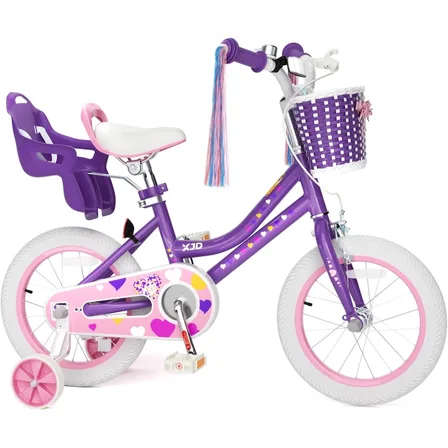
Purple XJD Girls' Bike with Doll Seat & Basket
For girls 71–122 cm tall (about ages 3–7), this XJD girls' bike in Purple pairs …$75.99
$99.99 -

XJD 24-Inch Green Beach Cruiser Bike with U-Brake
This XJD 24-inch beach cruiser in green is made for riders about 4'8" to 5'4" ta…$159.99
$199.99 -

Kids Bike Helmet by XJD for Boys & Girls – Black, Blue, Green, Pink, Purple
The XJD Kids Bike Helmet covers a wide 2-to-8-year age range thanks to two head-…$59.99